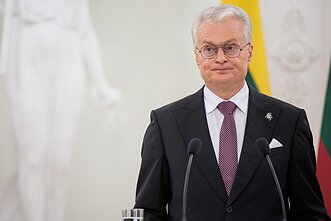






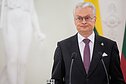





Lithuanian President Gitanas Nausėda and Prime Minister Ingrida Šimonytė believe that Lithuania should help Ukraine get back its military-age men living abroad.
The Ukrainian parliament has recently amended the mobilisation law, lowering the age of conscription to 25 and increasing penalties for military service evaders.
Ukraine has also decided to stop issuing new passports to conscription-age men living abroad and to suspend consular services for men aged 18–60.
“Ukraine needs to have its mobilisation plans,” Nausėda said during a debate on the LRT RADIO on Monday. “Ukraine must have the means and instruments to invite its young men to serve their homeland. We must cooperate with Ukraine in every sense.”
For her part, the prime minister believes Lithuania could take steps to help Ukraine, adding, however, that some measures need to be discussed at the EU level.
“We could probably look for some ways to make sure that a person has performed their mobilisation duty or is exempted from it when we consider whether to extend their temporary residence permit. But we need to work not only with the Ukrainian authorities but also more broadly because right now, the EU has the so-called temporary protection in place for Ukrainian people,” she said.

According to the Migration Department, there is currently no legal basis obliging Lithuania to assist Ukraine in the mobilisation process.
“This is a political issue. The fact that Ukraine or another country has declared mobilisation has no influence on us, according to our legislation. Any reaction, if any, would be a political decision of Lithuania,” Evelina Gudzinskaitė, head of the Migration Department, told the Elta news agency.
“Some national legislative initiatives would have to be taken to implement these decisions, but again, there would be a huge question of how this would be compatible with EU law,” she added.
Last week, Polish Defence Minister Wladyslaw Kosiniak-Kamysh said Warsaw was ready to help Kyiv bring back military-age men.
In response, Lithuanian Defence Minister Laurynas Kasčiūnas said Lithuania could follow in Poland’s footsteps when it comes to the conscription of military-age Ukrainian men living abroad.
Nevertheless, Polish Foreign Minister Radosław Sikorski said later Warsaw’s assistance in handing over military-age men to Ukraine was an ethically questionable step, adding that Kyiv must take the lead on this issue.
According to the Migration Department, a little over 29,000 military-age Ukrainian men currently have residence permits in Lithuania.
Further reading

Newsletter
Every Friday morning.