












Four possible sources for increased defence funding were proposed for consideration at a government meeting on Monday. They will now be further considered by employer and trade union representatives.
Prime Minister Ingrida Šimonytė says discussions at the Tripartite Council – which included representatives of the government, employers, and trade unions – and the Coalition of Non-Governmental Organisations will take a couple of weeks. If they produce a basic proposal, it will be then discussed by politicians.
“If after that we see that we already have a more serious basis we can continue working on with the help of politicians, and I hope that in the meantime the opposition will be kind enough to come back after having dispelled their doubts, which they expressed on Saturday, then we could already talk about a concrete proposal by the government,” Šimonytė told journalists on Monday after the meeting attended by representatives of the ruling coalition, businesses, and trade unions.
The presented options are still under consideration and can be modified or combined, the prime minister said.
The plan foresees raising defence funding to 3 percent of GDP, from the existing 2.5 percent.
According to Šimonytė, the possible sources of funding could come from revising personal income tax exemptions, introducing progressive rates, raising the value-added tax, the profit tax. One of the option proposes “sharing the burden with municipalities”, that is, cutting the share of tax revenues that the central government shares with local authorities.
According to the prime minister, 3 percent of GDP is the baseline requirement for defence, while additional investments could be financed through borrowing.
“However you look at the priorities and try to move them around, it is very difficult to deny the fact that we have a long-term need for 0.5 percentage points of additional funding for at least a decade, and the 3 or 3.4 percent of GDP in some years, depending on the progress of investment solutions, these waves may be dealt with through borrowing instruments to push them back to a sustainable level of 3 percent around 2030,” the prime minister said.
She hopes the government will be able to agree on sustainable additional national defence funding with the opposition.
The latter’s representatives were absent from Monday’s meeting, saying that they did not see the point of negotiating defence funding following the recent resignation of the defence minister and before the appointment of a new one. They also expressed concerns about comments made by the outgoing minister about possible pressures from defence companies on politicians.
After the meeting, representatives the Freedom Party and the Liberal Movement, both part of the ruling coalition, said they would discuss the proposals within their parties and hoped that the opposition would eventually get back to the negotiating table.
Further reading
Four options to raise additional 400 million
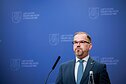
The Finance Ministry has presented four options to raise an additional 400 million euros for national defence. Minister Gintarė Skaistė emphasized that these decisions are necessary.
The first option proposes a partial return to the government’s tax reform package, which included reviewing progressive rates, bringing the taxation of self-employment income closer to that of employment, and scrapping some tax breaks and incentives.
The changes could generate an additional 270 million euros, and almost 400 million euros if the corporate tax rate is raised from 15 percent to 16 percent.
The second option, based on proposals from the Lithuanian Business Confederation, calls for increasing the VAT rate by 1 point. According to Skaistė, this would generate almost 300 million euros in additional revenue.
The third proposal involves raising the basic corporate tax rate by 2 points to 17 percent to generate 244 million euros in revenue, and increasing the reduced corporate income tax rate for small businesses by 5 points to 10 percent, which would bring in 36 million euros.

Additionally, scrapping the current zero VAT rate on central heating would bring in an extra 70 million euros.
The fourth option suggests cutting the share of income tax revenues that goes to municipal budgets.
“The proposal would be to have a certain security component, which would be applied when adjusting the share of personal income tax that goes to municipalities; this could generate around 150 million euros in revenue,” Skaistė said, noting that the measure would not require changing the personal income tax rate.
This option also calls for raising the corporate tax rate from 15 percent to 17 percent.
The minister said that additional decisions on national defence funding are necessary, given this year’s projected budget deficit of 3 percent of GDP, estimates of potential additional revenue in 2025, based on current economic indicators, and the needs already programmed into laws.
President opposes VAT hikes
Lithuanian President Gitanas Nausėda has commented that defence spending rises should not be funded with higher consumption taxes or taking money away from municipalities.
“The proposals that have been put forward are debatable, but I can say right now the proposals aimed at taking the financial blanket away from municipalities and shift it to security issues are certainly unacceptable. I think that municipalities in general lack funds to carry out many of their functions,” Nauseda told reporters in Zarasai on Monday. “I am also sceptical about the increase in the VAT rate. All other proposals are negotiable.”
The president also lamented the fact that opposition representatives were not present at Monday’s meeting on additional sources of defence funding.

Newsletter
Every Friday morning.