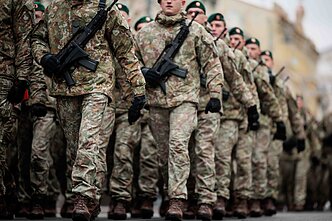








As Lithuanian lawmakers consider amendments that would ban the country’s troops from travelling to unfriendly countries, the Defence Ministry has proposed including in the list not only Russia and Belarus but also China and the Transnistria region of Moldova.
The ministry has drafted a resolution for the government to approve a list of foreign countries or territories professional troops would be banned from travelling to for off-duty purposes. The changes would come into force in January.
The list of banned countries would include Russia and its occupied Crimea, Belarus, as well as Armenia, Azerbaijan, Kazakhstan, China, Kyrgyzstan, the Transnistria region of Moldova, Tajikistan, Turkmenistan, Uzbekistan, and the Abkhazian and South Ossetian regions of Georgia.
Similarly, professional troops would not be allowed to travel to foreign countries or territories if the Foreign Ministry advises citizens against travelling to these countries or tells them to leave immediately.
The draft resolution also proposes defining cases and establishing the procedure under which professional troops would be allowed to travel to foreign countries or territories included in the above-mentioned list.
Under the proposed amendments, the government could determine cases, including exceptions due to personal circumstances, and the procedure when professional troops could travel to foreign countries or territories included in the list with a permit or declaration of departure information.
The Defence Ministry says such a ban has to do with national security interests.
In late September, Lithuania’s National Crisis Management Centre announced that people working with classified information would not be able to travel to Russia, Belarus and other countries that pose a threat to Lithuania.
Some 56,000 people will be affected by these restrictions, the centre said.
The move to restrict some Lithuanian citizens from travelling to unfriendly countries comes amid reports that Belarusian intelligence services have been stepping up their activities at the Lithuanian-Belarusian border.
The previous version of this article incorrectly stated that the travel ban would include Moldova and not only the Transnistria region of Moldova.

Newsletter
Every Friday morning.