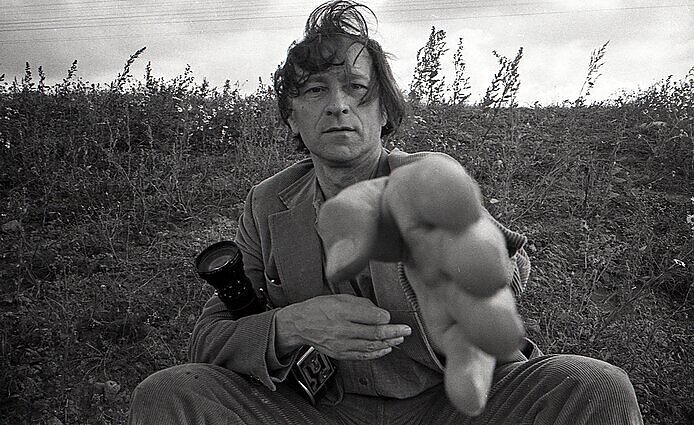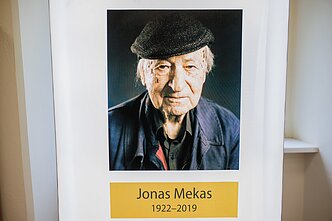








Where he could not return in flesh, Jonas Mekas returned in his carefully selected archive, and finally in ashes. The image of his native village of Semeniškiai in the Biržai district forever remained in the memory of the world-famous avant-garde filmmaker. After 70 years in the US, he was laid to rest in Lithuania, having previously donated a large part of his archive to Biržai.
The village of Semeniškiai, where Jonas grew up in a farming family with four brothers and a sister, no longer exists. However, the loyal fans of the Lithuanian artist travel here from all over the world.
“A few times the Japanese have come and said: ‘We know that Jonas is from here and we want to see that village.’ But that village no longer exists, there is nothing there. [...] We were amazed that people would come and take pictures of the grass where Jonas’ native village used to be,” says Indra Drevinskaitė, a representative of the Jonas and Adolfas Mekas Heritage Study Centre in Biržai.
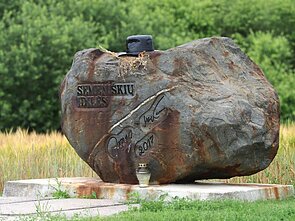
This is how the idea of erecting a memorial stone to Jonas Mekas in Semeniškiai was born. As the artist’s 95th birthday approached, Drevinskaitė found his e-mail address and wrote to him, asking where he would like the stone to stand. The woman, who had never had any contact with Jonas before, says she did not expect the artist to write back.
“But he did. He wrote back in Lithuanian. He wrote that, if possible, I would like the stone to stand where my childhood bed used to stand,” Drevinskaitė recalls.
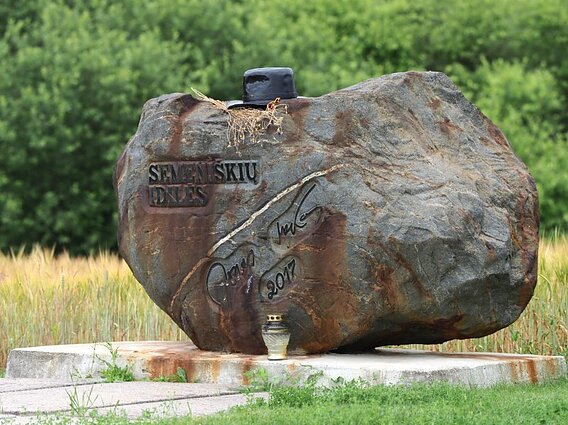
The stone with Jonas Mekas’ signature and the hat that had become his symbol was unveiled in Semeniškiai on December 1, 2017. However, not exactly in the place where the artist’s childhood bed used to stand.
The Mekas family lived in two places in the village. The first homestead, as well as Jonas’ childhood bed, stood at the end of the field, next to the river. Today, it is a private farmland, so the stone, with the permission of the owner, was placed closer to the road. Jonas agreed to this.
Greetings home
“I wish you a very good day,” Jonas wrote on a large white sheet of paper on the occasion of the unveiling of his memorial stone in Semeniškiai. He himself did not attend the event, although “he wrote that he was leaving the door open for his arrival”, Drevinskaitė recalls.
“I received that greeting, written and drawn by him, in June 2018 because it got lost. It came half a year too late because Jonas had written the wrong address,” she smiles.
But the Biržai Public Library had already received one parcel from Jonas Mekas before that.
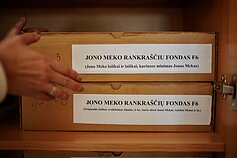
“We neither asked for it nor thought that we could receive something from him. But before the unveiling of the stone, he wrote and asked if we would be interested in his ‘junk’ from New York,” says Drevinskaitė. “So, in September 2017, we received a 35-kilogram shipment from him.”
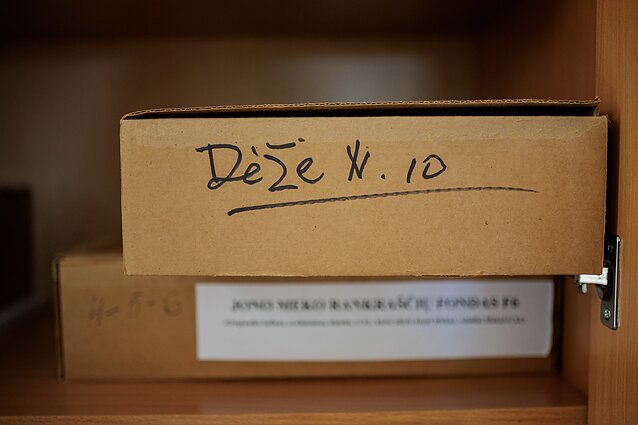

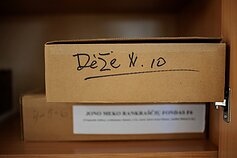
In brown cardboard boxes, Jonas sent to Biržai his carefully catalogued correspondence, letters addressed to him and his brother Adolfas, as well as his collected publications about Biržai, Lithuania, and the country’s path to independence.
“Jonas never threw anything away. Scraps of unknown newspapers and dates also came to us,” says Evaldas Timukas, who is now researching Jonas Mekas’ archive.
This “junk” became the basis for the establishment of the Jonas and Adolfas Mekas Heritage Study Centre at the Biržai Public Library in 2020.
Over time, the centre’s archive has expanded, and important items were donated to Biržai after Jonas’ death by his son Sebastian, who visited his father’s birthplace several times.
“It is so wonderful to be here, where my father once found home, and now, many years later, he has returned and found home again,” Sebastian wrote in the centre’s guestbook.
In June 2019, the urn with Jonas’ remains was buried in Semeniškiai Cemetery, next to his parents Povilas and Elžbieta. Jonas himself wanted to be buried here and thus return to his homeland, which he was forced to leave at a young age.
“He gave himself to Biržai. First, he returned here with the help of the archive, and later, with the help of his ashes,” Timukas says.
Paths in Biržai
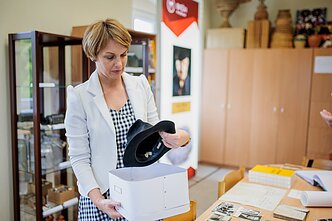
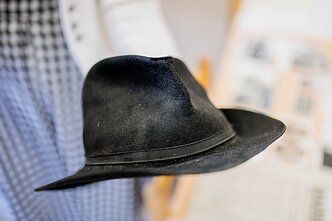
Drevinskaitė shows the hat of Jonas Mekas sent by his son from the US. According to Sebastian, this was one of his dad’s favourite hats, which he wore until his death.
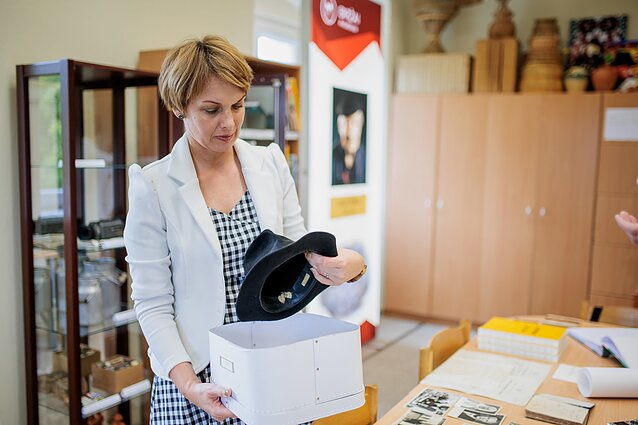
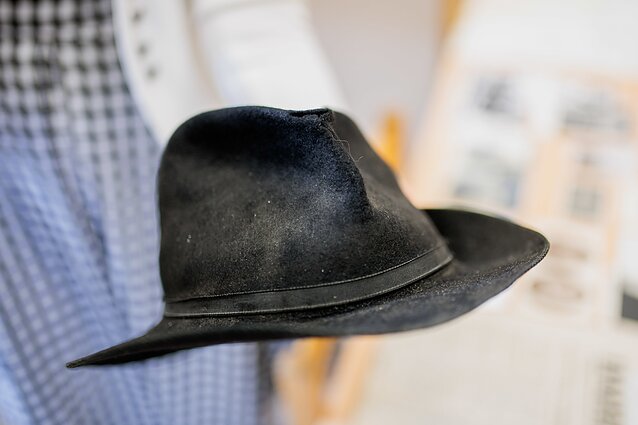
This hat first visited Biržai on Mekas’ head. He was immortalised wearing it in a famous photograph taken at the Biržai Evangelical Reformed Church parsonage, a place of great importance to Jonas.
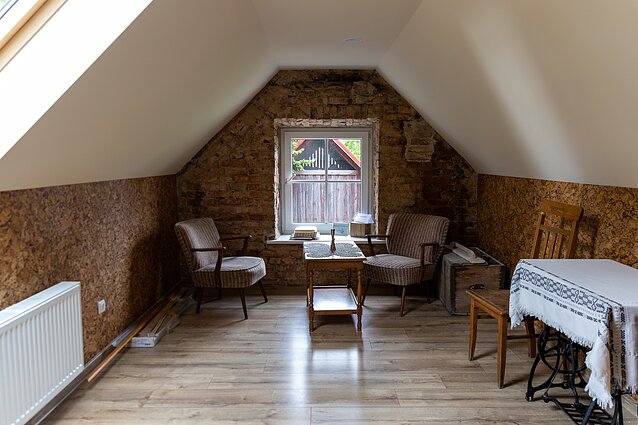
The artist grew up in an Evangelical Reformed family. When Jonas moved to Biržai to study at the local gymnasium and his brother Adolfas started studying at the Biržai School of Crafts and Trade, the brothers lived in the parsonage of the Evangelical Reformed Church, where their uncle, their mother’s brother, was pastoring.
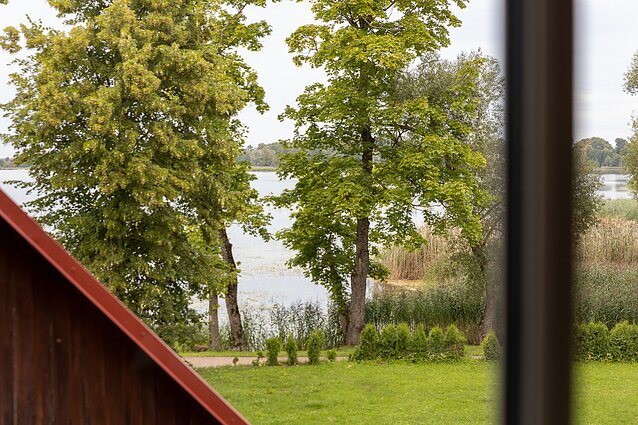
“We know the exact room in the parsonage where the brothers lived. Jonas, when he visited Lithuania in 2010, went to the parsonage and asked to be allowed to sit in that room for a bit. [...] There may not be anything authentic there anymore, but it’s the same little room, the same view of the lake from the window,” Drevinskaitė says.
In the courtyard of the parsonage, in a pile of firewood, Jonas hid a typewriter with which he used to print anti-Nazi pamphlets. Nobody knew about Jonas’ underground activities, but once, when he could not find the typewriter in the usual place, he told his uncle everything. The latter, realising the danger, managed to get documents for Jonas and Adolfas to leave Lithuania and go study in Vienna.
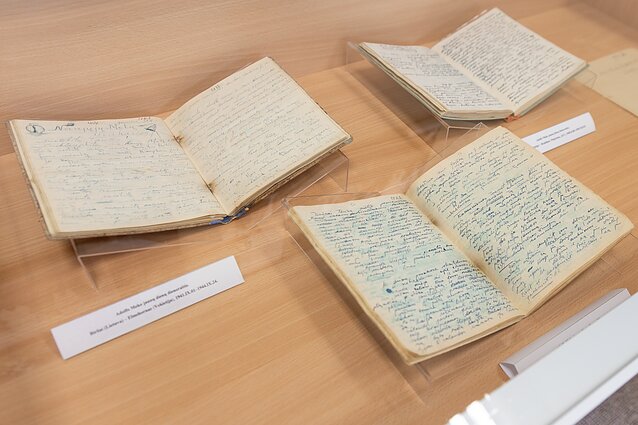
Although Adolfas did not participate in the underground activities, he and Jonas were very close. They were the youngest of the family of several children and left Lithuania together. Adolfas’ widow also gifted the Biržai Centre three of his diaries where he described this period.
“Adolfas writes about his reflections while walking along the shore of Lake Širvėna in Biržai – to leave Lithuania or not to leave? What should a young person do? He writes that he loves a girl. If he leaves, what will happen to this girl?” Drevinskaitė says.
Jonas was 21 and Adolfas was 19 when on July 12, 1944, they left Biržai for Panevėžys and from there continued their journey abroad.
Signs of longing
The brothers never reached Vienna. When their train was stopped in Germany, they became prisoners of war. After the war, Jonas and Adolfas found themselves in a displaced persons’ camp, and in 1949, went to the US, where they were called to work in a Chicago bakery. However, when the brothers saw New York from the deck of a ship, they were so impressed by it that they decided to stay there, even though they had no job, home, or money.
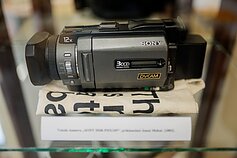
Soon, the brothers bought their first camera with borrowed money and started documenting their daily lives, giving birth to the so-called poetic documentary cinema.
Although Jonas Mekas soon became famous and joined the circle of contemporary artists in New York, he never forgot his native Semeniškiai. “I am a farmer’s child from Lithuania,” he often introduced himself.
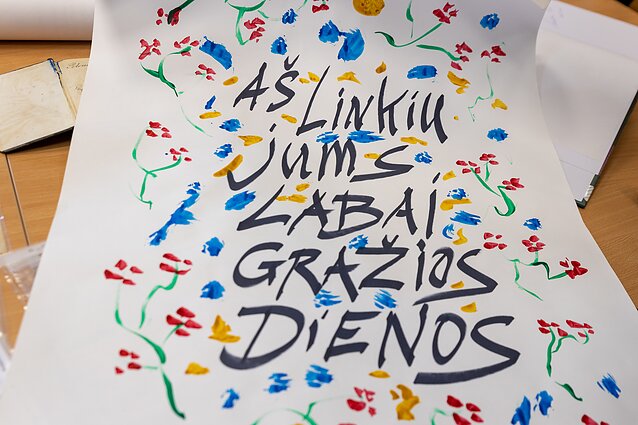
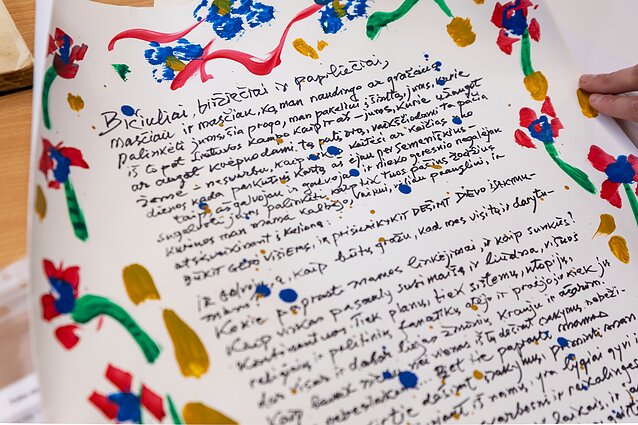
Drevinskaitė points to the flowers painted by Jonas on a greeting he sent to the people of Biržai.
“He was drawing those flowers all his life. Jonas Mekas’ nieces told us that these were buttercups from his childhood. Buttercups used to bloom in Semeniškiai, between the old and the new cemetery. Although they are yellow, Jonas used to draw them in different colours,” she says.
Rolandas Andrijauskas, a Lithuanian photographer living in the US, also said that Jonas often carried bread, sausage, and garlic in the pocket of his jacket. This was a symbol of his shepherding days in Semeniškiai, as a shepherd “always had food in his bag”.
In no way inferior
Much less is known about Adolfas Mekas than about Jonas, although the former is “in no way inferior to his brother”, say the representatives of the Jonas and Adolfas Mekas Heritage Study Centre.
“This is because Adolfas turned to academia in 1971 and taught at Bard College until 2004, while Jonas continued to make experimental films and interacted with all the famous artists in New York,” Timukas explains.
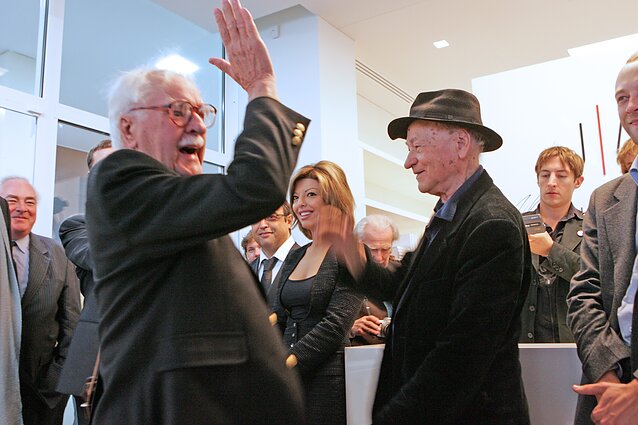
In 2025, Adolfas would have celebrated his centenary. On this occasion, the Biržai Centre aims to make him more widely recognised.
“It’s not easy because there is less material about him, and there is automatically less interest in him. But he is certainly worthy of the same attention as Jonas Mekas,” Drevinskaitė says.

Newsletter
Every Friday morning.