




Almost half of shoppers in Lithuania would like retailers to label goods from producers that retain business with Russia, according to an opinion poll conducted by Vilmorus for BNS in July.
In the survey, 47.4 percent of respondents said that such products should be labelled at the point of sale, while slightly more than a fifth, 22 percent, thought that they should not.
Just over 30 percent of the respondents indicated that they had no opinion on the issue.
Some retailers say they fear the legal implications of such labelling, while others would like the government’s help in accurately identifying companies that do business in Russia.
Four conservative members of parliament approached Lithuania’s major retailers in late June with a proposal to label such products.
‘No response’
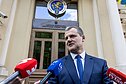
According to MP Vilius Semeška, one of the authors of the appeal, no response has been received from any of the supermarket chains so far.
“This is a bit disturbing and saddening, because such an attitude is strange and not entirely acceptable,” he said. “We wanted to look for solutions without any legal obligations, in the sphere and atmosphere of goodwill and cooperation, but there has been no response. They seem to think that they will wait for the summer and then it will all be forgotten, that perhaps the subject will be exhausted.”
He added, however, that the authors of the appeal planned to approach retailers again in autumn and hold meetings.
Semeška said he took inspiration from Sweden where, according to him, retailers themselves took initiative to label the goods of companies with trade links with Russia.

“Our supermarkets could also ask for some kind of declaration from suppliers and manufacturers that they do not trade or operate in Russia. A declaration would make it clear,” the politician said.
He said that, at the beginning, Lithuanian companies that operate in Russia could have their products labelled.
“That would be a start, they are publicly known, they are linked to certain politicians in Kaunas,” said Semeška, referring to Kaunas Mayor Visvaldas Matijošaitis and the Vičiūnai Group he owns.
Further reading
“Retailers must not stand on the sidelines. I think the first supermarket chain to make a move would get support. I would choose the number one chain and go shopping,” said the politician.
In mid-June, various Scandinavian organisations announced a boycott of Mondelez, which produces biscuits and chocolate such as Oreo and Toblerone, without withdrawing from the Russian market.
At the end of May, Mondelez was added to a list of “international supporters of the war” drawn up by the Ukrainian authorities, which accuses companies of helping to finance Moscow’s war by continuing to operate in Russia and paying taxes there.

Fear of legal problems
Vaida Budrienė, head of communications for the Iki supermarket chain, told BNS that the company does not intend to label goods on its own initiative.
“At the moment we have not decided to do it. We are constantly talking about this topic with our suppliers. We hope that businesses will be aware and make the right decisions. We are very careful about checking incoming goods, because we have had cases where suppliers still send us goods made in Russia, even though we order them from European or Chinese markets,” said Budrienė.
“Even though the supermarket chain Iki does not strictly accept them, we can assume that such goods are still circulating in the market. So there is still work to be done on this issue too,” she added.
The spokesman for the Norfa supermarket chain, Darius Ryliškis, said that labelling would land the chain in court.
“If you label a firm incorrectly, you will have to answer in court. What if you cause reputational damage? [...] We are not going to chase after them, we can’t know if they are working in Russia, how they are working. We won’t be hiring someone to investigate,” he told BNS.
Indrė Trakimaitė-Šeškuvienė, spokeswoman for Maxima, told BNS that the supermarket chain would consider marking products from Russia-linked producers only if the authorities themselves come up with a definite list.
“Otherwise, marking goods without an official list confirming the manufacturer’s activities in the aggressor country risks misleading buyers and exposing them to legal liability for disseminating potentially false information about the manufacturer, and, in the absence of an official list, there is no possibility of applying the same conditions to all suppliers,” said Trakimaitė-Šeškuvienė.

Newsletter
Every Friday morning.