













As a child, Nadja Gircis, a Brazilian of Lithuanian descent, heard stories about Lithuania that sounded like fairy tales to her. She first visited her great-grandparents’ homeland at the age of 15 and has dreamt of settling here ever since. It took decades for her dream to finally come true.
Nadja’s great-grandparents Emilija and Vincas lived in Rokiškis in north-eastern Lithuania. During the interwar period, they worked as farmers but struggled to make ends meet. When they saw an advertisement about the opportunity to work on farms in Brazil, they decided to respond.
“Rich people in Brazil needed people to work their land. They paid for the trip. At that time in Europe, Brazil seemed like a miracle – good soil where everything grows and you can farm freely,” Nadja says.
After selling off their modest possessions, her great-grandparents embarked on an arduous journey first to Hamburg, then by boat to Brazil. Emilija was pregnant at the time, so Nadja’s grandfather’s brother was born en route to Brazil.
“I can imagine how difficult it was at that time, especially with children. They only spoke Lithuanian,” the woman says.
Notebook for Lithuanian words
Nadja’s family has built a life in Brazil generation after generation. Her Lithuanian grandfather died when she was ten years old. But the girl felt a close bond with his sister, with whom she liked to talk about Lithuania.

“I used to go to her house in another city to listen to stories about Lithuania. I remember her telling me about Lithuanian nature and how green the country was. It was like a fairy tale to me,” Nadja recalls.
“I imagined that life and always wanted to visit Lithuania. I also started learning Lithuanian words. When we were cooking, I would ask, for example, how to say ‘bread’ in Lithuanian. I had a notebook and I used to write Lithuanian words in it,” she adds.
However, no one else in her family was interested in their Lithuanian roots. When asked about what attracted her to her great-grandparents’ homeland, Nadja shrugs – it is an inner feeling that is hard to explain.
First visit
According to Nadja, listening to stories about Lithuania was not enough for her, so she dreamt of visiting her great-grandparents’ homeland. At the age of 15, she was finally able to realise her dream.
“At that time in Brazil, there was a tradition that when a girl turned 15, she could either have a Festa de Debutantes and present herself to the public or go to Disneyland. I didn’t want either. I wanted to go to Lithuania,” the woman says.
Nadja’s mother was sceptical about her wish, as it was difficult to travel from Brazil to Lithuania at the time. But through the Lithuanian community in São Paulo, she managed to find a guide who was gathering a group to travel to Lithuania.
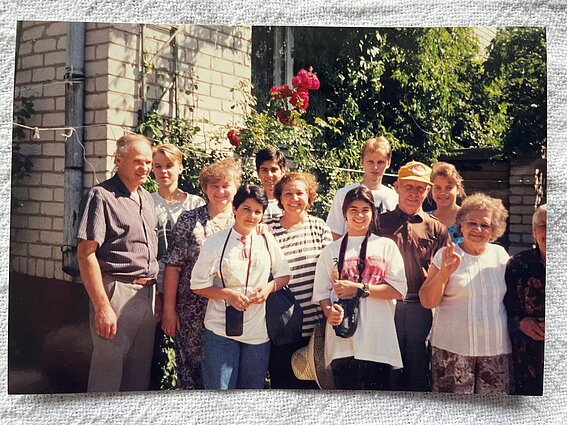
Most of those going were members of the community. Nadja, her mother, her grandfather’s sister, and a few other relatives also joined the group.
“When we arrived, it was very exciting and impressive. My grandfather’s sister was still in touch with her cousins in Lithuania through letters, so we were able to meet. It was a big celebration, a lot of emotions,” Nadja recalls.
“My grandfather’s sister had to be the interpreter because she was the only one who spoke both languages,” she adds.
No surprise
After her first visit to Lithuania, Nadja’s interest in the country had only increased.
“From the first time I visited, I wanted to live here. I can’t explain why, it’s just a feeling. Even the smell is different – the smell of the buildings, the smell of the food, the smell of the black bread,” she notes.
After she came back to Brazil, Nadja started dancing folk dances in the Lithuanian community and learning Lithuanian. Later, she attended the Lithuanian High School in Germany, where she studied for a year.
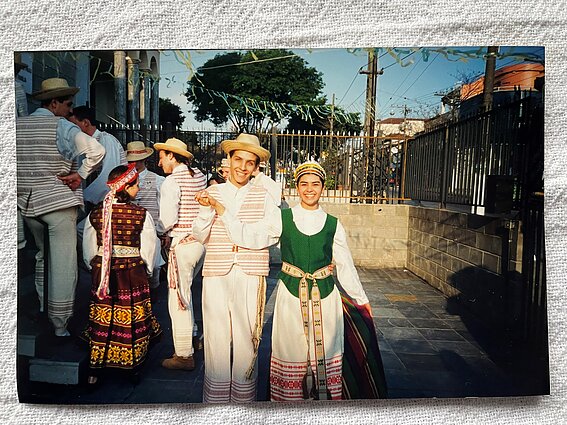
After graduating, Nadja wanted to study medicine in Lithuania, but she listened to her mother’s advice to choose studies in Brazil. She later went to England for her surgical residency.
“I wanted to go to Lithuania, but I hadn’t spoken to anyone in Lithuanian for almost ten years. I went to England because I could study in English there,” she explains.
After five years of residency, Nadja was offered a job in Germany. However, the desire to move to Lithuania has not diminished over the years.
“My desire to live here has only grown. […]. Time passed until one day I said to myself: I don’t want to do this anymore. I want to go to Lithuania, I’m going,” she says.
“I took my dog, a few things, some clothes, documents, photos that were important to me, and I left thinking that I would live here and never go anywhere again,” Nadja adds.
She says her family was not surprised by her decision because she talked about living in Lithuania her entire life. Nevertheless, she was worried about how her dad, who preferred England or Germany, would take the news.
“I told him a week before I left when I had already rented temporary accommodation in Lithuania. My stomach hurt when I had to talk to him. Even though I was already 38 at the time, I was still scared of his reaction because a dad is a dad. But he said: ‘You’ve always wanted to do this, so it’s okay. I’ll come and visit you’,” Nadja smiles.

Difficult men
In Lithuania, Nadja first started attending Lithuanian language classes three times a week. At the same time, she worked out what she needed to do to obtain a medical licence in Lithuania.
“When I got my licence, it took me six months to find a job,” she says.
She currently works in three clinics in Vilnius. After first acquiring the qualification of urological surgeon, the woman discovered the field of medical acupuncture. She now consults both as a urologist and as an acupuncturist in Lithuania but intends to focus on the latter.
Nadja has now lived in Lithuania for five years. She says that it took time to adjust, even though she feels more Lithuanian than Brazilian.
“The culture is different. Sometimes Lithuanians seem angry, but now I know that they are not angry but direct,” she explains.
According to Nadja, she is also not afraid of the cold, as she used to live in Bavaria, where temperatures also drop to 20 degrees below zero in winter.
When asked what is the most difficult for her to get used to, Nadja laughs: “It’s still hard to understand Lithuanian men. They are a bit difficult, maybe a bit shy. Maybe it’s because I don’t look Lithuanian or because of my temperament, as I’m determined, independent... Or maybe I just haven’t found the right one.”

However, the woman says she is happy in Lithuania and does not think about going back to Brazil where she felt unsafe.
“When I’m there, I always feel anxious. When I get in the car, I close all the windows and lock the doors. But here, I can walk my dog at 23:00 and feel at ease,” Nadja says.
According to her, she is grateful that she finally lives in Lithuania and can speak Lithuanian: “Sometimes, I drive past Gediminas Castle, look at it, and thank God that I am in Lithuania. It’s a good feeling to finally live here.”
Nadja also often remembers the history of her great-grandparents.
“They didn’t want to leave Lithuania, but they had to. It was a choice between starving to death or trying to survive elsewhere. Now, I can pay back and do good for Lithuania and its people in the name of my great-grandparents,” Nadja says with tears in her eyes.

Newsletter
Every Friday morning.