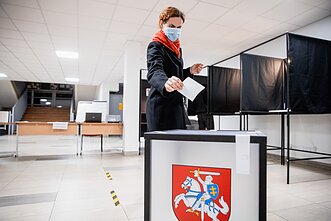













This March 5 marks the day when all Lithuanians and foreign residents over the age of 18 will be meeting at the ballot box. It’s municipal election day, where members of Lithuania’s municipal councils and their respective mayors are elected by locals for a four-year term.
LRT English brings you Guide to Lithuania, a series of articles by the International House Vilnius, an initiative helping new arrivals settle in Lithuania. You can find all the explainers here.
Municipal governance oversees a number of areas that play an important part in daily lives, like education, infrastructure and transportation, waste management, housing, and much more.
So, let’s dive in and find out exactly how the process works.

Getting involved
While voting in other Lithuanian elections (presidential, parliamentary) is limited to citizens of the country, municipal elections in Lithuania stand out for being open to local foreigners, who can vote and even run as candidates.
Giving foreigners the right to be fully involved in the municipal agenda has proven to be an efficient way for them to integrate and feel more connected within the community. By engaging in local politics, foreigners can learn more about the issues facing their municipality, meet other residents who share their concerns and gain insight into the institutions and structures that govern their daily lives.
Grounds for voting and running for office
The age requirement to vote and run a political campaign varies; for municipal elections the voting age is 18 and the minimum age to run for office is 20.
In Lithuania, European Union citizens who have the right to live in the country are entitled to vote in municipal elections. This right is granted to:
- foreigners with a permanent residence permit in Lithuania. To qualify for a permanent residence permit, individuals must have lived continuously in Lithuania for the past five years or have come to live with a Lithuanian citizen as a member of their family.
- EU citizens who have been issued a temporary residence certificate, residence permit card of a family member of an EU citizen or similar documentation.
Please note, only a permanent resident of a municipality has the right to vote and run, meaning a person must have their place of residency declared no less than 60 days prior to elections.
Looking for information and getting hands on
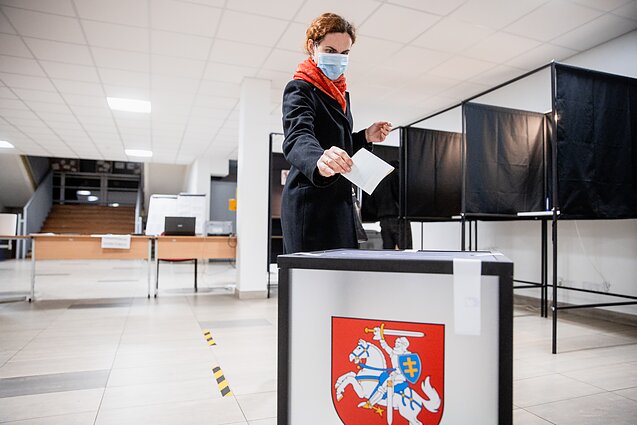
Municipal Council Elections have two separate ballots – one for the council and another for the mayor. The first round of the election will be held on March 5 and the second one is exactly two weeks later.
The Central Electoral Commission (VRK) is an independent institution responsible for organising and conducting national and local elections in Lithuania. Its main objective is to ensure that elections are free, fair and transparent. Moreover, the VRK functions include organising the voting process, counting ballots and announcing election results and educating voters about their rights and responsibilities.
All voters can vote once for their candidates at two different times. Not many know that despite March 5 being the official election day, ballots can be cast early on February 28 and March 1-2 from 07:00 to 20:00. Voters can vote at the municipal building or designated polling stations provided by the city and located closest to their declared places of residency.

Election results are usually announced the same night after voting closes (20:00), but it may be possible that there are not enough votes to elect a mayor (who is the head of their respective council) on the first go. In these cases, another round of voting is held exactly two weeks later.
To find all the information about the candidates and select your representative, please visit the VRK website.
If you have any questions about upcoming elections, please don’t hesitate to contact the VRK Election Organisation Unit.
Find more information about the Elections to Municipal Councils on March 5, 2023, in English.
Don’t forget your passport and see you at the polling stations.

Newsletter
Every Friday morning.