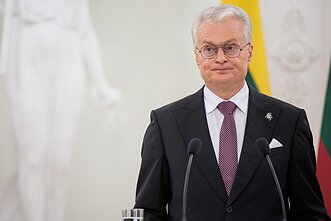





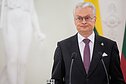




Many ridiculous things are being said about Russians and the Russian culture, as the world justifiably condemns the Russian army’s atrocities in Ukraine, says Lithuanian scholar and public intellectual Tomas Venclova.
Poet, translator, and author, Venclova is one of the most respected intellectuals in Lithuania. He is one of the founders of the Lithuanian Helsinki Group. In 1975, Venclova wrote an open letter to the Central Committee of the Communist Party, in which he said he could no longer live under the communist ideology and asked to be allowed to leave the USSR.
Between 1980 and 2012, he taught Russian literature at Yale University, where he received his PhD in philosophy in 1985, later becoming professor emeritus. Venclova’s main works focus on the history of Russian literature, especially the Silver Age, as well as Lithuanian and Polish literature.
In an interview with LRT.lt, he discusses some of the reactions to Russia’s war on Ukraine, blanket ostracisms of everything Russian, and claims that all Russians are guilty for their government’s crimes. “I won’t call them fascists, rushists, I won’t call them orcs. That is dehumanising,” says Venclova.
- Amid the wave of anti-Russian sentiment unleashed by Moscow’s war in Ukraine, Lithuania’s authorities recently renamed the Russian Drama Theatre in Vilnius. Do you think that was a justified move?
- Because of what is happening in Ukraine, there is a legitimate indignation in Lithuania and across the world at the actions of the Russian authorities and Russia as a state. The shadow of this indignation also falls on the Russian people and Russian culture, which is natural and inevitable. However, we don’t always express it with intelligence and tact. […]
The urge to rename the theatre stemmed from the desire to show our patriotism and attitudes towards what is going on. Quite a few are also trying to score reputation points. Was it necessary to change the name? I don’t think it was. It is fine if we want to rename the theatre, but I don’t think it was necessary.
Some argued that the Russian Drama Theatre was a colonial landmark, a garrison theatre. In the beginning it undoubtedly was, but that has changed over the years. Some also said that people wouldn’t go to the theatre out of patriotism. I went. I think patriotism can be expressed in other ways, but it is a matter of a person’s free choice. […]
Read more: Lithuania’s Russian Drama Theatre to be rebranded as Old Theatre of Vilnius

There were even opinions that the theatre should be closed altogether. But it would be quite silly. Thankfully, that didn’t happen. There’s another issue: the theatre performs in Russian, a language which is less and less spoken here. And so the theatre will gradually lose its audience. But that is a matter for the future.
- Soviet and Russian architectural heritage is another area that has recently became controversial. What should Lithuania do about it?
- What is Russian architectural heritage? There is Tsarist architecture, which is not always brilliant. There is one brilliant building in Vilnius, designed by the Russian architect Vasily Stasov, the President’s Palace. It adds beauty to the city and is no inferior to anything in Saint Petersburg.
As for the other tsarist buildings, there is the Romanov Church. I wouldn’t say it’s very beautiful, but it has its own parish and of course should stay. There are many such buildings in different parts of the city – the tsarist barrack architecture. It is a monument to the epoch, but it doesn’t really shine in terms of architectural accomplishment.
Take, for example, the tsarist architect Nikolai Chagin [the main architect of Vilnius in the late 19th century]. He built a pseudo-Gothic bell tower near St. Anne’s Church. It’s a poor one – Nikolai Vorobyov, a great connoisseur of architecture, thought it should be demolished. People were talking about doing it, but not anymore. As far as I am concerned, let it stay. Pseudo-Gothic is now acquiring a patina of antiquity.

Chagin also built a church near the Town Hall. I wouldn’t say it’s a gem, but it has somehow blended in with the landscape of Vilnius.
As for the Soviet socialist realist buildings – such as the Vilnius railway station or the airport terminal – they will probably be transformed. Vilnius deserves a better station, and even more so a better airport terminal. When you arrive from Riga, it’s obvious that Vilnius airport is quite provincial. They’ll build something better and the question will go away.
Some socialist realism monuments have somehow become embedded in Vilnius and may very well remain part of the city’s landscape.
Besides architecture, there are other Soviet remnants. Many people, who are very anti-Soviet and anti-Russian, exhibit a very Soviet, very Komsomol mentality when they call for renaming, tearing down old symbols and immediately putting up their own. They destroy in order to assert themselves. In my opinion, nothing good comes out of this kind of mentality. This is no patriotism.

- There have also been some indignation that Russian is among the most popular foreign languages taught in Lithuanian schools.
- [Journalist] Andrius Užkalnis has written that there is no need for the Russian language and it should not be taught at all. I think that maybe it should be taught less, but in the same way that French, German or Polish are taught. It is the language of a neighbouring country, a big country that will not go away, whichever way our political relations develop. And by the way, Chinese has to be taught as well. […]
Even though Russia is now the enemy, you have to know the language of your enemy. During World War Two, German was taught in American, British and, incidentally, Soviet schools. And knowing German was crucial at the front – it wasn’t useless for an officer to speak German.
- And what do you think about the wave of “cancelling” Russian culture that is now sweeping across Europe?
- Yes, there is the opinion that we don’t need the Russian culture, that it didn’t produce anything good, that it is toxic, that it should be [“quarantined”]. That the entire essence of the Russian culture should be re-evaluated, because, some argue, it was what produced the Russian imperialist mentality. Some of these opinions, in my view, are far-fetched and ridiculous. […]
- Their argument is that we should protect young Lithuanian and Western minds from Russia’s soft power, because it is using its cultural prestige to win sympathy for atrocious violence against its neighbours.
- You see, the Russian culture’s soft power, like the American, English or French, is mostly modern pop. And since many pop performers support Putin, they of course should be barred from Lithuania. Western countries are closed for them too. Or take the conductor Valery Gergiev and the singer Anna Netrebko. They supported Putin and have to pay for it.
But Vladimir Vysotsky did not support Putin. And if he had lived to this day, I am sure – I knew him a little – he wouldn’t support Putin. Bulat Okudzhava – who was Georgian, not Russian, but Georgian of the Moscow ilk, as he himself put it – would not support Putin.
What happened to Alla Pugacheva, to her husband Maxim Galkin? There was an article saying that we don’t need Galkin either. He used to support Putin, but now he doesn’t. A person has the right to change their mind. If he has changed so much, then great.
But that concerns living people. It can be more difficult to talk about the classics. They say, for example, that Alexander Pushkin was a singer of Russian imperialism. He has these two or three poems. […] But on the whole, he hasn’t written many imperialistic ones. One can still think of some Caucasian poems.

Lermontov has some imperialist poems, such as The Dispute, but nevertheless, the great mass of Pushkin’s and Lermontov’s works have nothing to reproach them with. They were not the ones who built up Russian imperialism. Pushkin and Tolstoy should not be confused with Minister Sergey Uvarov, who came up with the formula “Orthodoxy, Autocracy, Nationality” – a formula for Russification that was opposed by the majority of Russian writers. There were Slavophiles – they supported Uvarov – but there were also Zapadniks (Westernisers) and they predominated.
Moreover, some say that what the Russian language gave us is just swearwords. But aren’t there any foul language in English? Almost every nation has it. We, the Lithuanians, perhaps have less, so we borrow swearwords from Russian. To be honest, I myself oftentimes can’t do without them. It is better, of course, to use them less.
So it’s all a bit ridiculous. They say Leo Tolstoy is toxic and imperialistic. This is patently untrue. It’s enough to read War and Peace or Hadji Murat to know that there’s not a trace of imperialism there. It’s a little bit more complicated with Dostoyevsky, granted, but if one doesn’t read Dostoevsky, one impoverishes oneself psychologically and philosophically.
What would the Russian classical authors make of today’s situation? It’s hard to say, but intuitively I am sure that neither Dostoevsky nor Tolstoy or Pushkin would support Putin and the Ukrainian campaign.
- What do you feel is the responsibility of ordinary Russians who do not protest Putin’s war in Ukraine?
- Yes, they say: Putin is the villain, but nor are the Russian people good and innocent, they all, as one person, support Putin. Well, first of all, that is not true. There are Russian people who do not support Putin, and as the months go by there are more and more of them. You can see how they have reacted to the mobilisation.

There is a psycho-social law: when war breaks out, at first almost every society is supportive of its government. This was the case in Russia in World War One, as was in Germany or France. It was even worse in Germany in World War Two, when a vast majority of the German people (although there were exceptions) supported Hitler, even when he was hiding in his bunker and about to commit suicide. It took a long re-education process to change that.
The French people were about the same. In World War One, everyone was a patriot: “Beat the boches (as Germans were pejoratively called), we’ll get to Berlin.” This changed somewhat later on.
In Russia, when it became clear that the war was a serious matter and resulted in deaths and hardship, the mood had changed completely by 1917. There was the February Revolution and then the October Revolution. Wait three years and the Russian people will change their attitudes.
Moreover, we hear that the Germans have repented, while the Russians never have and never will. We hear that the Russian people are born rapists. Horrible barbarians who swear, rape every woman and little girl they see, and torture prisoners. Sure, there are people like that. But there are people like that in other nations, too.
Guilt is always individual, I insist. You have to prove that a person killed a civilian, raped a girl – and you have to punish them. But punish them individually, not collectively.
Read more: Sakharov backed Baltic dissidents. Vilnius should honour him – opinion

It’s very complicated. We have empathy for the Ukrainians – as we should. But we should also have empathy for those dumbfounded Russian guys who are shipped to the front to die senselessly. Some of them commit crimes. But those are special cases. Those who do not commit crimes, just die senselessly – I feel sorry for them, too. I won’t call them fascists, rushists, I won’t call them orcs. That is dehumanising. When these words are shouted in the trenches, during bombings, it is understandable. But we can’t say it’s a good thing.
A major political figure of ours said the other day: Russia is a cancer of humanity, it must be cut out. But then one must ask: how do you cut it out and where do you put Russia? Should we exterminate one hundred and forty million Russians? Or occupy, like Germany post World War Two, and re-educate them? It would be nice, but it is unlikely to succeed. We will have to be more sophisticated – if you will, treat cancer with chemotherapy. […]
I watch this programme called The Living Nail. In it, Russian journalists – some of them in Russia, at great personal risk – speak out against Putin. Some of them have emigrated and make their case from exile. True, it is rare that very brave people speak out against the regime, so to speak, in its den. […]
We hear that Russians must not “desert”, run and hide in free countries, they must rise against Putin. In their silence, they support him. But then what about Lithuanians? Lithuania was silent for almost 50 years before Sąjūdis. Many were praising the Soviet regime. […] They were drumming pseudo-Marxism into our brains, for which they were reaping salaries, university degrees and somehow getting by. Although many people deeply hated all this and were “for Lithuania” at heart, they kept silent. They started talking only when Gorbachev allowed it – and not immediately. […]
Again, we hear: Russians were deporting us, Russians were killing us, Russians were robbing us. Didn’t Lithuanians take part in all this? Sometimes they even say that the Jews did everything, which is even more absurd. […]
- Five years ago, you gave a talk at Vilnius University. You said there was a difference between Putin and Stalin, but you wished it was bigger. Is there less of a difference between them now?
- Yes, undoubtedly, this difference is narrowing. It has not disappeared completely yet. If Putin were no different from Stalin, 10 million people would be in prison and three million would be shot.
But of course, the difference is narrowing. Putin has put himself almost next to Stalin in history. We also hear that Putin is like Hitler – they call him Putler – but that, too, is far-fetched. Hitler’s casualties are greater, he caused more damage.

- But Putin’s threat to use nuclear weapons puts him on the same plane?
- Undoubtedly. Although so far these threats have not been put into action. I hope very much that they won’t be. I even hope that if they are, it will not be the end of mankind.
If Hitler, sitting in a bunker, had possessed atomic weapons, he would undoubtedly have set them off. Werner Heisenberg, the German scientist tasked by Hitler to develop atomic weapons, saved us from it. Either he sabotaged it (as he claimed after the war) or he simply didn’t have enough time. And so World War Two ended the way it did. […]
- You are a great expert on the Holocaust. Now we also hear that what Russia is doing in Ukraine amounts to genocide, particularly in Bucha, Irpen, Izyum. Do you think it is genocide?
- You know, genocide is a very particular concept. Genocide is when you are killed – not exiled, not imprisoned, not deprived of your native language, but literally killed, taken to a pit and shot in the back of your head. And when this happens to every member of the people who fall into the clutches of the criminals. This is what happened to the Jews. It happened to Armenians in Turkey during World War One. But that is quite rare.
There can be weaker genocides. It was committed against the Chechens who were deported to the last person. All Balkars, all Crimean Tatars were deported. This is repression for nothing else than belonging to a given people. You can love the Soviet government and still be deported. You can fight for it at the front and still get deported. It was said that, in the Soviet times, they wanted to deport Ukrainians, but it was too difficult, there were too many of them.
As for the Lithuanians – Stalin may have wanted to deport them all, he discussed such plans, but they were not carried out. In Lithuania, they exiled the elite of the people, the educated, the well-to-do, the patriotically-minded. And if you were an ordinary Lithuanian and spoke Lithuanian – they most likely did not touch you. Such a crime has a different name – stratocide.
As for Bucha – yes, civilian people were killed there, apparently simply because they spoke Ukrainian and the occupiers did not like them for one reason or another. This is genocide. But genocide on a smaller scale than the genocide of the Jews. If similar events continue to develop in Ukraine, God forbid, a genocide of the Jewish type may happen. But what happened in Bucha and in many other places has signs of a genocide – it is a grave crime that must be investigated, documented, and punished.

Newsletter
Every Friday morning.