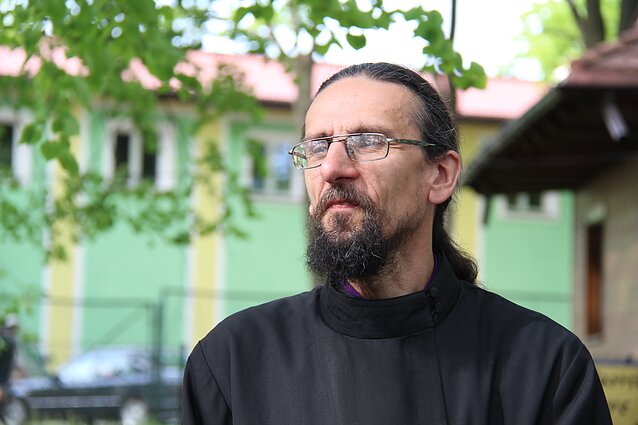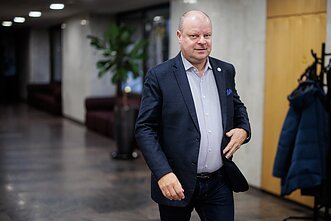


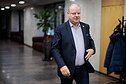



When Russia invaded Ukraine, Orthodox Deacon Viktoras Miniotas tore up a prayer, which said that a civil war broke out in Ukraine. Today, he is one of eight clergymen in Lithuania who are leaving the Moscow Patriarchate. But tensions within the Orthodox Church in Lithuania started much earlier, when Russia invaded Georgia in 2008, Miniotas said in an interview with LRT.lt.
How are you feeling today?
It’s not just me, I guess we’re all filled with mixed feelings. There is a war going on, and for a week or so, I couldn’t do anything at all [...].
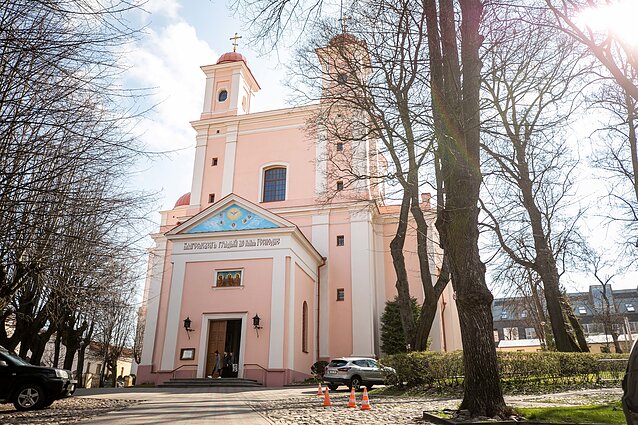
The war started on February 24. On February 27, I went to the Orthodox Church of the Holy Spirit in Vilnius. I went on Sunday and saw that prayers were being read about the civil war in Ukraine, about Ukrainians fighting with other Ukrainians. […] I tore up that prayer, threw it away, and told the priest that if we don’t have another prayer, we will not say anything at all in the liturgy.
I came again on Wednesday, I think, and I heard the same prayer being read. And I said, “I will not sing Amen for such a prayer”. Then, the superiors started a verbal battle with me, so I said – I’m out of here. That was the last time I served there and the last time I sang in the monastery.
I was the first one [to leave]. I left because I was free [...]. Then, all the proceedings started with priests Gintaras, Vitalis, Vitalijus...
Read more: Three Orthodox priests sacked in Lithuania after criticising Russian invasion of Ukraine – media
My wife Svetlana and I were wondering where we should go to receive communion. It’s not right to go to the Catholics because we are Orthodox. But all the Orthodox were in favour of Kirill [Patriarch of Moscow], and all the Orthodox churches mentioned Kirill.
We cautiously went to Saint Parasceve Orthodox Church to see what was going on there. We saw that Kirill was not mentioned there, everything was fine, people spoke Lithuanian […]. We went there three times before they took over that church, parish, fired the priests, and now, there is nothing there.
Bishop Amvrosijus has now taken over all authority there. It seems to me that Metropolitan Inokentiy [head of the Lithuanian Orthodox Archdiocese] is not in charge anymore, even though he signs the papers. I have information that people from Moscow call Amvrosijus […].

Eight Orthodox priests have left the Moscow Patriarchate so far. But others are silent, afraid. Fear is the foundation of the Moscow Patriarchate. The Metropolitan always said: “You can think whatever you want, but don’t say anything”. This was also the case in 2014, after the event in Crimea.
Read more: Some Lithuanian Orthodox priests to turn away from Moscow Patriarchate
Why can’t you talk?
To avoid differences of opinion. In 2014, clashes broke out between priests. The occupation of Crimea was supported by most, if not all, of my acquaintances.
There is no secret group, as the Metropolitan’s letter claims, which has been making plans, conspiring to break away. We thought that everything would pass, that Kirill would die, maybe there would be another Patriarch, there would be a change of power in Moscow, and everything would be fine.
Has it ever occurred to you that you were coming to serve in a church that was very much connected with politics and the Kremlin?
My wife and I lived in Russia [Miniotas was born into a family of exiles]. I have a lot of experience in Russia, I know what is happening there. I even served in the Soviet army, so I was not at all surprised by what happened in Bucha.

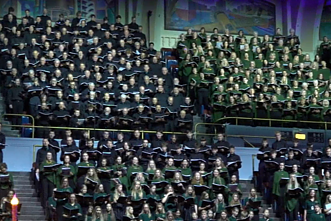
My wife and I came to Lithuania in 1996. [...] It was a different time then. We came to the Orthodox Church to sing, there was a big choir. [...] Then, my daughter Žana said, “You would be a good deacon”. And so, I came to Metropolitan Chrysostomos and said that I would like to serve in the Orthodox Church. In 2004, I was ordained a deacon.
Those were very different times. There was Patriarch Alexy, Putin had just come to power, there were good relations between Russia and Lithuania, and we thought that democracy would develop in Russia and everything would be fine.
The problems started in 2008, with the Russian war in Georgia. Metropolitan Chrysostomos of Lithuania wrote that he supported Russia.
Did he support Russian aggression? [The former head of the Lithuanian Orthodox Church, Metropolitan Chrysostomos, is known for his support of Lithuania’s independence in 1991 and opposition to Moscow.]
Yes. It was a shock, and I wrote him a reply. He said that he was proud to be Russian because Russians would make order in Georgia [...]. That’s how it all started.
I myself thought that this will pass, everything will be fine in Lithuania because there is a Lithuanian parish, and Father Vitalijus Mockus reassured everyone. Metropolitan Inokentiy was also calm and peaceful, he was in contact with Lithuania, mentioned our martyrs, there were words about Lithuania in his prayers.

Everything seemed to be fine. But the war put everything in its place […].
Vilnius Mayor Remigijus Šimašius said that our churches should not belong to Moscow. What do you think?
Moscow owns them through television and through the fact that they send a bishop here. Bishop Amvrosijus was sent from Moscow. That Inokentiy is in charge. The letter that he supposedly sent does not resemble his style at all. He never spoke like that. I doubt he could write like that.
What future do you see in Russia?
Throughout my time in the church, I have been waiting for something to change. Now, something has to change [...].
That is why I kept my Russian passport, although I could have thrown it away. My mother still lives there, and if anything changes, I will be able to go. For the time being, of course, I am not going there because I might get arrested.
My wife wants to give up her [Russian] passport, but she only has a residence permit in Lithuania for now. The children also have Lithuanian citizenship, one daughter wants to renounce her Russian citizenship and get Lithuanian citizenship. Then, all the children will be Lithuanian citizens.

Newsletter
Every Friday morning.