














With tens of thousands of Ukrainian refugees having arrived in Lithuania, there are fears that some may fall prey to exploitation and human trafficking.
Dovydas Petrošius, an NGO worker who works with refugees, says that Ukrainians come to Lithuania without thinking too much; their main goal is to leave the country.
“There were some people who went to Lithuania because they had someone to go to. But some just packed their small bags and left. They don’t even know where they are going. When you ask them, they say that it doesn’t matter where they are going, the important thing is to get away from the situation in Ukraine,” Petrošius tells LRT RADIO.
Kristina Mišinienė, who heads the Centre for Combating Human Trafficking and Exploitation, says that from day one when Ukrainians started arriving in Lithuania, there were reports about attempts to recruit and exploit them.
“Our colleagues’ job is to protect them from potential threats, so that all the exploiters, recruiters, pimps, cheap labour hunters who come out of their caves, cannot simply approach them. Unfortunately, every day we get notified by volunteers, by Ukrainians themselves, that they are being recruited, that they are being lured with hard-to-believe offers,” says Mišinienė.

There have been reports, although not in Lithuania, of entire buses with women being diverted to brothels.
“In Lithuania, we have not received such reports. However, we have been seeing prostitution of migrant women for years. The largest percentage, I would say about 90 percent, were women from Ukraine. We have also seen cases of exploitation in the transport sector and in the construction sector,” says Mišinienė.
Renata Kuleš, a representative of the United Nations (UN) Refugee Agency in Lithuania, says the fact that most refugees are women and children exacerbates the risk of sexual exploitation.
“Not only in the Lithuanian context, but in general, this is a huge movement of people, 90 percent of whom are women and children. We see that the risk of human trafficking and sexual exploitation is really very high,” says Kuleš.
In order to prevent dire consequences, the she says it is necessary to take preventive measures, such as raising awareness among refugees and controlling access to registration centres.

“We also believe that there should be a person in the registration centre who is trained to be more observant, to know people’s behaviour and to see when they have a problem,” says Kuleš.
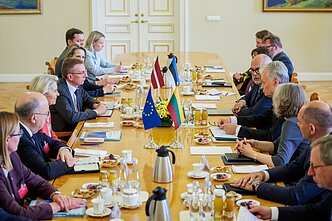
Laura Perevičiūtė, head of the Foreigners' Integration Group, says that just a week ago, a meeting at the Ministry of the Interior discussed measures to help Ukrainians avoid falling prey to exploitation. The agreed measures include training for volunteers, videos and leaflets informing about dangers.
“There are 24-hour information lines where you can report if you are experiencing any kind of violence in the registration centres. We are already providing template employment contracts, information about the minimum wage in Lithuania, what an employment contract looks like, what it should contain, how much time off will be given,” says Perevičiūtė.
According to Petrošius, an NGO worker, Ukrainians refugees are oftentimes dropped off in a city without much guidance.
“We saw on social media that a lot of people pooled resources and drove to bring people here to Lithuania. But the best they can do is drop them off at the registration centre. Others just drop them off in the city and go back to pick up more people,” according to Petrošius. “Naturally, these people do not even know what to do here. And that’s where the ‘do-gooder’ employers come in, offering jobs in Germany. I personally met two young girls who came to Klaipėda, and when I asked them what they were going to do, they said that someone had offered them to go to Germany to work as models.”

According to Perevičiūtė, monitoring refugees and their wellbeing is all the more harder without any restrictions for them to travel across the Schengen area.
“They should inform us if they move on to another country. The same goes for people who give away their temporary accommodation,” says the head of the Foreigners’ Integration Team.
Unaccompanied minors are among the most vulnerable groups. According to Mišinienė, the large number of people seeking to adopt Ukrainian children poses a particular danger.
“Specifically, I think that we need to take steps today to ensure that not just anyone has access to these children. The mass appeals for sheltering them, I think, hide a danger. We are also receiving reports that there are no night watchmen in the places where children are temporarily accommodated,” Mišinienė says.
“It may sound strange to say this now, but I would very much encourage adoption service workers to leave their offices for a bit, to volunteer, to broaden their scope of work, to go see these children, to have a very clear understanding of what each child needs, and then the help will be much more concrete,” says the head of the Centre for Combating Human Trafficking and Exploitation.

Newsletter
Every Friday morning.