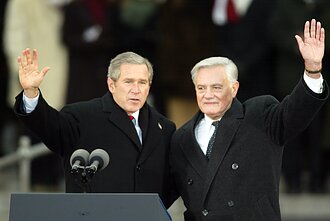







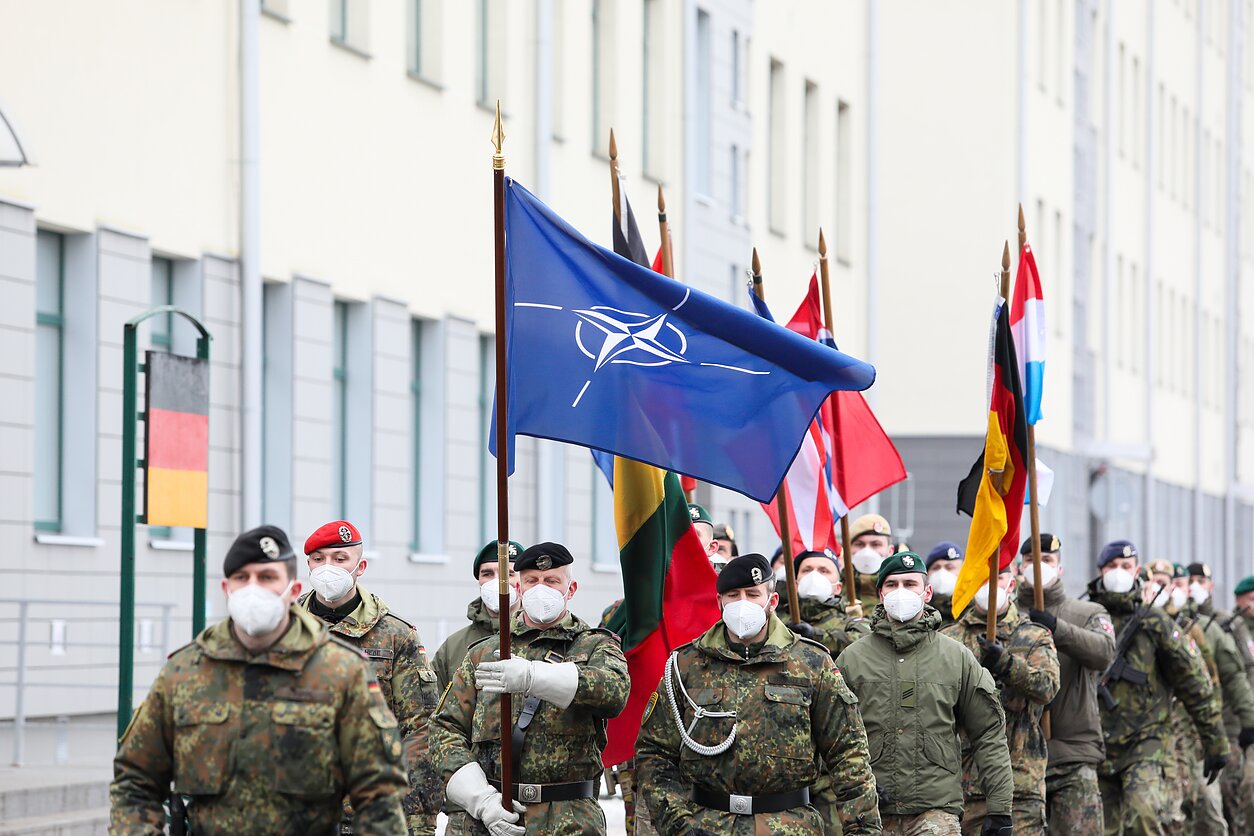
March 29 marks 18 years since Lithuania became a full-fledged member of NATO. The country’s road to membership was not an easy one, but US President George W Bush’s visit to Lithuania in 2002 marked a turning point.
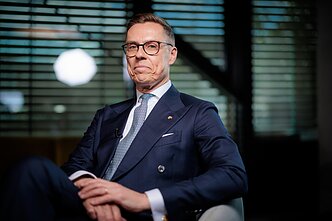
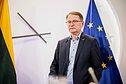
Lithuania appointed Linas Linkevičius as its first Ambassador to NATO in 1997, three years after President Algirdas Brazauskas wrote to the then NATO Secretary General Manfred Worner to formally request the country’s admission to the alliance.
According to Linkevičius, who later served as a minister for defence as well as foreign affairs, Lithuania’s path to NATO membership was not simple. For some, it even seemed hopeless.
“We chose that path quite a long time ago, and there was a consensus among all political forces since 1994, when President Brazauskas made his official appeal,” Linkevičius told LRT.lt.
“But many people were quite sceptical because the country had just emerged from occupation, had virtually no military, and was only starting to build one. With such ambitions, joining NATO seemed unrealistic to many,” he added.
In his words, even some of the future allies openly doubted Lithuania’s chances of joining NATO.
“When we asked to be considered for membership, our future allies said to my face: "You will never be a member of NATO.” They said that they have to look at the interests, at the map, that Lithuania’s struggle for freedom was impressive, but they have to be realistic,” Linkevičius said.

Nevertheless, consistent efforts were made by Lithuania to prove that it was worth becoming a NATO member. The Baltic state was one of the first to join the Alliance’s Partnership for Peace and establish its mission to NATO.
“We used the cooperation mechanisms and were very active in introducing the Membership Action Plan, as well as in implementing it,” Linkevičius said.
Turning point
According to Linkevičius, Lithuania was determined to join NATO despite all difficulties, and the turning point that changed the allies’ thinking took place after the September 11 attacks in the US.
“After the threat and the activation of NATO Article 5 by the US, for the first time in history, there was a realisation of the need for a global coalition, regardless of the size of the countries,” the former ambassador to NATO said.
“There was a certain turning point in thinking. First of all in the US,” he added.

Linkevičius pointed out that George W Bush’s administration at the time took the decision to defend the Baltic states if necessary.
“In 2002, when [President Bush] was in Vilnius, he said that whoever chooses Lithuania as his enemy will be an enemy of the US. This was not poetry but a well debated and very serious decision to defend the Baltic states,” he said.
President Bush’s speech in Vilnius turned on the green light for Lithuania to join NATO, as it changed the opinion of even the biggest sceptics in Western Europe, according to Linkevičius.
Growing importance
Lithuania’s position in NATO has only strengthened over 18 years of membership, said Margarita Šešelgytė, head of the Institute of International Relations and Political Science of Vilnius University.

According to her, the strengthened position was due to the situation in the region and the fact that Lithuania has taken serious steps, such as allocating more than 2 percent of its GDP to defence.
She also stressed that NATO has three main functions – collective defence, peacekeeping, and partnerships – the importance of which has changed over the years.
“After the Cold War, the priorities shifted slightly towards partnerships and then more towards peacekeeping operations. After the 2014 Ukraine crisis and the occupation of Crimea, NATO started returning to its original mission of collective defence,” Šešelgytė said.

“That’s why we got Enhanced Forward Presence battalions, while security in the region has been strengthened,” she added.
According to her, Lithuania was also an active participant in military operations even before 2014, and the country’s efforts were directed toward strengthening relations with the US.
“By gaining experience in missions, we have established ourselves as a good fighting nation. We had forces, especially our Special Operations Forces, which were appreciated, and so the relationship with the US improved and our weight in NATO grew,” Šešelgytė said.

Newsletter
Every Friday morning.