














Amid war in Ukraine, some Lithuanian MPs were arguing that it is not the time to discuss same-sex partnership laws which they claim is divisive. However, the parliament has voted to include the bill into the spring session.
A group of activists with rainbow flags could be seen in the Lithuanian parliament on Tuesday when MPs were voting on which bills it would debate in the coming months.
While response to the war in Ukraine will doubtlessly dominate the spring session, another important bill on the agenda is civil partnership allowing same-sex couples to register as partners. The law has been a key campaign issue for the liberal Freedom Party, which is part of the conservative-led ruling coalition, but has been stalled by scepticism among parts of the opposition as well as some conservatives.
On Tuesday, MP Agnė Širinskienė, member of the opposition Faction of Regions, submitted a proposal to cross out the bill from the parliamentary agenda.
“We need exceptional unity and avoiding divisions in our state. And, as we know, the civil partnership law and other proposals by the Freedom Party are dividing and antagonizing the Lithuanian society,” argued Širinskienė.

MP Dainius Gaižauskas, member of the biggest opposition faction of the Farmers and Greens Union, commented that the liberals were trying use the cover of war in order to push through “malicious” bills.
However, the opposition is far from united on the issue. MP Gintautas Paluckas, leader of the Social Democratic Party group, argued that the parliament has a duty to discuss and vote on all issues important for the country.
“The partnership issue is urgent for part of the society. Once the bill is on the table, we will then be able to decide what to do with it,” Paluckas said, while MP Lukas Savickas, of the Democratic Group For Lithuania, argued that it was high time to move the issue “from social networks and street rallies” to the parliament.
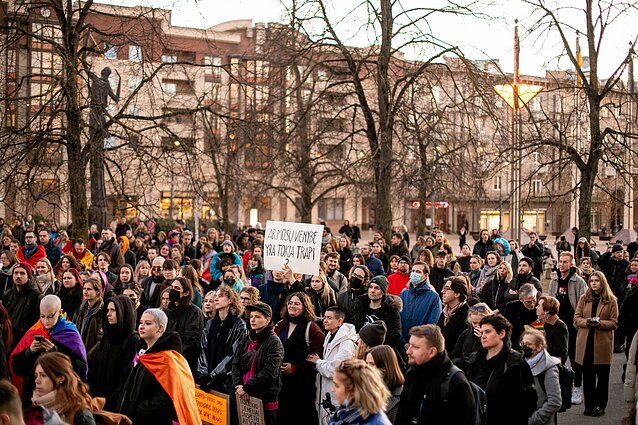
Liberals in the ruling coalition argue that Russia’s aggression in Ukraine makes issues like same-sex civil partnership more urgent rather than less, since social conservatism and opposition to human rights are tools deployed by leaders like Vladimir Putin.
“I have said many times that our approach to human rights is what makes us, Lithuania, a full-fledged member of the Western democratic family,” said Viktorija Čmilytė-Nielsen, speaker of the parliament and leader of the Liberal Movement.
In the end, the parliament voted 62-48 to reject Širinskienė’s proposal and keep the civil partnership bill on the agenda.
MPs are expected to vote on the bill before July.
Lithuania remains one of few EU countries not to recognize same-sex couples. The country does not recognize civil partnership – either among same-sex or opposite-sex couples – while the Lithuanian constitution defines marriage as exclusively between a man and a woman.

Newsletter
Every Friday morning.