






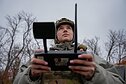



Last weekend, several dozen civilians gathered on Lithuania’s border with Belarus to patrol and look for irregular migrants crossing into the country. The initiative has raised questions due to the participants’ alleged ties with fringe political actors.
“We cannot let the illegal migrants enter Lithuania and get involved in consideration of asylum applications,” Laurynas Juozas Liutkus, one of the organisers of the civilian border patrol, wrote on Facebook.
According to Liutkus, the border guards “welcome our assistance”.
“The police have police supporters; the military has the Riflemen's Union. So, we try to be unofficial supporters of the border guards,” Liutkus told LRT.lt.
In his words, the initiative is not only aimed at stopping the movement of migrants but also at monitoring other irregularities at the border, such as suspicious vehicles and possible smuggling.

“If we notice a movement of migrants, we pass the information on to the border guards. But we don’t intervene ourselves, we’re not there,” Liutkus said.
He denied any connection to the far right. But Vitalijus Balkus, a former political associate of Algirdas Paleckis, convicted of spying for Russia, was noticed among the civilian patrols. In a comment sent to LRT.lt, Balkus said he had no longer had connections with Paleckis.
“Balkus is an independent journalist, a YouTuber. He came as a journalist. But he plays no role in the initiative, its coordination, or organisation,” Liutkus said.
According to him, the initiative is not linked to any political forces.
“These are civic-minded, patriotic individuals who wish to contribute to the defence of their country and its borders,” Liutkus said.

One-time patrol
According to organisers, the patrol initiative is ongoing, and everyone who has large vehicles is welcome to join it. But the Lithuanian Border Guard Service (VSAT) said the civilian action was a one-off occurrence.
“Now, the situation is radically different, and it is difficult to talk about extending [the initiative],” VSAT’s spokesman Giedrius Mišutis told LRT.lt, referring to the state of emergency that was declared in Lithuania’s border region with Belarus on Wednesday.
Under the state of emergency, the movement of vehicles without the permission of the border guards is restricted in the border area. Civilians, except for the local residents, are also banned from entering the border area, stretching five kilometres inland.
According to Mišutis, the civilian patrol initiative cannot be condemned because it shows that “people care and want to help”.
“This initiative is legal and does not interfere with the border guards’ work,” he said, adding that the patrol did not lead to any additional detentions of migrants.

No accountability
According to Ieva Jusionytė, an anthropologist researching power relations on countries’ borders, there are significant risks associated with civilian patrol initiatives.
“Citizens organise patrols because they perceive a threat and think that the state institutions are not strong enough to deal with it,” Jusionytė said. “Their threat perception is largely influenced by rumours, social media, and politicians, rather than by direct experience.”
According to the anthropologist, such unofficial patrols “could lead to illegal actions, even lynching” that the society might never find out about.
Civilians are also not allowed to ask for people’s documents, so patrols might form opinions about those they meet based on their looks.
“This will inevitably lead to racial and ethnic discrimination and profiling. Even Lithuanian citizens who belong to national or racial minorities could become their victims,” Jusionytė said.
In the United States, such groups work along the border with Mexico and "usually attract men, who may not always have experience in the military and often subscribe to far-right and openly racist views," she added.
"In Lithuania, the situation is similar. The alleged threat posed by migrants against the state motivates their mobilisation," she said. "It is very likely that they will receive support from some politicians, leading to the fostering of nationalism."

Newsletter
Every Friday morning.