












Most contemporary skyscrapers that dominate the skyline of Vilnius are located near the Neris River waterfront. The very first ‘skyscraper’, however, was built over a century ago during the Tsarist era, writes Artūras Savko for the Neakivaizdinis Vilnius magazine.
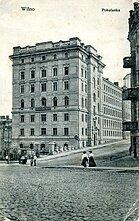
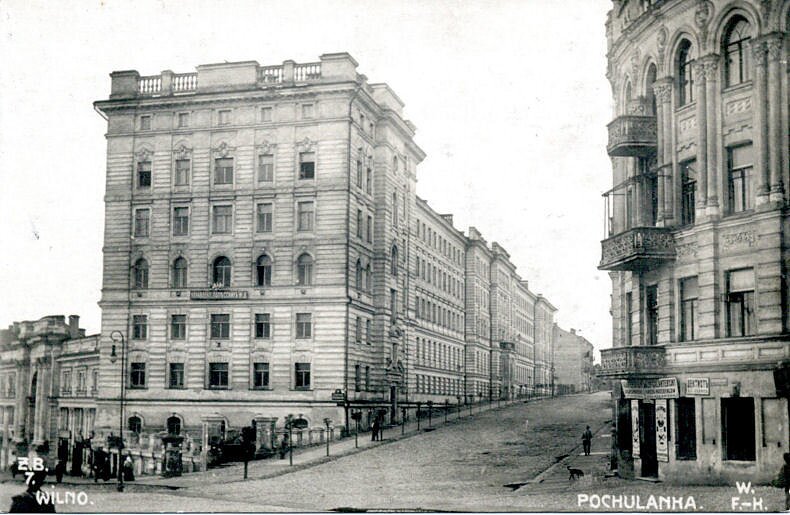
A huge building in the neoclassicist and neo-baroque styles is located atop the street named after the Lithuanian National Revival activist Jonas Basanavičius.
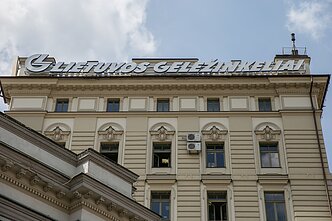
On its roof, a giant sign used to proclaim until very recently that the building accommodates the Lithuanian Railways headquarters. While the railway workers are due to move out, the fate of the city's first 'skyscraper” remains uncertain.
Until the 19th century, the western part of Vilnius had remained poorly urbanised, mostly featuring slums and grazing areas.
But everything changed in just two decades. Between 1890 and 1897 alone, as many as 400 large apartment buildings were built in Vilnius. The Pohulianka area that enclosed the current Jonas Basanavičius street was one of the most rapidly developed parts of the city.
In 1923, Vladislav Zahorski published a Vilnius guidebook, where he called the street “one of the most impressive and beautiful streets in the city”.

According to him, there were several high-rise brick houses on the street. The largest compound was built in 1903 and belonged to the Polesė (region between Western Belarus and Western Ukraine) Railway Board.
The giant building was drawn up by Tadeusz Maria Rostworowski. The design of a smaller building and an ornate gate, forming an ensemble with the main construction, belonged to Konstantin Koroyedov. Both architects were active figures in the city’s development – together they designed around one-tenth of new buildings constructed in that period.
Rostworowski’s work was characterised by refined, pompous architecture in academic historicist style, reminiscent of buildings in major Russian, German, French, and Austro-Hungarian cities. Not surprisingly, the architect studied in St Petersburg, Krakow, Munich, and Paris. Koroyedov also designed ornate historicist buildings rich in tasteful decorations.

Height race
The construction of buildings more than four storeys high was rare until the mid-19th century. It is only with the invention of safe elevators (in 1852), their connection to electricity (after 1880), and the use of steel and reinforced concrete in construction that cities began to build in height.
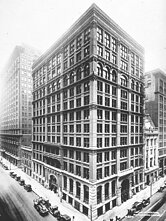
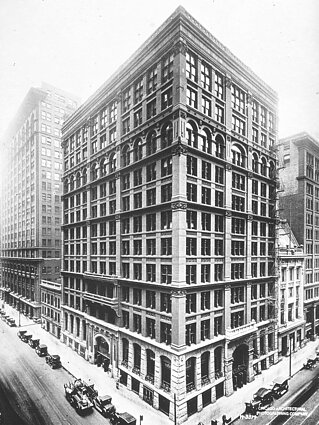
The world’s first skyscraper was built in Chicago in 1885 – the ten-storey building was 42-metre-tall.
The seven-storey headquarters of Polesė Railway Board was 36-metres-tall and was considered to be the first skyscraper in Vilnius. It remained the tallest building in the city for half a century.
It wasn't until the 1950s that the Scientists’ House, designed by the Italian architect G Rippa-Anjoleto, surpassed the Railway building.
Polesė Railway Board headquarters also featured one of the first elevators in Vilnius, which could carry up to four people or 320 kilogrammes.
The office even had a telephone. At a time when there were only around 150 telephone users across Vilnius, Polesė Railway Board had two numbers – 28 and 62.
Although the building marked a new stage in Vilnius’ development, some residents were not satisfied with how it looked.
Before, the city’s skyline had been dominated by countless church towers, while the tallest secular building was Vilnius University.
Read more: Abortive utopias in Vilnius: from Soviet palaces to metro and marina
Some critics had a hard time coming to terms with the changes in the hierarchy of buildings and desacralisation of the cityscape. Art historian Mikalojus Vorobjovas in his book The Art of Vilnius wrote that “a huge monster of the Railway Board entered the city landscape with dissonance”.
But the building could have been even taller, as it was initially designed to reach 65 metres. If built, the structure would have been the tallest skyscraper in Europe. The final version of the building also featured less intricate decorations than initially planned.
Archival information about why the building of Polesė Railways Board was simplified has not been found yet.

Newsletter
Every Friday morning.