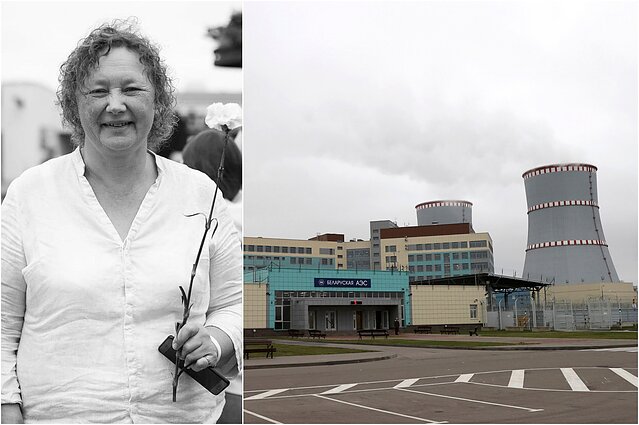














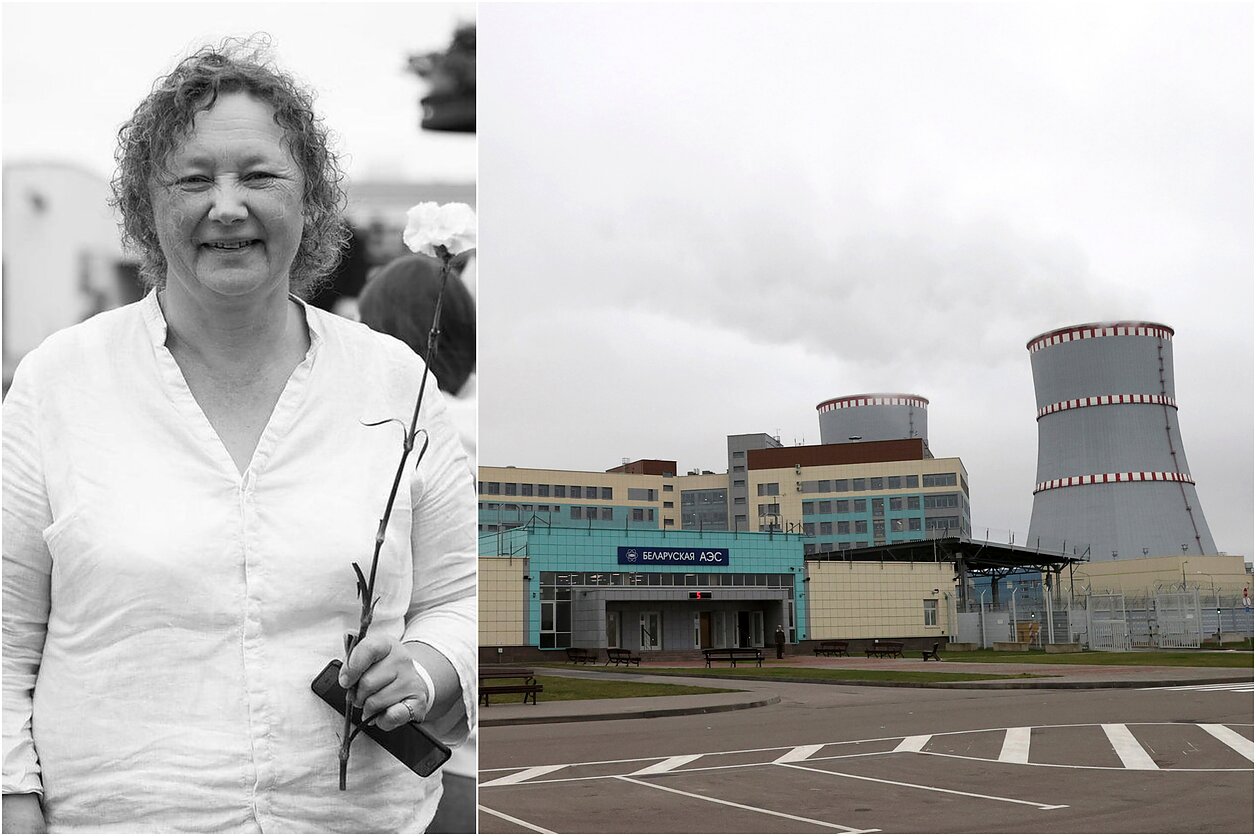
Belarusian environmental activist Irina Sukhi has spent five days in prisons for protesting against Astravyets nuclear power plant. According to her, ecology is not a priority in Belarus right now, but the ongoing protests give hope that society could unite on this issue as well.
Sukhi, who works at a prominent Belarusian NGO Ekodom (Ecohome), told LRT RADIO that environmental activists also suffer because of the growing tensions in Belarus.
“Women environmentalists have always been visible. [The government] is now looking for women’s march organisers, so they decided to go through all active women's organisations,” she explained.
“They do not understand that this movement is horizontal – it does not have a single leader. They are looking for a non-existent black cat in a black room,” she added.
The Belarusian regime has already arrested most of the female activists, Sukhi said. She has also spent five days in the infamous Okrestina detention centre in Minsk.
Read more: Nuclear quagmire facing the Baltics. Severing the last Soviet ties

The activist was arrested after one of the women’s marches, where she carried a poster against Astravyets NPP. According to Sukhi, her arrest was “planned” because she was detained after the protest that served only as a “formal pretext”.
But the international community of environment activists immediately reacted and wrote letters demanding Sukhi's release.
“The support was stunning,” the activist said. “I think it was because of the international attention that I was released after five days and not more. Such attention and support for our quest for freedom and democracy is very important to the Belarusian people.”

'They do as they see fit'
Astravyets NPP was officially opened on November 7. Belarus then said that the first reactor should be fully operational by early 2021, and the second one a year later.
Belarusian environmentalists are worried that the project has reached an irreversible stage.
“We are very sad and confused seeing how things are going. We doubt that everything has been done right to assure safe operation of the plant,” Sukhi said.
“It seems to me that the nuclear plant could be launched only after obtaining the operation license. But they do it as they see fit,” she added.
The organisation analysed the project and demanded compliance with national and international environmental legislation.
Read more: Belarus’ radiation monitoring goes dark after alleged incident
“We asked to at least postpone the launch of the power plant due to the unstable political situation, the crisis in the country, and the pandemic,” the activist said. “Energy demand is not growing, and there is no need for additional capacity. The nuclear facility is only needed to threaten the West.”
According to Sukhi, the Astravyets NPP project is not profitable and only serves as a political tool.
“We are not economists, but based on publicly available data, we tried to calculate economic benefits of the nuclear plant. We concluded that not launching it and paying back the Russian loan would be the best option,” Sukhi said.
“[With Astravyets NPP], the cost of electricity will rise, and the production capacity in other power plants will be reduced. The cost of electricity from gas is much lower. But this is a political project that is moving forward despite all the arguments against it,” she added.
Read more: ‘Secrecy’at Belarus nuclear plant a danger to Lithuania – intelligence
Lithuanian politicians slow to get involved
On November 3, Belarus started producing electricity at Astravyets NPP. On November 8, however, the facility stopped operating because of an incident. Belarus did not make it public and Lithuania found out about it only three days later.
According to Sukhi, Belarusians also want more transparency regarding the new nuclear facility.
“The official channels say that everything is alright and that there have not been any incidents or problems. Unfortunately, we do not have any reliable information either,” the activist explained.
“There is a lot of anxiety about this secrecy. If something happens [in Astravyets NPP], it will be like in Chernobyl and the local people, as well as Lithuanian people, will suffer,” she added.
According to Sukhi, Lithuanian radiation sensors at the border with Belarus are the only hope that the disaster could be avoided.
Meanwhile, Jan Haverkamp, an expert at Greenpeace and Nuclear Transparency Watch, told LRT RADIO that Astravyets NPP is his “difficult child”.

Read more: Rosatom on Lithuania's doorstep: a Russian Trojan horse?
“The Belarusian regulator, which had to oversee the [Astravyets NPP] construction, did not have the necessary experience and had to ask for outside help. That help came from a Russian regulator, which is completely dependent on Rosatom,” Haverkamp explained.
He noted that Hungary, Turkey, and Bangladesh are constructing similar power plants. Another one is planned in Finland, but it is subject to much stricter requirements.
“In Finland, construction should have started a long time ago, but regulators keep returning the project for improvement,” said Haverkamp. “Most of the questions asked about the construction of a similar power plant in Finland have not been raised in Belarus.”
He added that in Belarus, the nuclear regulator lacks independence from the government, which could lead to negligence.
“The construction process in Astravyets was sped up […]. I am afraid we cannot talk about the Belarusian power plant that is compliant with all standards,” Haverkamp said.
He also regretted that Lithuanian public figures who won the fight against the country's Visaginas NPP in 2012, have not been actively involved in the opposition against Astravyets.
“Belarusian organisations were very active in Astravyets NPP’s planning procedures. Some of them were arrested when they tried to hand in a petition with reasonable questions. But Lithuania’s involvement in international procedures was lacking. It would have helped the neighbours and strengthened their positions,” said Haverkamp.
The interviews for the story were conducted in late 2020.

Newsletter
Every Friday morning.