













Moscow has been criticising Lithuania for prosecuting people accused of spying for Russia, aiming to portray the ongoing investigations as a witch hunt. Several demonstrations have popped up outside of the Lithuanian embassies.
Russian media accuse Lithuania of persecuting human rights activists who are allegedly supported by citizens from at least 10 European countries. In Lithuania, so-called activists are accused of espionage.
Accusations against Lithuania
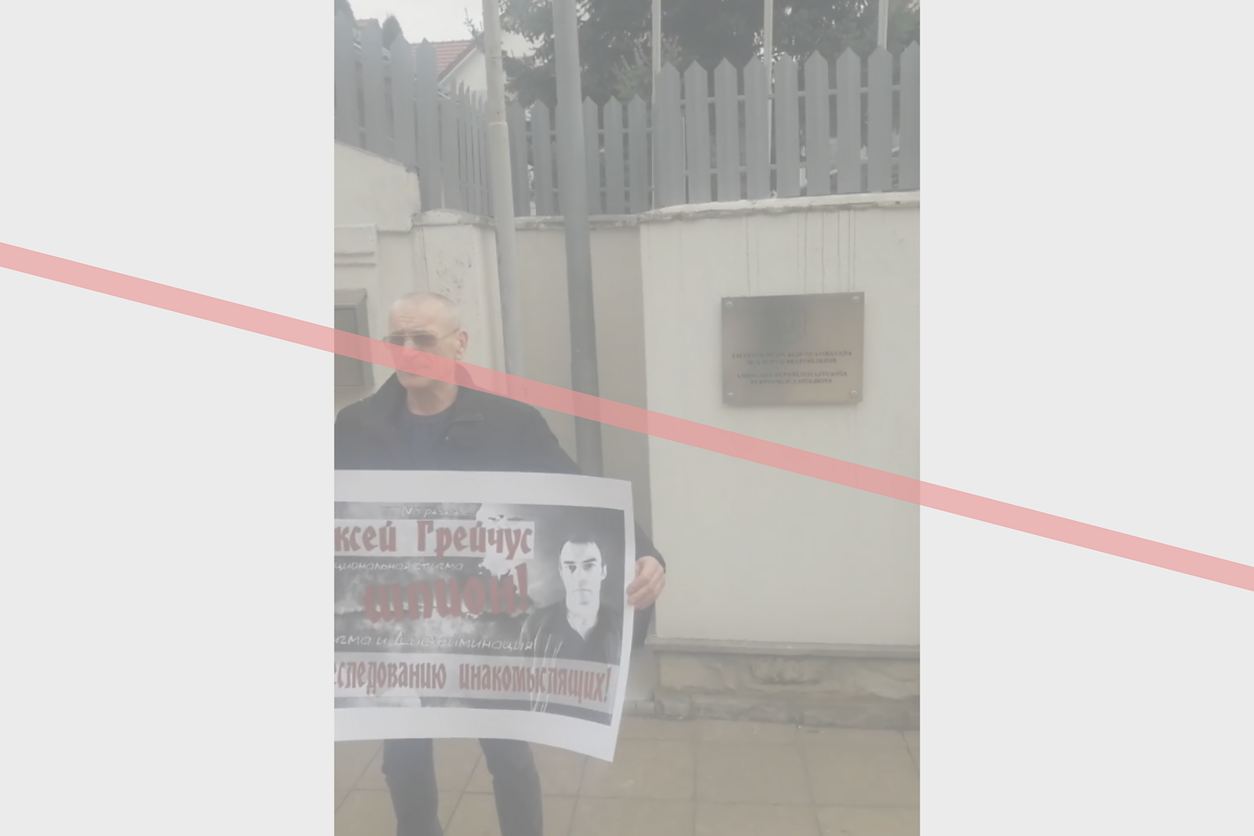
According to several Russian news websites, demonstrations have recently taken place in front of the Lithuanian embassies in countries ranging from Belgium to Azerbaijan.
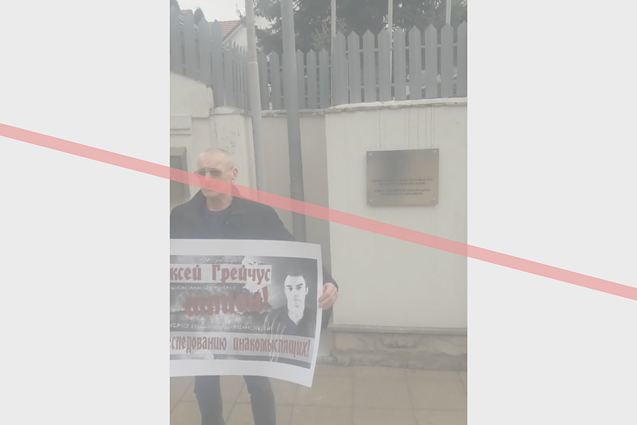
In one instance, two men stood in front of the Lithuanian embassy in Moldova’s capital Chisinau, holding signs “Aleksej Greičius is not a spy” and “stop the witch-hunt”. One of them explains in Russian that they are protesting against the arrest of their anti-fascist colleague Aleksej Greičius, claiming he was detained only because he was an activist in Lithuania.
The trail of spying cases
In some media publications Greičius is mentioned as an organiser of cultural events in Lithuania. All of them are exclusively related to the Second World War.
Six years ago, he also ran unsuccessfully in the elections to the Klaipėda Municipal Council. His colleague was controversial pro-Russian politician Viačeslavas Titovas who lost his seat in the municipality council after the court found him guilty of defaming a leader of the Lithuanian anti-Soviet resistance.
Greičius, whose case for espionage is currently pending, was allegedly recruited by a Russian intelligence officer in Kaliningrad. During their meeting, Greičius allegedly received money to organise the events and agreed to hand over the footage and pictures of the participants. Despite warnings from Lithuanian intelligence officers that he is communicating with Russia's FSB agent, he continued his activities.
Read more: Lithuanian court to start hearing another case of spying for Russia

The supposedly non-governmental, cultural organizations are one of the Kremlin's policies to keep its influence in the other countries. The International Anti-Fascist Front is one of the most prominent organisations, which was established by Algirdas Paleckis, a Lithuanian citizen and a former politician who is also on trial for espionage.
“If we look at the demonstrations [organised in front of Lithuanian embassies] Russia is clearly involved. Whether directly or not is another question,” said Balys Liubinavičius, senior analyst at disinformation research initiative Debunk EU.
According to Liubinavičius, the majority of Russian support is directed towards organisations, such as World Without Nazism and Russian World, active in the post-Soviet countries.
“These demonstrations [in front of the embassies], whether it's about expressing support for the arrested people or an outcry about high profile cases of espionage, all of them have the same pattern,” he said.
The repeated demonstrators are aiming to create an image of Lithuania as a country where human rights are violated and people are persecuted for their political views, said Viktoras Denisenko, a researcher of propaganda at Vilnius University.
“In a way, such efforts instil a message in the public sphere of different countries, framing Lithuania as not democratic, where dissidents are persecuted and, as a result, a negative image of the country is created,” said Denisenko.
“More narratives can then emerge: Lithuania is undemocratic, but was accepted into the European Union, European values are worthless,” he added.
Read more: Lithuania plans to expand definition of spying

Pointing fingers
Lithuania and Russia are fighting an intense, yet invisible, battle within various international organisations, according to analysts.
In the Council of Europe, the Organization for Security and Cooperation in Europe, and even in the European Parliament, Russia has accused Lithuania, Latvia and Estonia of repressions against human rights advocates, minorities, and journalists.
However, the so-called human rights advocates have been found to work in organisations that are linked to the Russian government, while the allegedly persecuted journalists report for propoganda outlets, such as Sputnik.
“Russia chooses this narrative because human rights is a universal language widely used in international organisations. The promoted stories [...] help catch attention in the international institutions,” Liubinavičius says.
This is a common approach used by both Russia and China, which is also often accused of human rights abuses. “They point the finger at others and say: why freedom of speech is not protected in your own countries,” he added.
Currently, the Russian Foreign Ministry is publishing reports on alleged human rights violations in European countries and the United States. Moscow, for example, criticises Washington for military action in other countries, the death penalty, the prison system and police work.

In Lithuania, Russia has most actively targeted the January 13 case, where 67 Belarusian, Russian, and Ukrainian nationals were sentenced for war crimes and crimes against humanity during the Soviet crackdown in Vilnius in 1991.
Russia claims the case is politically fabricated and the link between the Soviet army and the killing of civilians has not been proven.
“[These actions] fall into the grand narrative, which we can describe as if the bad state of Lithuania is persecuting Russian speakers and other minorities. Every attempt to limit or respond to such misinformation is portrayed as an attack on freedom of expression.” Denisenko said.
How should Lithuania react?
Yet, it's difficult to estimate the impact of Moscow’s campaigns. Russia's complaints about Lithuania are ignored by the international media and decision makers.
“They [Russia] cannot prove their arguments in front of the Western audience, because it requires them to follow legal principles and legal language. People are not prosecuted because of their nationality, but Russia ignores it,” Liubinavičius said.
In the Russian media, people accused of spying for Russia in Lithuania are presented as persecuted public figures and human rights activists. According to the analysts interviewed by LRT.lt, Russian politicians are merely trying to influence Western audiences and international organisations.

Newsletter
Every Friday morning.