










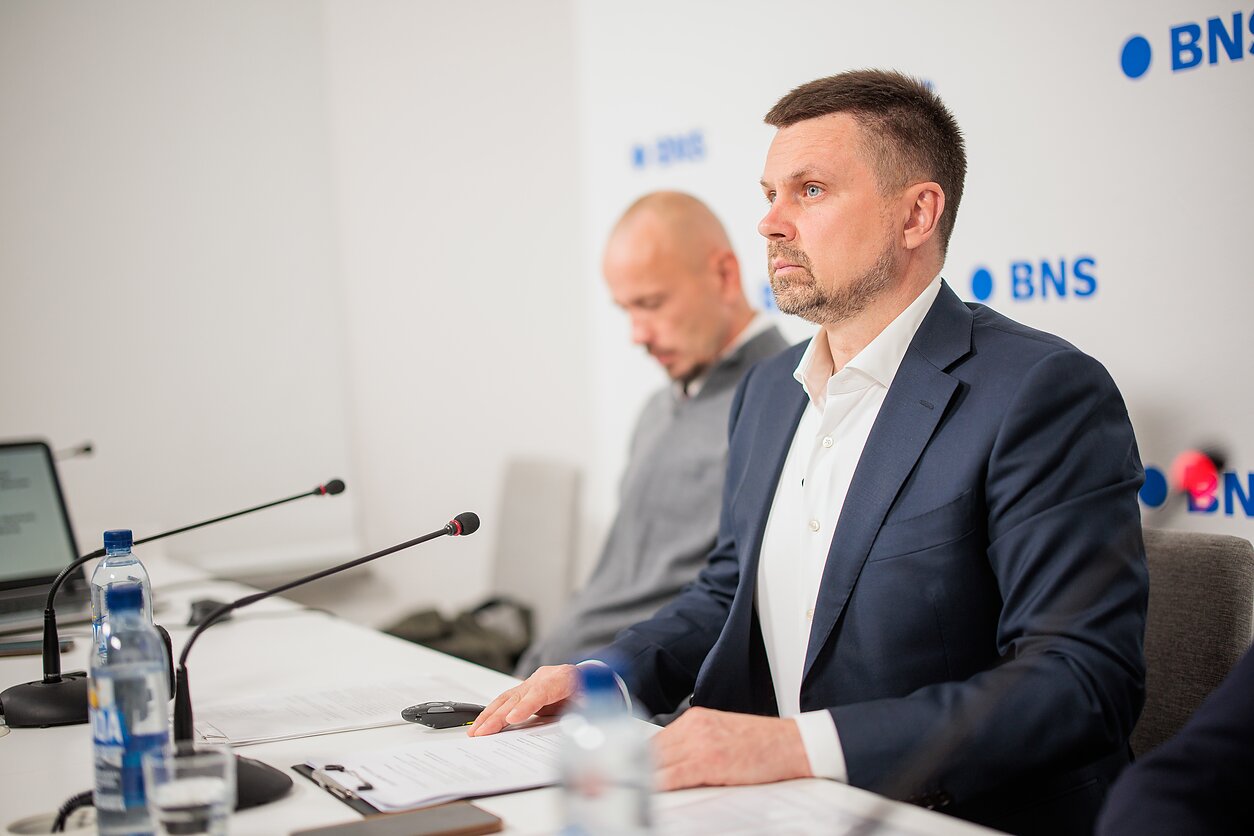
A Belarusian businessman living in Lithuania, Dmitry Skinderev, claims the Migration Department is planning to revoke his refugee status because of his criticism of Sviatlana Tsikhanouskaya and her inner circle. But his colourful past paints a different picture.
Skinderev is a controversial figure: he threatened an adviser to opposition leader Sviatlana Tsikhanouskaya in Vilnius, while videos in which he criticises the Belarusian opposition regularly appear on Belarusian propaganda programmes.
The businessman, who says he had “no interest in politics” until the mass protests in 2020, was also sentenced to prison in Belarus for extortion.
After realising that “the rule of law was weakening in the country”, he said he joined a civic movement in 2020 and later ended up in Lithuania.
However, the independent Belarusian outlet Nasha Niva reports that Skinderev did not participate in the protests following the disputed election results. In addition, in spring 2020, he posted a strange video address on his YouTube channel in which he claimed that unknown individuals had offered him the chance to overthrow the regime.
“I was offered the chance to organise an armed coup, to organise a Maidan here, as happened in Ukraine. […] I am not a representative of the opposition, I am not a politician,” Skinderev said.
In the same video, he said he had reported the incident to Belarusian law-enforcement authorities and included a photograph taken outside an office at a police station.
“I believe elections and a change of government should take place democratically. I simply want the rights of businesspeople to be protected,” he continued.
According to Nasha Niva, by 2020, Skinderev was deeply in debt, owing about €160,000. This coincided with the beginning of his more active online presence.
‘Extortion as part of an organised group’
At the beginning of the 2010s, Skinderev ended up in a Belarusian prison, where he spent two years.
Nasha Niva reports that Skinderev was convicted of “extortion as part of an organised group, or causing serious consequences, or on a large scale”, according to information from BelPol, an association of former Belarusian security officials who joined the opposition.
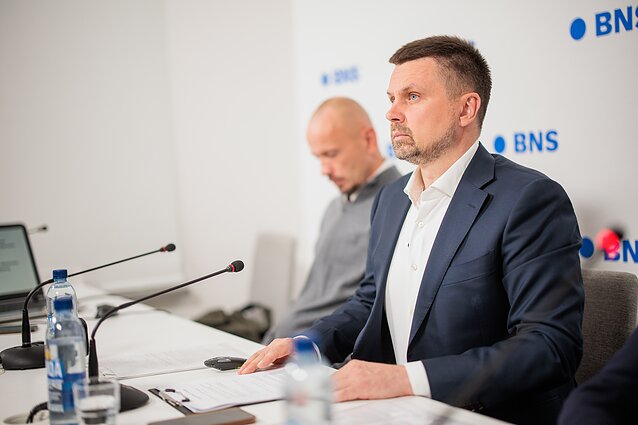
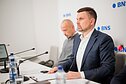
Asked about this at a news conference, the Belarusian became irritated.
“I was slandered. I disagree with this and never expected that I could be imprisoned for something I did not do. My goal is, if we manage to change the regime in Belarus, to review my [2002] criminal case,” Skinderev said.
Asylum not yet revoked
Skinderev says he came to Lithuania with a valid visa. According to him, after he applied for a residence permit, he was immediately summoned to Lithuania’s State Security Department (VSD) because he was wanted by Interpol.
“I was on Interpol’s wanted list, but I did not know about it. Because of the criminal case, the KGB wanted to bring me back,” Skinderev said.
Asked by LRT.lt which specific case had led to him being wanted, the Belarusian replied: “For bribing an official.” He immediately clarified, however, that the case had been fabricated, as Belarusian special services often brought economic charges in order to seek the extradition of political opponents.
Such a practice did exist. For example, presidential election candidate Viktar Babaryka was imprisoned after being accused of money laundering and taking bribes.
At the time of publication, Skinderev’s name did not appear in Interpol’s wanted persons database. He says that 12 criminal cases have been opened against him in Belarus.
His lawyer, Mikhail Parchimovich, said the Migration Department’s notification stated that Skinderev posed a threat to Lithuania’s national security.
According to him, the document did not specify the grounds for that claim.
Information on whether a person poses a threat to national security is collected by the Lithuanian State Security Department (VSD) and passed on to the Migration Department. In a comment provided to LRT.lt, the VSD said it had acted on the basis of the Intelligence Law and the principle of confidentiality.
The VSD also said that the decision in the case would be taken by the Migration Department.
“When a decision is made, the foreign national will be able to assess it and, if dissatisfied, appeal to the courts,” the department told BNS in a comment.
Harassing opposition member
Skinderev is convinced that the procedure to revoke his asylum is linked to his criticism of Sviatlana Tsikhanouskaya and her inner circle. Judging by the news conference he organised earlier in July, this is the issue to which he devotes most attention.
The businessman says he came to Lithuania at Tsikhanouskaya’s invitation to work with her team, but became disappointed.
Now, he openly criticises her office, focusing primarily on what he claims was the non-transparent distribution of $380m provided by the EU and the US to support Belarus’s democratic forces. He has provided no evidence for this claim.
Meanwhile, this winter a video circulated in the Belarusian media showing an aggressive man approaching Tsikhanouskaya’s adviser Dzianis Kuchynski at a cafe in Vilnius and beginning to insult him. It later emerged that the man was Skinderev.
When Kuchynski asked Skinderev to leave, the businessman shouted: “I’ll hit you in the head!” Skinderev himself does not consider those words a threat.
Organising provocations with Lithuanian MEP Gražulis
Another incident took place on the day a group of released Belarusian political prisoners was brought to Lithuania. An asylum centre was set up for them in Vilnius, with Kuchynski coordinating its activities.
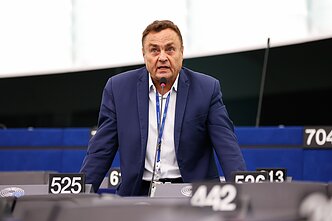
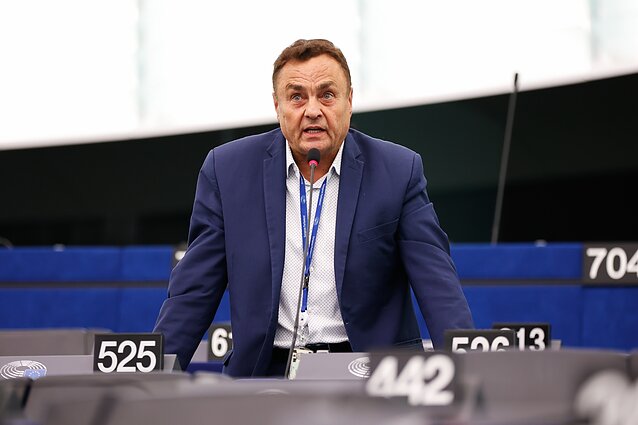
That day, Skinderev again tried to provoke a conflict. This time, he was accompanied by European Parliament member Petras Gražulis.
“They came with Gražulis to the asylum centre, supposedly wanting to meet the released political prisoners. But a provocation against me and everyone present began immediately. As soon as they saw the police, they left. Of course, they neither met nor wanted to meet any political prisoners,” Kuchynski recalls.
Skinderev was also with Gražulis during the first incident at the cafe near the Seimas. Asked about the nature of their relationship, Skinderev again gave an evasive answer.
“I was in contact not only with Gražulis but also with many other Lithuanian politicians. I was always looking for an answer to the question: how do you fight a dictatorial regime?” he said.
Sanctions on potash fertiliser?
Gražulis is interested in the Belarus issue and opposes Lithuania’s approach to Minsk. In the spring, when John Coale, Donald Trump’s special envoy for Belarus, visited Vilnius, the MEP organised a meeting with the US official. Seimas members Ignas Vėgėlė and Rimas Jankūnas also took part.
Gražulis told LRT.lt at the time that the meeting discussed the possibility of dialogue between Lithuania and Belarus, given that Belarusian authorities had blocked Lithuanian lorries from crossing the border back to Lithuania.
At the time, the Lithuanian government rejected any dialogue, despite signals from Minsk. According to Gražulis, the meeting’s participants presented Coale with a position “different from the official one”.
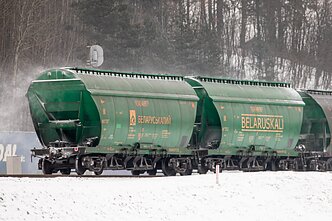
The issue of sanctions on the transit of Belarusian potash fertiliser was also discussed. In Gražulis’s view, Lithuania was losing while Russia was benefiting from the restrictions.

In March, the US lifted sanctions on Belarusian potash producer Belaruskali, and in May it proposed that Lithuania, Poland, and Ukraine consider allowing Belarusian fertiliser to transit their territories.
Skinderev also knew about the upcoming meeting with Coale.
“I was in contact with Gražulis and knew that such a meeting would take place. Of course, I asked for the political prisoners to be released,” the businessman said.
Asked about his position on the transit of potash fertiliser and whether he had discussed the issue with Gražulis, Skinderev incorrectly claimed that the sanctions had only been introduced after Russia launched its full-scale invasion of Ukraine.
“I’m probably not yet enough of a politician to decide on lifting sanctions. I came here so that they would be tightened. That is the first thing. The second thing is that I would remind you that Lithuania imposed sanctions on potash fertiliser not because of what happened in Belarus in 2020, but only after the war in Ukraine began,” Skinderev said.
The ban on transporting Belarusian potash fertiliser through Lithuania came into force on 1 February 2022 – one month before Russia’s full-scale invasion began.
The decision was made in response to US sanctions imposed on Belaruskali on August 9, 2021, over human rights violations, the suppression of protests and the forced landing of a Ryanair flight on May 23, 2021.
Debt and business problems in Lithuania
In Lithuania, Skinderev founded Bovaja, a company involved in delivering cars and machinery from Europe to Lithuania, Belarus and other CIS countries.
Nasha Niva reported that the company was struggling, operating at a loss and owing money to creditors.
He denied the report: “Of course I have no debts. If I had debts, I would be helped by a lawyer specialising in economic issues.”
However, this isn’t true. According to data from Rekvizitai.lt last year, it owed creditors €354,000.
Meanwhile, Kuchynski denies that Skinderev came to Lithuania at Tsikhanouskaya’s invitation.
“When the office was being established in Vilnius, he tried to get in, but there was never any official cooperation between us. When we were forming the team – speaking specifically about Skinderev – we did not know him and, of course, not everyone you meet can simply come and work with you,” Kuchynski said.
According to Tsikhanouskaya’s adviser, he first saw Skinderev on the day of the incident at the cafe.
Kuchynski did not report the threats to the police or any other institution and therefore doubts the claim that the procedure to revoke Skinderev’s asylum is connected to his criticism of the office and personal attacks against him.
Skinderev says that if a decision is made to revoke his refugee status, he will challenge it in court. “I certainly do not intend to return home with my head held high,” he said.

Newsletter
Every Friday morning.