







Last week, Vilnius Mayor Valdas Benkunskas announced that he is opposed to the construction of a new mosque in the capital. A representative of the Muslim community described the mayor’s remarks as “interesting” and pointed to their ambiguity: how can Muslims who have arrived in Lithuania be encouraged to learn Lithuanian if the mayor of Vilnius signals they are not welcome?
Photos recently circulated on social media showed Muslims living in Vilnius gathering for prayers at the Perkūnas football arena in the Pašilaičiai district. This has reignited debate not only about migration but also about what Lithuania should provide to foreigners who choose to settle in the country.
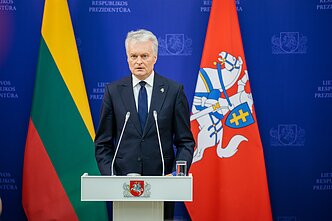
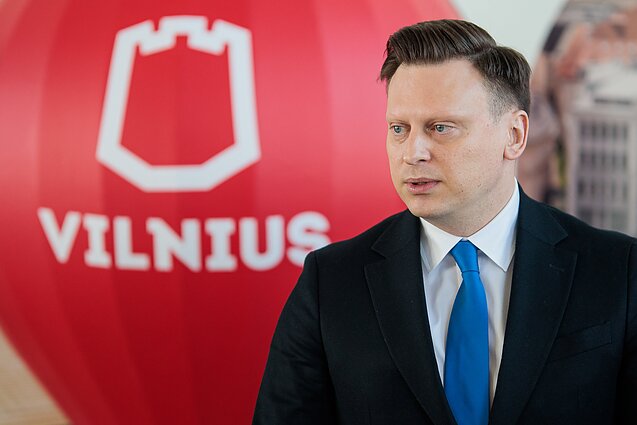
Speaking last week on the Lrytas.lt programme, the mayor said he sees no need to discuss building a new mosque in Vilnius. According to Benkunskas, such a project would send a signal to migrants to settle specifically in the capital.
“The construction of houses of worship, mosques, is a signal for families to reunite, to arrive as entire families with many children and even multiple wives, and to establish themselves in Vilnius.
“Such signals, at this moment, would be misguided – not denying the religion itself or the right to come to Lithuania, but clearly outlining how we envision our future here in Lithuania and in Vilnius,” he said.
He reiterated his position in a social media post on Monday, emphasising that he opposes the construction of a new mosque in the capital.
“I stand by my view: migration policy priorities need to be set differently. First, the Interior Ministry should establish stricter requirements for individuals who wish to live in the country long-term to learn the state language. At present, this issue is more important than discussing the construction of a new mosque,” Benkunskas wrote.
He also noted that data from the Migration Department show that thousands of foreigners from predominantly Muslim countries live in Lithuania on temporary permits, while only hundreds seek permanent residency.
“It would seem illogical to build a mosque for temporary residents of Vilnius, wouldn’t it? Freedom of religion in Lithuania and Vilnius certainly exists and will continue to exist. There are already mosques in Lithuania and around Vilnius. In my view, migration policy should prioritise solving real problems and tightening controls, rather than building new facilities,” the mayor stressed.
Lithuania currently has four functioning mosques: in Kaunas, in Raižiai in southern Lithuania, and two in the Vilnius District – Nemėžis and the village of Keturiasdešimt Totorių.
Discussions about building a new mosque in Vilnius have been ongoing for over three decades, with various locations under consideration. However, no concrete decisions or construction permits have been issued to date.
Calling it unnecessary is absurd
Representatives of the Muslim community have criticised the mayor’s stance. Paulius Bergaudas, chairman of the Islamic Centre and a doctoral researcher in Middle Eastern studies at the University of Cambridge, described the mayor’s remarks on Lrytas.lt as “interesting”.
“Perhaps in his imagination, a mosque is equivalent to a free apartment block or even a hotel, such that its construction would somehow magically attract immigrant families with children.
“The comment about multiple wives is simply anecdotal. It seems to invoke stereotypes, as if Muslim immigrants working here had several wives in their home countries, when in reality such cases likely do not exist at all,” Bergaudas said.
He added that the mayor’s remarks raise questions about whether Muslims are even expected to remain in Lithuania long term. Family reunification, he noted, is a natural part of long-term residence – suggesting the mayor may be implying that Muslims should not seek to stay.
“If that is the case, how can they be motivated to integrate and learn Lithuanian if they are told they are not welcome here for the long term? Short-term residence and integration are difficult to reconcile,” he said.
According to Bergaudas, the two Islamic centers currently operating in Vilnius can accommodate up to 800 worshippers at a time, while recent prayers at the sports arena drew between 3,000 and 4,000 people.
“Both centres are overcrowded during Friday prayers. This is uncomfortable not only for Muslims but also for local residents, as these facilities were not designed for such flows of visitors. It leads to frequent conflicts over parking and general inconvenience for neighbours, which is entirely understandable.
“If a mosque were built with its own grounds and parking, the primary beneficiaries would be Vilnius residents currently affected by the sudden increase in visitors near these centres. The mayor can debate what kind of mosque should be built and who should build it, but to say it is unnecessary is absurd,” he said.
Bergaudas added that most Muslim immigrants are satisfied with life in Lithuania. Many, he said, are hardworking individuals who resemble Lithuanian emigrants in terms of demographics following the country’s accession to the European Union.
“These people are often burdened with work and try to send as much money as possible to their families abroad. Under such conditions, even with the best intentions, learning a new language and fully integrating into the local culture is not always easy. Those who are willing to do so – and there are many – will be replaced after a few years if they are not given the opportunity to stay long term.

“In this way, Muslim immigrants will integrate very slowly. I am somewhat concerned that this will later be used as ‘proof’ that Muslims do not integrate, even though that would not reflect reality.
“Over the past decade, the Muslim community has grown significantly – at least tenfold – and given Lithuania’s demographic trends, it is likely to continue growing. I hope that priorities will be set correctly and that integration will not be made even more difficult,” Bergaudas told LRT.
Aleksandras Beganskas, head of the country’s Muslim religious communities, also told LRT RADIO that a mosque is needed in Vilnius. He stressed that there is currently no mosque within the city itself.
“In Vilnius, there are only prayer houses and prayer rooms. There is a misconception in public discourse that there is a mosque in Vilnius – there is not. This issue has been raised since 1994. As the Sunni Muslim community of Vilnius, it is written in our statutes that we seek the construction or restoration of a mosque in the city,” he said.
Tatar Community: ‘Enough mosques’
Meanwhile, Motiejus Jakubauskas, chairman of the Union of Lithuanian Tatar Communities, told LRT RADIO that Lithuania already has enough mosques, and that there are alternative ways to accommodate Muslim worship.
“There are certainly enough mosques across Lithuania – they are practically empty, with no one to pray in them. I’m not sure it would be purposeful, especially at this time, to build another mosque. Muslims can pray anywhere, not necessarily only in houses of worship.
“I work in a school, and we have set up a prayer room so that Muslim students can pray freely without facing bullying. We were probably the first to do this in a school, and I believe it is a meaningful solution,” he said.
He also stressed the need to distinguish between different Muslim communities in Lithuania, namely the historic Lithuanian Tatar community and more recent arrivals.
Member of Parliament Dalia Asanavičiūtė-Gružauskienė, who supports the mayor’s position, noted on social media that the Union of Lithuanian Tatar Communities was established in 1996 and remains active.
Two years later, in 1998, the Sunni Muslim Spiritual Centre – the Muftiate – was founded. According to the MP, both organisations represent a continuation of interwar-era institutions established by the Tatar community.
“It was this muftiate that oversaw the four historic mosques in Raižiai, Nemėžis, Keturiasdešimt Totorių village, and Kaunas. However, in 2019, a second muftiate – the Council of Muslim Religious Communities of Lithuania – was established,” she said.
It is this latter body that is headed by Beganskas, who maintains that a new mosque in Vilnius is necessary.

Newsletter
Every Friday morning.