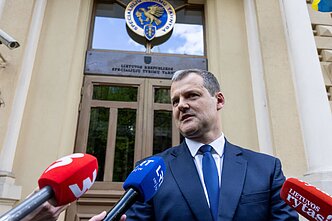










The Vilnius City District Court on Thursday fined Erika Švenčionienė 3,750 euros for denying crimes committed by the Soviet Union.
She was convicted over public statements questioning the official account of the July 31, 1991, attack on the Medininkai border checkpoint, in which seven Lithuanian officers were killed and one was seriously wounded.
In a Facebook post that led to the case, Švenčionienė wrote that the “Medininkai tragedy is a dark consequence of the actions of the Lithuanian special services,” adding that “many facts pointed to the killers being from among their own” and claiming that “the truth is hidden, witnesses fall silent”.
Prosecutor Šarūnas Šimonis had asked the court in January to impose a one-year-and-six-month restriction of liberty with intensive supervision through electronic monitoring. He also requested that Švenčionienė be required to reside in Kaunas or Prienai District, remain at home between 22:00 and 06:00, delete her Facebook post, register with the Employment Service or find work, pay 1,000 euros into a victims fund and be barred from visiting the Medininkai memorial.
The court instead imposed a fine.
Ahead of the verdict, Švenčionienė called on supporters via social media to attend the hearing. Only a few people appeared, including Kazimieras Juraitis, who is on trial with her in a separate case for allegedly aiding another state in actions against Lithuania, and pro-Russian activist Laurynas Ragelskis, who is awaiting a verdict on charges of inciting hatred against a group of people and desecrating a site of public respect.
Linguistics expert Gintarė Herasimenkienė testified during the proceedings that Švenčionienė’s statements reflected “narratives typical of hostile propaganda”.
Švenčionienė is a co-founder of the now-dissolved International Forum of Good Neighbourhood, an organisation advocating for better relations with Russia and Belarus.
She is also on trial before the Vilnius Regional Court in a separate case alongside Valery Ivanov and Juraitis, accused of aiding another state in actions against Lithuania and of publicly supporting, denying or grossly trivialising international and Soviet crimes.
Further reading

Newsletter
Every Friday morning.