








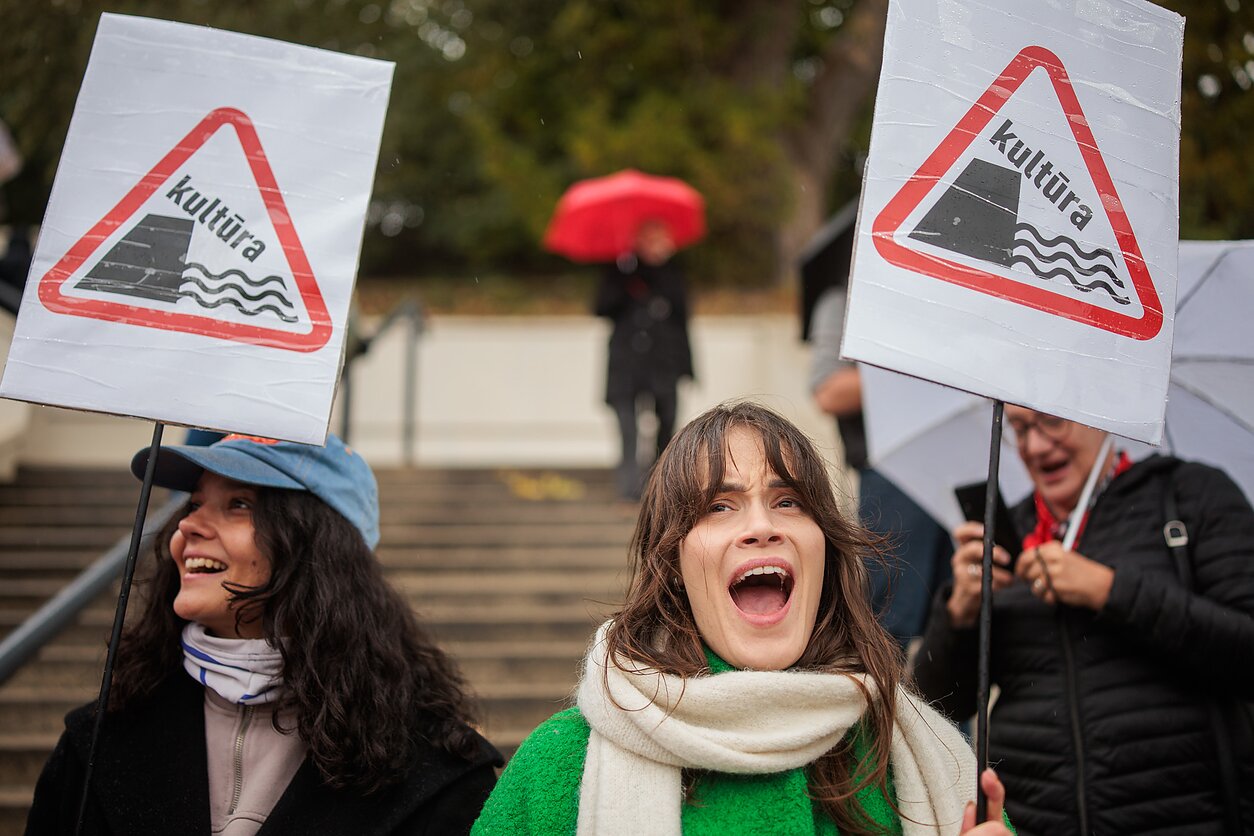
As Lithuania’s cultural sector continues protesting, there are lessons from Slovakia that they should pay close attention to, writes Vilnius University lecturer Audronė Rimkutė.
In 2025, the New York-based non-governmental organisation The Artistic Freedom Initiative (AFI) released a report on the state of the cultural sector in Slovakia following the 2023 parliamentary elections, when a coalition led by Robert Fico came to power, according to a publication prepared by The report, Early Warning: The Politicisation of Slovak Arts and Culture, was produced in cooperation with Otvorená Kultúra! (OK!), a civic initiative from Slovakia’s cultural sector.
It reviews recent changes in Slovakia’s cultural policy and the resulting erosion of artistic freedom and cultural autonomy. Robert Fico’s coalition handed control of the Ministry of Culture to the far-right Slovak National Party (SNS).
Under the leadership of Minister Martina Šimkovičová, a far-right media figure appointed by the SNS, the ministry began politicising the cultural sector. It first took control of the Slovak Audiovisual Fund (AVF) and the Slovak Arts Council (FPU), initiating legal amendments that increased the number of ministry-appointed members on these institutions’ boards and changed the process for making funding decisions.
The new rules grant boards the right to veto expert committee recommendations, allowing them to block funding for projects that do not align with the ruling party’s ideology. The amendments also abolished procedures that had ensured transparency in the appointment and dismissal of cultural institution directors.

The leadership of seven key national cultural institutions – including the Slovak National Theatre, the Slovak National Gallery, and the Slovak National Museum – has changed.
Within the Culture Ministry itself, a “personnel purge” took place, with nearly 50 percent of staff dismissed. Core analytical units, such as the Institute of Cultural Policy (IKP), were dismantled, eliminating evidence-based decision-making.
These actions by the Slovak Culture Ministry and their consequences are commented on by Robert Špoták, former chair of the Slovak Arts Council.
Robert, let’s start with the impact of the processes described in the AFI report. What were their consequences for Slovakia’s cultural sector?
The changes in national institutions caused chaos, project cancellations, staff resignations, a loss of expertise, and threats to cultural heritage [within the Monuments Board and the Slovak National Museum].
Perhaps the most critical situation is at the Slovak National Gallery: after the dismissal of director Alexandra Kusá and the appointment of four new directors within six months, around 100 employees resigned, international projects were cancelled, and the exhibition schedule disappeared. Essentially, the gallery can no longer perform its role as the country’s leading visual arts institution.
The paralysis of national institutions caused by these changes has severely limited local artists’ opportunities to create, exhibit, and, in some cases – such as through the Literature Centre – present their work abroad.
Changes in state funding bodies have resulted in the discontinuation of support for promising and well-known projects like festivals, collaborations, co-productions. After my dismissal as director of the Slovak Arts Council and the subsequent period of poor management, one-third of the staff resigned, and decision-making processes have been massively delayed.
For example, in previous years, by this time three calls for applications would already have been announced, whereas now the structure of next year’s funding programmes remains unclear, and not a single call has been published.
As far as we know, major changes to the funding structure are coming: multi-year funding – considered a major step forward compared with ministry-run programmes – will be abolished; systemic support for independent organisations and cultural centres will disappear; regional institutions will see drastic cuts in support (since regions have criticised the new leadership); and some sectors – such as digital games, cross-genre works, and even libraries – will be entirely excluded from funding.
Essentially, the traditional cultural funding system is being dismantled.

What is the most concerning aspect of the current situation?
The greatest concern is the ministry’s ability to selectively influence funding through its appointees, allowing the government to promote ideologically acceptable cultural production while financially suffocating institutions, organisations, and artists who are or might be critical.
Combined with reduced transparency, this creates the conditions for indirect censorship – harder to detect, define, and resist.
What made such changes possible in Slovakia? Why did they happen so quickly?
First and foremost, Slovakia’s cultural sector is highly dependent on state funding. We do not have a clear, effective system of private cultural financing – there is little tradition, the mechanisms are complex, and donations do not grant tax relief.
Regional and municipal funding also functions poorly – even institutions directly subordinated to regions are largely financed by the state.
Only a few regions or municipalities have their own funding programmes, and those that do are usually very limited in scope and budget. Hardly anyone makes use of international funding sources, such as European Commission programmes, as they are considered overly complicated.
As a result, independent cultural actors have very limited access to funding and often rely heavily on a single source. Once that source is removed, many projects simply cease to exist. Unfortunately, in recent years we have failed to make the cultural sector less dependent on state resources.
Another reason is that the sector is highly fragmented and lacks effective umbrella organisations. This problem became evident during the pandemic; there were attempts to unite, but these efforts quickly faded once the crisis ended. Cultural professionals in Slovakia are simply reluctant to organise.
This stems both from internal conflicts and hostility and from the legacy of the communist era, when artists were forced to join organisations (for example, a writer had to be a member of an association to publish).
This fragmentation is also linked to excessive workloads and the precarious status of cultural workers – they lack the time and energy to organise, as it often amounts to yet another unpaid job.
Only recently, in response to the latest developments, has the sector begun to unite – but this is happening under external pressure and with minimal resources. Under such conditions, cultural workers and artists who manage to organise must both strive for systemic change and respond to the ongoing developments in the sector.

Is there anything positive to be found in this situation?
In the current climate, many cultural professionals feel compelled to act, to organise, and to get involved. A sense of connection has emerged; previous internal disputes are being forgotten or at least set aside.
I see this as an opportunity to build a more resilient, conscious, united, independent, and self-governing cultural sector. The sector faces serious danger, but this could also become an opportunity for systematic cooperation, reform, and improvement. Several initiatives are countering the ongoing destruction—the largest is probably Otvorená Kultúra! (Open Culture!), which operates on multiple levels: from protests, petitions, and public statements to targeted support for artists and organisations, and even reconstruction and development planning.
Nevertheless, the outlook for the future is not very bright. Most activities this year are financed through projects approved last year, but as the planned cuts to cultural funding take effect, the coming year will be, to put it mildly, challenging.
How can the politicisation of the cultural sector be prevented? What would you recommend to other countries where similar processes are beginning?
I would recommend five things. First, organise into larger groups – professional associations, think tanks, chambers, unions. In short, create strong umbrella organisations; if you do not have them, establish them as soon as possible. Explain to artists and cultural workers why they are needed, ensure they are properly funded, and build broad networks connecting people and initiatives.
Second, defend the principles and institutions that could become targets before harmful political processes gain momentum and turn into reality. Expose their initiators and resist them – do not dismiss them as marginal.
Third, ensure that as many cultural institutions as possible are independent and led by experts. It should not be easy, for instance, to dismiss the director of a national theatre. If such mechanisms do not exist, establish independent boards to govern institutions and cooperate to make culture as autonomous as possible.
Political control should be limited to oversight of legal compliance and financial stability; all other aspects must remain separate from direct state influence.
Fourth, create and maintain strong regional and municipal cultural policies and funding.
And finally, reach out to and engage with “disconnected” audience groups – build relationships with them and take the time to explain things. Do not be deceived – we are not facing isolated acts or lone individuals; they are interconnected and learn quickly from one another. Culture is one of the first sectors targeted by anti-democratic forces, and therefore we must act.

Newsletter
Every Friday morning.