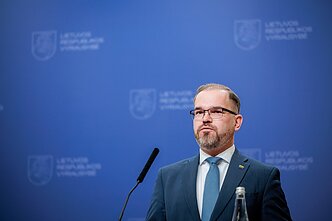
















Justice Minister Rita Tamašunienė said Tuesday that value differences remain within Lithuania’s ruling coalition over the ratification of the Istanbul Convention and the legalisation of civil partnerships.
Speaking on LRT TV’s Dienos Tema program, Tamašunienė said these issues reveal “value differences” among coalition partners but stressed efforts to implement the government’s shared program.
“There are value differences. That’s how it is in the coalition – there are partners with truly different values,” she said. “We are trying to implement the government’s program, but in some cases, we cannot betray our values. That’s why an annex was added to our coalition agreement, outlining issues where we cannot agree.”
The remarks came after Prime Minister Inga Ruginienė said during a visit to Latvia last week that she saw no obstacles to Lithuania ratifying the Istanbul Convention on preventing and combating violence against women, though she acknowledged the issue remains controversial.
Latvia’s parliament voted last Friday to withdraw from the convention, but President Edgars Rinkēvičs vetoed the bill, saying such a move would send a conflicting message to Latvian society and international partners. Lithuania, meanwhile, has yet to ratify the Council of Europe’s document adopted in 2011.
Further reading
Tamašunienė said Lithuania should focus on strengthening its existing system for preventing domestic violence.
“Lithuania already has, in my view, more laws and regulations addressing violence and protecting victims than are outlined in the convention,” she said, noting the country’s domestic violence law, arrest orders, and network of support institutions. “We need to make the system more effective so that violence in our society truly decreases.”
Lithuania signed the Istanbul Convention in 2013 but has not ratified it. In March 2023, the Constitutional Court ruled that the treaty does not conflict with the country’s Constitution.
The Istanbul Convention is a Council of Europe treaty requiring member states to adopt comprehensive measures to protect women from all forms of violence, provide victim support services, and prevent domestic abuse.

Disagreement over civil partnership
Tamašunienė also confirmed that her parliamentary faction – comprising the Farmers and Greens Union and the Christian Families Alliance – will not support a proposal to legalise gender-neutral partnership in the Civil Code.
“On this issue, we have a unified position,” she said. “That’s why our coalition agreement includes an annex specifying that, on this value issue, we cannot support the stance of the larger Social Democratic faction.”
Under the coalition deal, certain issues – including civil partnership and same-sex marriage – are listed as those on which the joint Farmers and Greens–Christian Families faction will dissent.
Tamašunienė said the proposed amendments to the Civil Code, which would define partnership as a family relationship between two people regardless of gender, would effectively equate it with marriage.

“This will again spark debates in the Seimas,” she said. “Such value-based discussions should take place in parliament, where members elected by the people can express the nation’s position.”
The Justice Ministry does not plan to submit a partnership bill itself, but groups of lawmakers may do so.
According to the proposed amendments registered Tuesday, partnership would be a legally recognised agreement between two adults based on mutual responsibility, understanding, and commitment. The proposal does not include adoption rights.
The initiative is backed by Social Democrats Laurynas Šedvydis, Ruslanas Baranovas, Birutė Vėsaitė, Modesta Petrauskaitė, Julius Sabatauskas, and Algirdas Sysas; Liberal Movement members Simonas Gentvilas, Viktorija Čmilytė-Nielsen, and Simonas Kairys; and Conservatives Arūnas Valinskas and Matas Maldeikis.
In April, the Constitutional Court ruled that parliament violated the constitution by failing for 24 years to adopt a law regulating partnership, as required by the Civil Code. The court also stated that partnership must include both opposite- and same-sex couples.
Several attempts to pass a gender-neutral partnership law have failed in past parliaments.

Newsletter
Every Friday morning.