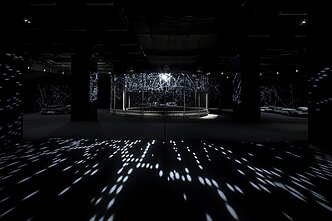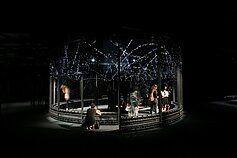















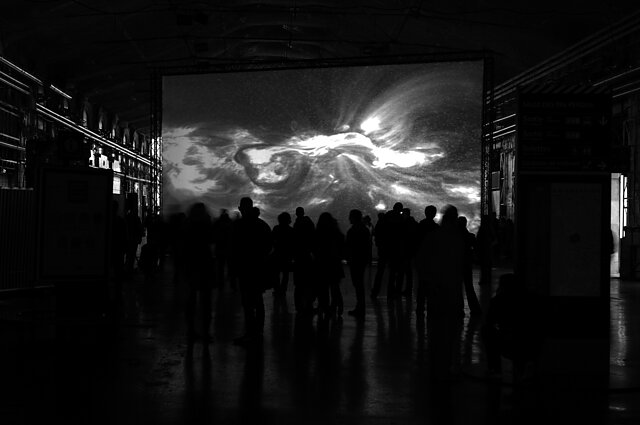
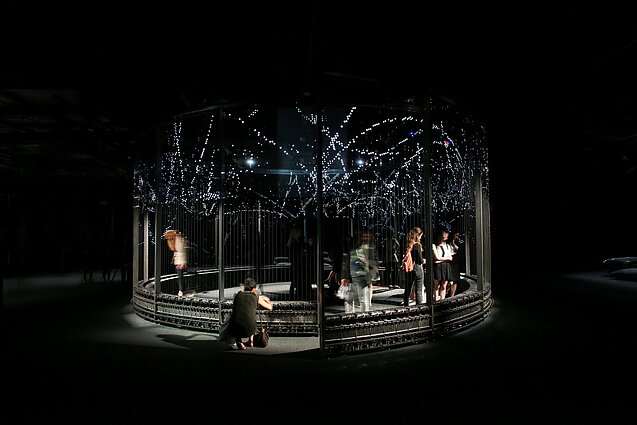
The duo of interdisciplinary artists Joe Gerhardt and Ruth Jarman, known as Semiconductor, have been skillfully merging art and science for 25 years. Their work, which spans some of the world’s most prestigious science laboratories, is currently featured at the National M. K. Čiurlionis Museum of Art in the exhibition titled From Amber to the Stars. Together with M. K. Čiurlionis: Now and Then.
In an interview by Justė Litinskaitė of the M. K. Čiurlionis Museum of Art, the artists discuss the unexpected intersections between art and science and the beauty found in raw scientific data.
Could you start by telling me a little about yourselves? You’ve been collaborating for 25 years now. How did it all begin?
Joe Gerhardt: We met while studying fine art at the University of Brighton. We started to produce music and sound at the beginning as a collaboration, as a kind of performance, and that’s where we formed the name Semiconductor. For us, the computer, the Semiconductor, was the kind of the third part of our group. We played with the idea of us conducting the computer and the computer conducting us. We were fighting the aesthetic and language of the digital. It was all a brave new world back then.
Since then, we’ve been investigating not just the material nature of the digital world but also asking the same questions of the natural world, and how we understand and create a language of the fundamental make-up of the natural world. So, we look at how we experience the material nature of the physical world and how science informs us and changes how we perceive things. In a way, it’s a kind of questioning of how we model nature and reality in response to our place in it. We see ourselves as natural philosophers in the way that scientists existed before they were called scientists.
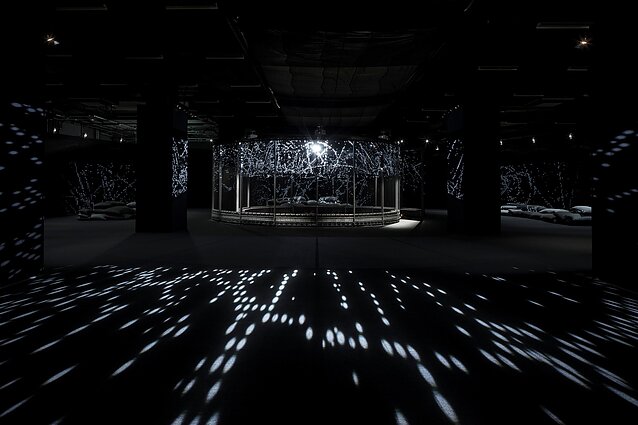
You are recognized for your ability to re-contextualize raw scientific data related to earthquakes, volcanic activity, and climate patterns and turn it into captivating videos, sculptures, or immersive visual and sound installations. How do you look for data? Does it all start with the data or with an idea? Could you walk me through your research process?
Ruth Jarman: The first time we worked with raw data was probably with Brilliant Noise (2006), the work we’re showing at the exhibition “From Amber to the Stars”. We came across that data because we were doing a fellowship at the Space Sciences Laboratory at UC Berkeley in California. We were artists in residence in this science lab for six months. And it’s where we laid the foundations, which would then inform how we always went into science labs and our research process. We knew what we were interested in, but broadly, we didn’t know the exact science they were doing there. And so, we went in very naive, which is something we always try to replicate now because we realise it’s a very useful place to be. So, we would spend a lot of time walking around the science lab. We can’t really call it interviewing the scientists, but we were having conversations and absorbing a lot of scientific information as a process of doing that. We remained very open to the tools, languages, and processes they used as space scientists.
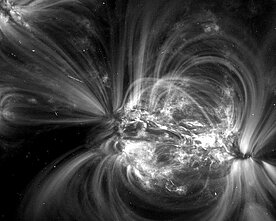
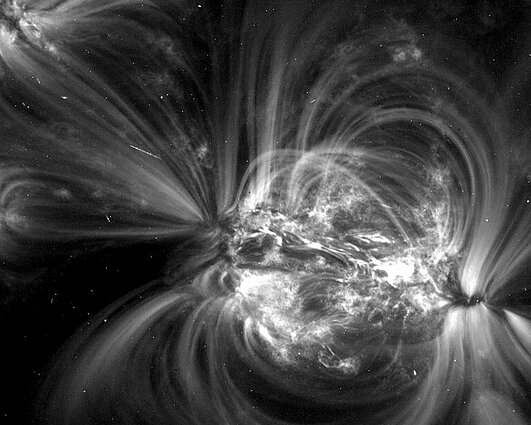
We’re always interested in an element of the unfamiliar and the unknown. We’re interested in exploring, as Joe was saying, how we experience the world through the languages of science and technology. Once, we saw an image in one of the scientist’s cubicles, which was really unfamiliar. It was a black-and-white photograph of the sun, as it turned out, but it wasn’t obvious on first viewing because, at that point, those images weren’t readily available. NASA would normally colorize these images, process them, and remove all the noise before making the images public. But when we first saw this raw image, it told us so much about the capturing process. Its materiality made us find more of a connection than the glossy NASA-processed images would. So, we talked to the scientists about this and went on to make Brilliant Noise by collecting hundreds and thousands of these images.
We worked closely with several scientists who taught us how to access the solar databases. What partially drew us towards these images was the noise in the image, this raw quality which reflected the errors in the capturing technology. Maybe we weren’t even calling it raw data at that point. But when we went into other labs, we would go looking for that, and we knew that there was always an effort because, in science, there’s a way that they want to present their language and they want to tell the story of their science. So, we have to work quite hard with the scientists, which requires us to spend time in laboratories because we have to go beyond just the science stories they present to the public. Not all scientists can necessarily understand why that’s interesting, but we go through this journey with them, and then perhaps they will come out the other side and see why it’s interesting.
Joe Gerhardt: The raw data has more information than the cleaned-up, scientifically useful version that the scientists are interested in. And by having in the noise of the raw data, it tells you stories about other things. And it’s also more aesthetically interesting because our brains don’t immediately have a single narrative. I mean, it’s a different type of interesting. In that way, we can be more consumed by the beauty of nature, the sublime, than through the cleaned-up narrative of the scientific product.
Ruth Jarman: Yes. It’s closer to how we experience the world. Our brain is constantly cleaning up the world around us, whether it’s what we hear or see. We live in a very noisy world, so when you’re presented with a very clean image, it’s slightly dissonant. You can’t really engage with it.
You frequently collaborate with scientists and scientific institutions, such as the NASA Space and Science Laboratory in Berkeley, California; CERN in Geneva; and the Charles Darwin Research Station in the Galapagos, to mention a few. Do scientists eagerly accept you as a collaborator?
Ruth Jarman: Many residencies have come about through our interest in specific labs and finding a way to connect with them. For example, CERN has an arts program called Arts at CERN, which facilitates artists’ access to the laboratory through an application process. We’ve done many residencies, each of which has been amazing. One was at the Smithsonian Museum of Natural History in the Mineral Sciences Laboratory Department in Washington, DC. The Smithsonian offers an Artist Research Fellowship, which allows you to select a department within the institution to work with. However, you first apply to the arts division, and once they approve, you contact the department you’d like to work with. The art division might say, “Yes, this sounds great; we’d love you to do it; contact the lab.” So, we contacted the lab and sent them the same proposal we’d used for the art division, but they responded by saying they didn’t understand what we wanted to do. It was a fascinating clash of cultures. So, we explained that we wanted to be in the lab every day, observing and poking our noses, to which they agreed. We enjoy these contradictions, that clash of cultures. Going into a lab is always uncomfortable because we don’t have the same knowledge they do, but over time, we’ve learned to embrace that discomfort, recognizing it as an important part of the process.
Considering that your work is heavily based on scientific data, does a viewer need specific knowledge to fully appreciate your works?
Joe Gerhardt: We hope that people can appreciate the work for its natural qualities and that it’s engaging just as it is. But that then leads you to ask questions about what is happening. So, you don’t need information to read it initially, but you want to learn more afterwards.
Ruth Jarman: We’re working within the realm of the unknown, which might be an unknown for the viewer, and it might be imagery you’re familiar with. We’re interested in that boundary between knowing and unknowing and how that leads you to question what you’re seeing and makes you think about perceiving in some ways.
So, it’s quite important for us. In the past, we’ve worked with curators, and sometimes, we’d make videos about larger-scale works that describe the process of making the work as background because our work is quite research-heavy, so it’s quite nice to pull those things together. Sometimes curators say, “Oh yeah, we’ll have this before you see the work.” No, no, no, no, you can’t. You can’t see it before you read the work. That’s gonna ruin things.
Could you tell me though a little more about the Brilliant Noise?
Joe Gerhardt: During our residency at the Space Sciences Laboratory at UC Berkeley in California, the scientists showed us the online databases, which we wouldn’t have known otherwise, and taught us how to define search algorithms to access the data. We kept collecting and trying to keep the data as close to its raw form as possible. After a few months of exploring these early internet databases, which was quite a novel concept then, we created a significant collection. NASA has always been great about making its data available to the public.
Ruth Jarman: While the data is online and probably easier to access now, you still wouldn’t have been able to navigate it without a scientist’s help. There were seven archives in total, a mix of ground-based and satellite data. Some came from observatories on Earth, while the rest came from satellites observing the Sun in space, each using different wavelengths of light. These different wavelengths make the Sun appear to have different qualities in all these black-and-white images. The cameras collected data at specific wavelengths, taking pictures of the Sun roughly every five minutes. We had to download each image individually, extracting it from a packet of information, and then we brought them together as a time-lapse footage.
Joe Gerhardt: We also define how you see the image as well. Because it has more data than the human eye needs and reads.
Ruth Jarman: When we talk about having more information in an image, we mean that while you can see the Sun and its activity, there’s also a lot of noise or artifacts in the image. Some of those are through the capturing process, such as too much or too little light, which causes visual anomalies. In Brilliant Noise, you can see tiny points of light, which are actually cosmic rays—high-energy particles traveling through everything, including us. They leave tiny white spots as they pass through the camera’s CCD. The name Brilliant Noise reflects this, celebrating the noise in the image. Brilliant also means brightness, you know. So, we were playing around these notions.
An interesting story from our residency: we visited various NASA facilities, including the Goddard Space Flight Center, where we met a team working with solar data. A few people we spoke to were responsible for writing algorithms to clean up the data. At first, they were excited to help us access their archives, but we didn't hear from them again when they found out we wanted to work with the raw data. We were removing their job a bit.
At the end of the residency, we had created a version of Brilliant Noise along with other projects. We had to give a talk to the lab, which was terrifying. It felt like we were holding up their science to them, and it was weird. It was 20 years ago when we were younger and still learning. The lab had never worked with artists before, so it was all experimental. Their response was incredible, though. Usually, they work on short clips describing something like a solar event, spending years analyzing it. Nobody had brought everything together before like we did, and we learned a lot from their feedback.
In the UK, there is a saying about taking coal to Newcastle, which means bringing something to a place where it is already plentiful, as a lot of coal comes from Newcastle. We often feel like we’re doing that when we present our work in a lab, only to be surprised when the scientists see it as something unfamiliar. The scientist with whom we’ve been working recently told us, you make us see what we do. It’s a subtle shift, but they felt like we were celebrating their work, helping them step back and see it in a new light. We learned a lot from creating that work, being in those uncomfortable situations, and showing scientists those things.
In many of your works, sound plays a crucial role alongside visuals. Brilliant Noise is an excellent example of that.
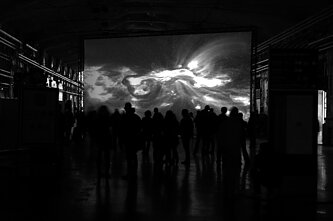
Joe Gerhardt: Yeah, well, sometimes in our work, the sound generates the image, and sometimes the image generates the sound. So, for Brilliant Noise, we used the brightness and the luminescence of the image to control and generate the soundtrack. The scientists are getting the information they need from looking at the brightness of what happens on the sun’s surface. We decided to use that by sampling the luminance to control sound, noise, and frequency waves. So, it makes it feel like you are seeing and feeling what you’re looking at. Sound can have a more physical response and just makes it bring you into what’s happening more.
Ruth Jarman: You can listen to the sun through radio waves by tuning in, but what you hear is white noise. We used this white noise as our foundation, but we realised it wasn't interesting enough on its own. So, we wanted to start with the sound of solar radio and build upon it, transforming it into what we called the “symphony of the sun,” which adds more visceral quality to the experience.
Joe Gerhardt: That’s how the noise of the cosmic rays becomes a noise in the soundtrack.
Do you have any expectations of what the viewer must experience while experiencing Brilliant Noise, which is very abstract?
Ruth Jarman: I think there’s a certain space we seek in our work where you don’t need to fully understand what you’re experiencing. You get a sense of nature intertwined with artifacts and noise, along with the formatting that gives off a feeling of technology and structure. This combination evokes a sense of nature and humankind’s signature. So, it lends itself to being this very humbling experience. You get this sense of physical scale. Often, people describe it as feeling quite humbling. Much of our work aims to place humankind in a broader context or question our position in the universe. So, much of our work can be very humbling because it removes us from being the center of everything. Which a lot of cultures try to avoid.
You are recognized for employing a different technological method with every project, whether video works, sculptures, or large-scale immersive installations like Halo. How do you navigate the technical challenges that arise from this?
Ruth Jarman: It’s annoying every time. [laughs]
Joe Gerhardt: It would be easy if it wasn’t. The area we’re researching will inform the direction the work should take. So, by trying to be truthful to the data, reaching it, in turn, is being truthful to nature of some form. It can be synthetic nature or whatever, but whatever it is, we try to let that shape the direction of the work. It will then define what mediums we work in and what software is best to hold and shape the data.
Ruth Jarman: We just thought that the research got us to the endpoint and got us to make the artwork. But now we realise that research is a thing in itself almost because we are interested in the raw data; we’re interested in going back to the very fundamentals of science and matter. We always have to work quite hard to get back to that bit. Then, we want to understand that bit, work with it, and process it. So that requires research for us to do. But we also really love doing the research. We love working with new technology and figuring out the parameters of that technology and how you can take it somewhere new, push it and shape it. So yeah, we’re interested in those things.
I find it fascinating that your work will be exhibited alongside that of Čiurlionis. Like you, Čiurlionis had a deep interest in science, nature, and the cosmos. However, he had to rely almost entirely on his imagination and the limited scientific and astronomical knowledge available at the time—a perspective that may seem incredibly restricted to us today. In contrast, you can access exquisite scientific data professionals collect worldwide. Yet, your artworks remain highly imaginative. How do you see the role of imagination in your art, especially with the wealth of scientific information available today?
Joe Gerhardt: Sometimes, we let our imaginations take control of our work. However, it is often most satisfying when we find a place in the middle where, by stripping away what we’re supposed to know from the data set, we can find shapes and forms that enable us to feel, understand, and respond in new ways. When we engage in more generative creativity, it’s important to pull ourselves back and find why we’re doing it. For us, it’s finding the balance between the two.
Ruth Jarman: Yeah, it’s a really good description. We work with speculative ideas, but we don’t engage in a visually imaginative process. It may be our perspective, but others might see it differently.
Joe Gerhardt: A lot of times we’re trying to reflect the theoretical aspects of scientific work, which is often very creative and imaginative, but scientists don’t want it to appear like it is. They want to show that their work is based in reality, although some of it is complete madness. Take the multiverse theory, for example; it’s just madness, yet many scientists believe it’s a fact, while others think they’re mad.
Ruth Jarman: Yeah, we’re often working within their framework, and that’s something we’re trying to explore. We must acknowledge that we bring something to that, and there are obvious choices that we’re making about it.
Joe Gerhardt: Yeah, I mean, that is something that scientists often look at us enviously because we can take their area of interest and play with it like its clay, and they wish they had that freedom.
Were you familiar with Čiurlionis’ work before this exhibition?
Ruth Jarman: Kathleen Soriano had done an exhibition of Čiurlionis work in London at the Dulwich Picture Gallery. His work blew us away. We felt a connection to it. As we did more research, we discovered even more of his paintings and the subject matter; we realized there were so many crossovers in our interests.
What’s your relationship with nature? Do you ever go stargazing?
Ruth Jarman: Yes. We were in our back garden last night with our telescope. We have a 13-year-old daughter, and she loves being outside now. So yeah, we spend as much time outside as we can. And we love hiking. We love being outside in nature as much as possible.
The exhibition “From Amber to the Stars. Together with M. K. Čiurlionis: Now and Then” will be held at the M. K. Čiurlionis National Museum of Art, located at V. Putvinskio Street 55 in Kaunas. It will be open from March 21 to October 12 of this year.