











Eighteen-year-old school-leaver Agnė Židelevičiūtė has spent five of the past twelve months volunteering in Ukraine. She is convinced that even the smallest contribution can save lives.
When war broke out in Ukraine in 2014, Židelevičiūtė was just eight years old. At the time, she had many Ukrainian friends, many of them have since died.
“I remember how they shared so many stories about what they had been through, what they had experienced. My family – and I’m very grateful to them – showed me that the world is not a safe bubble. [...] My family would talk about our own history, Lithuania’s history, what we’ve gone through. And there was this moment [when I realised], that when I grow up, I’d want to go and volunteer,” Židelevičiūtė recalls.
When Russia launched its full-scale invasion of Ukraine, Židelevičiūtė says she had never been more certain that she would go to Ukraine. She just needed to wait until she turned 18.
“There’s that moment when you sit down and think – either you fulfil your dream and then never regret it because you’ve done something you’ve been burning to do for ten years, or you get scared and take a step back. I’m really glad I went through with it, and I’ll always be grateful to my parents,” she says.

In the summer of 2024, Agnė spent two months in Ukraine, returning for another three months over winter. She says she felt the meaning of her presence the moment she arrived.
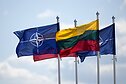
“I remember the first time I entered the centre of Ternopil and saw the flags hanging there. It was a very emotional moment, seeing people who, even in war, were trying to find joy in the moment,” Židelevičiūtė recalls.
On her very first day in hospital, Agnė was involved in medical work and got hands-on experience alongside doctors.
“I’m really happy the doctors and nurses included me in everything. They didn’t look at me and think, ‘Oh, just some young girl who’s come here – what could she possibly do?’ [...] I’m very glad they trained me, because this work was totally different from what I’d done at Kaunas Clinics, where I had also volunteered. In Ukraine, we went much deeper into the work – into the heart of volunteering,” says Židelevičiūtė, who worked in Ternopil, Kyiv and Kharkiv.
At the time, Ternopil had not yet been heavily affected by the war – unlike Kharkiv, where battles were ongoing.
“I’m grateful that it all went the way it did – that we didn’t get hurt. I remember telling people [...] and they were all worried because I was going alone, with no team, no backup. I was heading alone into a region that was deeply affected and very dangerous. I’m just happy everything went smoothly and nothing bad happened,” she says.
Her trips to Ukraine were entirely her own initiative – she is not affiliated with any volunteer organisation. She says she never expected to get so closely involved in medical work.
“In my first week in Ternopil, the doctors trained me on how I could help. I volunteered in the surgery, intensive care and emergency departments. I learned how to dress wounds, assist in surgeries, help with patient transfers in intensive care. In the emergency unit, I helped receive patients coming from the front lines. Ternopil Hospital acts as a short stop-off point between regions. Very often, patients come from elsewhere for just a week or two,” she says.
Židelevičiūtė says she knew she could be useful – but never expected to play such a direct role in helping people injured by war. She was also prepared for the emotional toll.
“I’ve been interested in psychology since I was little, and I know I couldn’t treat it like a holiday. I had to prepare – physically, emotionally, and in other ways too. I remember my first time there. The fact is, we’re all human – we feel things when we see others suffering or when a patient dies in your hands. It’s natural to reflect in those moments. And that feeling stays with you for a long time,” she says.

Still, she believes it’s important to release those built-up emotions. Writing and talking things out help her process the experience. Working on yourself is essential, she says – it’s naive to think things will get better without first helping yourself.
Over the winter, Židelevičiūtė continued her studies remotely from Ukraine. Now, with graduation exams approaching this summer, she says she’s looking forward to them as a major step in closing one chapter of life. While she plans to study in Lithuania, she also hopes to return to Ukraine for at least a couple of months.
She says she struggles to understand older generations who criticise Lithuania’s youth. She is surrounded, she says, by young people who care deeply about the world and work hard to make a difference.
“I believe we have so many amazing young people – beautiful in heart and purpose. That dismissal of youth, maybe by older generations, actually makes me a bit angry. We have so many young people doing meaningful work. So many are involved in youth organisations, in youth politics. And when you see them launching massive projects or achieving so much, you just sit there and think – wow. That’s what life is about – that sense of purpose,” Židelevičiūtė says.

Newsletter
Every Friday morning.