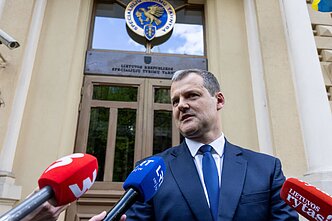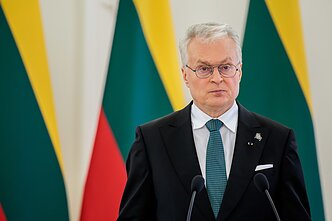
















Every year, the State Security Department (VSD) and the Second Department of Operational Services (AOTD) present the National Threat Assessment, which outlines the major threats to the Lithuanian state and the region.
In its latest report, published on Friday, the VSD and the AOTD say Russia could develop sufficient capabilities for limited military action against NATO within three to five years.
However, in their assessment, such a period would not be enough to prepare for a large-scale war with the alliance.
“In the medium term, Russia is unlikely to be able to build up the capabilities needed for a large-scale conventional war against NATO. However, Russia may develop military capabilities sufficient to launch a limited military action against one or several NATO countries,” the agencies said in their 2025 National Threat Assessment report.
“This may encourage the Russian leadership to use military force in the mistaken belief that NATO should not be able to react in time and that Russia should be able to localise the conflict and bring it to a swift and favourable end,” they added.
The intelligence defines the medium-term perspective as a period of three to five years.
The report says that the further growth of Russia’s military power will depend directly on the course of the war in Ukraine.
“The reduced demand on the front line would allow Russia to accelerate the formation of new troops and increase its reserves of arms and ammunition.”
Kaliningrad
To meet the demands of the war in Ukraine, Russia is sending troops and equipment from various regions, including Kaliningrad, according to the intelligence agencies.
However, they note that the military grouping in Kaliningrad remains capable of carrying out key tasks.
“The capabilities currently demonstrated by Russia in the event of a military conflict against NATO would not be sufficient to establish dominance but could disrupt NATO’s actions in the Baltic Sea region,” the report says.
“The A2/AD (anti-access and area denial) developed by Russia in the Baltic Sea region, and especially its air defence capability, although partially degraded, is operational and capable,” it adds.
The system includes air defence and anti-ship measures designed to prevent enemy forces from operating in a given area.

Ending war in Ukraine
Lithuanian intelligence said on Friday that a diplomatic end to Russia’s war in Ukraine is unlikely in the near future.
“A diplomatic solution to the war in Ukraine is unlikely in the short term,” the threat assessment report claims.
“The Kremlin’s perceived superiority over Ukraine-supporting Western democracies almost certainly will drive its war efforts until it secures substantial concessions,” they said.
According to the intelligence agencies, international pressure “has no effect on Russia’s position, and its strengthening alliances with Iran and North Korea indicate that in its confrontation with the West, Russia is willing to collaborate with any ally or use every possible means”.
“The conflict forces Russian leadership to allocate significant financial resources for the war effort, but Russia will not only be able to maintain a similar level of war funding in the near term but is likely to further increase it,” the report says.
Russia’s military spending this year is estimated at about 130 billion euros, or 6.3 percent of GDP, but officials have no doubt that actual war funding will be even higher, as Russia usually allocates additional funds from both the classified part of the budget and other areas of public finance.
According to the intelligence, Russia has not yet reached the limit of its financial capacity, but the Kremlin’s decision to continue the war is likely to “make the country’s economy weak, uncompetitive, and extremely vulnerable in the future”.
Belarus
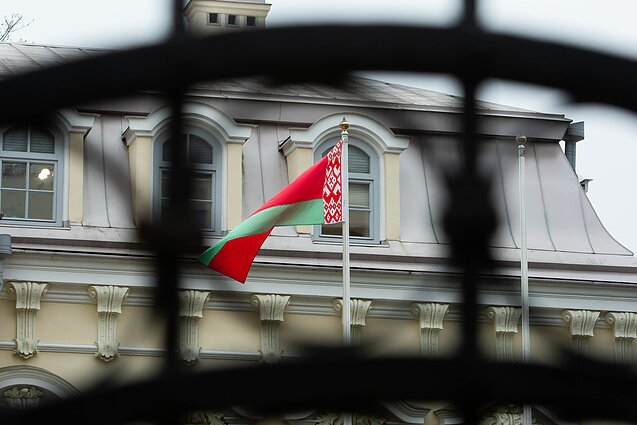
The Belarusian government detains Lithuanian citizens for supporting the Belarusian opposition, Lithuania’s intelligence services also warned on Friday.
“They carry out intelligence interrogations and illegal detentions of incoming Lithuanian citizens for supporting the Belarusian opposition, followed by prosecution for their political views,” reads the latest National Threat Assessment report.
In such cases, Belarusian intelligence and law enforcement authorities use extremely harsh methods and excessive force during detention, the report says.
Since 2023, Belarusian intelligence services have been building false cases against Lithuanian citizens with unfounded and politically motivated accusations.
“We assess that the Belarusian regime's actions are intended to exert pressure on Lithuania for it to reconsider its policy towards Belarus and to reinforce the narrative of a Belarus surrounded by hostile countries,” the report reads.
Targets in Lithuania
The VSD and the AOTD have previously reported attempts by Belarusian intelligence to recruit Belarusians living in Lithuania, but warned on Friday that one of its targets is Belarusian companies that have branches in Lithuania but sill operate in Belarus.
These companies are monitored by Belarusian intelligence officers who possess information not only on employees working in Belarus but also in Lithuania.
“Belarusian intelligence services pay close attention to individuals with even the slightest involvement in 28 opposition activities, with whom they remotely establish contact, apply pressure, and try to lure them back to Belarus. If these individuals return to Belarus, they are interrogated, often detained, and recruited by intelligence services,” the report states.
Lithuania’s intelligence says that the sizeable Belarusian diaspora in Lithuania continues to present opportunities for Belarusian intelligence services to establish long-term intelligence positions in Lithuania.
Belarusian intelligence services coerce members of the Belarusian diaspora into cooperation by threatening the security of their relatives remaining in Belarus and the right to use their own real estate or businesses in Belarus. Belarusian intelligence services are increasingly using remote communication tools to establish and maintain contacts with agents operating abroad; they are instructed to gather intelligence on Lithuanian institutions, the Belarusian diaspora, and the democratic opposition.
According to the Migration Department, more than 54,000 Belarusian citizens live in Lithuania.
Threats to Baltic Sea infrastructure
The Baltic Sea infrastructure could also be a target of deliberate attacks, Lithuania's intelligence services warned on Friday.
The warning comes after more frequent reports of damage to cables in the Baltic Sea in recent months, although investigations into all these cases have not found any signs of deliberate sabotage.
“It is possible that the Baltic Sea infrastructure will also be a target of deliberate attacks,” reads the latest National Threat Assessment report.
In terms of the language of probability “possible” is considered by the intelligence community to be a 30–45 percent probability.
“Atypical maneuvers by Russian vessels have been detected over underwater infrastructure and have also been observed near energy facilities in the Baltic Sea, such as wind farms,” the report states.

Newsletter
Every Friday morning.