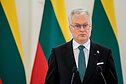













Lithuanian officials are hopeful that the United States’ approach to Ukraine will take a positive turn after President Donald Trump’s speech in Congress on Tuesday.
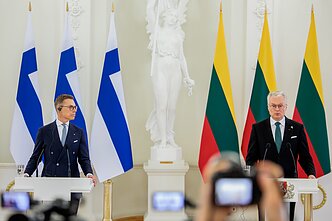
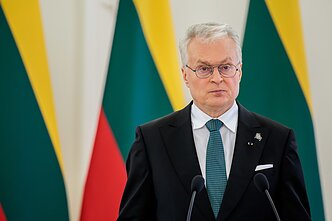
“I can confirm that Ukraine, President Volodymyr Zelensky, is doing everything possible to set aside the emotions that arose at the end of last week and is working very constructively with the US administration,” Lithuanian President Gitanas Nausėda told reporters on Wednesday.
“This is confirmed not only by the letter but also by very intense contacts – not necessarily at the presidential level but with other US administration officials – which lead me to believe that the attitude of President Donald Trump’s team toward Ukraine will change for the better in the near future,” he added.
Nausėda’s remarks came after Trump told Congress on Tuesday that he had received a message from Zelensky, in which the Ukrainian president signalled Kyiv’s readiness to negotiate with Russia and finalise minerals deal with the US.
‘We can see some positives’
Prime Minister Gintautas Paluckas echoed Nausėda’s sentiments, saying he noticed “softer tones” in the US president’s speech, which could signal some movement toward negotiations – a good sign not only for Ukraine but also for Lithuania.
“Recalling the tense conversation between the US and Ukrainian presidents just a week ago, I now see softer tones in yesterday’s speech by the US president,” Paluckas told reporters on Wednesday.
“We can hope that, with support from European leaders, President Zelensky can return to the negotiating table [...]. This is good news for Ukraine, Lithuania, and our region,” he added.

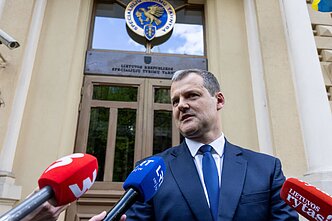
Meanwhile, Foreign Minister Kęstutis Budrys noted that Trump’s speech made it clear that his primary focus is domestic policy.
“Those topics dominated. As we saw, there was much less emphasis on foreign policy [...]. We had hoped for a clearer direction on that front,” Budrys told reporters before a cabinet meeting on Wednesday.
According to Lithuania’s top diplomat, Trump’s speech suggested that diplomatic efforts on Ukraine “are yielding results”.
“We see signs of greater engagement and a certain softening of the stance – we can also see some positives,” Budrys said.
“The fact that other key issues for us, such as deterrence and defence, were not mentioned – I wouldn't make a big drama out of it, because this event was primarily aimed at American citizens and lawmakers, whose priorities lie elsewhere,” he added.
Winning back Trump’s support
After last week’s public spat between the Ukrainian and US leaders in the White House, the minerals deal was not signed, and Trump suspended military aid to Ukraine.
Zelensky has since sought to win back Trump’s support, posting on social media that their clash was “regrettable” and that he wanted “to make things right”.
Nausėda said he hopes that the countries will return to the negotiating table and make decisions that “are the most realistic and strongest security guarantee for Ukraine”.

European leaders are also set to meet in Brussels on Thursday to discuss the security situation.
European Commission President Ursula von der Leyen on Tuesday unveiled a five-part plan to mobilise some 800 billion euros for Europe’s defence and help provide urgent military support for Ukraine after Washington halted its aid.
“The initiative basically means that an 800-billion-euro portfolio is being created for [European Commissioner for Defence and Space] Andrius Kubilius, if I can put it that way,” Nausėda said.
“It’s very important that this portfolio isn’t empty and that we can use these financial resources as soon as possible,” he added.
The president said Lithuania will support the proposal to allocate an additional 20 billion euros to Ukraine.
He also reiterated Lithuania’s earlier proposal to set January 1, 2030, as a “target date” for Kyiv’s EU membership.

Newsletter
Every Friday morning.