












Lithuania’s defence strengthening and support for Ukraine were the main targets of hostile information from Russia and Belarus in 2024, according to a report presented by the Lithuanian military on Thursday.
The 2024 hostile information environment report shows that messages about the Third World War and nuclear conflict, which had been quite rare in previous years, became commonplace last year.
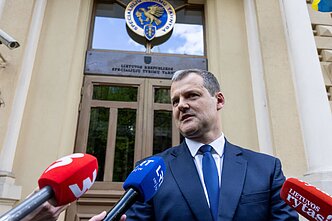
“Russia seeks to make us all surrender before day X even comes, portraying Lithuania as a failed state that’s not worth defending,” Commander Giedrius Valintėlis, head of the Armed Forces’ Strategic Communications Department, said while presenting the report on Thursday.
Ingrida Norkutė, a military analyst, said that last year saw a continuation of hostile information activities, with a particular focus on support for Ukraine.
“From French President Emmanuel Macron’s statements that sending troops to Ukraine for training shouldn’t be ruled out, to the transfer of F-16 fighter jets, and decisions allowing Ukraine to use Western long-range missiles,” she said.
“In this context, we observed an ongoing drawing of red lines and threats of a nuclear war between NATO and Russia, but we noticed that such rhetoric ran out of steam over time,” the analyst added.
According to Norkutė, there was also a significant focus on Lithuania’s efforts to beef up its military capabilities.
“There were messages suggesting that Russia poses no threat, so why is Lithuania building up its defence capabilities? These were presented as offensive, not defensive, forces,” she said.

The analyst added that while propagandists continued to paint Lithuania as an “insignificant, failed state”, they also portrayed it as a potential aggressor.
According to Valintėlis, Russia is trying to create an image of Lithuania in the information space as a threat to Belarus and the Kaliningrad region.
“The main task of Russian propaganda is to create an atmosphere of an inevitable bad outcome. The main objective is to radicalise society, hinder the possibility of reaching a consensus, and thus influence the democratic decision-making process of the state,” he said.
Valintėlis also noted that the Kremlin allocates significant financial resources to spreading hostile information.
“Open sources mention that at least 1.5 million dollars are earmarked for this purpose in 2025, and that’s only the official expenditure, not including the cost of secret services and other covert operations,” he said.
According to the military, the data used in the report was gathered from open sources and is representative, allowing the identification of key instances of hostile information targeting Lithuania in 2024, their characteristics, methods, and main directions.
The purpose of the report is to present changes in the scale and means of the dissemination of disinformation, as well as other distorted and manipulative information directed against Lithuania’s defence and national security interests.

Newsletter
Every Friday morning.