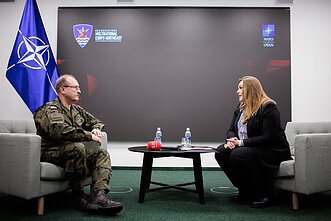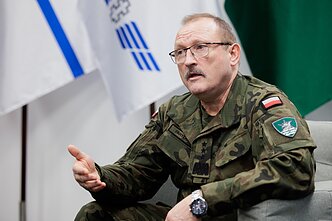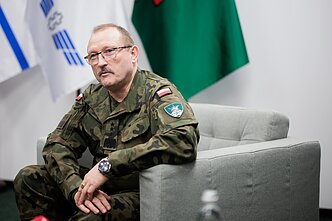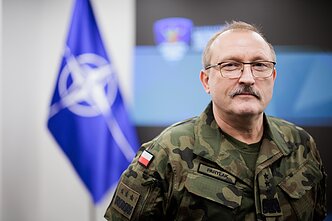



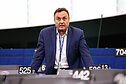





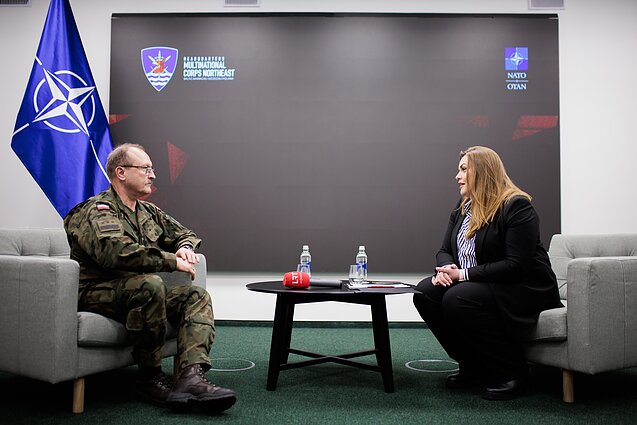
“Lithuania can be proud of itself. […] A country of three million people can afford a division,” says Lieutenant General Dariusz Parylak, who was in Lithuania this week in an interview with LRT.lt.
Lithuania last autumn signed a letter of intent to become the fourth ‘framework country’ of the Multinational Northeast Corps (MNC NE), whose headquarters in Szczecin is commanded by Lieutenant General Parylak.
So far, Germany, Denmark and Poland have been part of it.
Joining these major countries of the MNC NE would, among other things, allow Lithuania to integrate its national division into the international North-East Corps force and to second officers to command positions on the staff.
The inauguration of the Lithuanian Armed Forces National Division headquarters in Rukla took place on Tuesday, which is the first step for the establishment of the division in the country.
The headquarters would be the main headquarters responsible for the defence of the region in the event of an aggression against a NATO country. We talk to Lieutenant General Parylak about what the establishment of such a divisional headquarters in Lithuania means in practice.
What is the significance of the establishment of such a divisional headquarters in Lithuania for us and the region as a whole?
This letter of intent opens the way to becoming a framework country and the process just started some time ago. On the other hand, the process of forming a Lithuanian division, which will soon become part of the corps force as a tactical link, was opened on Tuesday.
What does the establishment of the staff specifically mean for the average Lithuanian? First of all, he will have the right to feel safer. Up to now, Lithuania, since it joined NATO in 2004, has been implementing various processes, allowing it to develop its armed forces. Of course, it has done this by the method of small steps and this is the best method, as it allows to achieve capabilities slowly but effectively. After joining NATO, it became a member state of the structure I command, the North-East Corps. It engaged officers, non-commissioned officers and learned, trained with us, practised interoperability elements. It increased its structures and then embarked on another project, which was the designation of the ‘Iron Wolf’ Brigade into the structure of the Multinational Division North-East, which today is stationed in Elbląg.
It has separated staff officers there and over the last few years it has been training with them together, as if learning this culture of action of ours, and has reached another level. Today, it has formed the staff of its own division, which opens up another way to improve its capabilities, and consequently it has also opened up the opportunity to become a framework country, because it already has quite a serious intellectual input, a cadre of officers and non-commissioned officers educated over several years, who have already operated in NATO structures. It directs officers and NCOs to study abroad all the time, so the problem of interoperability and understanding each other is starting to be less and less noticed, because we are talking to each other, you could say, in the same military language.

Now another element is being created - the increase in the capacity of the Lithuanian forces by more units, so, therefore, I will repeat again, today the citizen can feel safe.
From an economic point of view, the creation of new units means more jobs, it is also an opportunity for young people to serve and therefore realise their own ambitions. It is also a search for talent among young people for military service. The development of units is also an economic lever for the regions, so the process can be evaluated more broadly. The most important factor, however, is that potential adversaries have seen another signal. Lithuania is increasing its potential and armed forces, becoming a more committed member of NATO, consequently becoming stronger, so deterrence in the broadest sense is starting to take on colours and facts, rather than just becoming, let's say, such a PR element.
What is the uniqueness of the structure of the North-East Multinational Corps? What specific measures are you taking to strengthen combat readiness and interoperability?
Uniqueness in relation to other corps is characterised by three main factors. Firstly, the North-East Corps has a clearly defined theatre of operations and region of responsibility - the Baltic States and a defined part of North-Eastern Poland. This means that it is focused on this area and analyses related exclusively to this region.

The second thing that particularly distinguishes the corps from the others - the dedicated not inconsiderable forces. They are already deployed in those areas I just mentioned. They are operating, they are training, they are also identifying with the national forces, and at the same time they are preparing the ground to receive more NATO forces. To understand the difference, previously we were training, we were training, but we were not in theatre, meaning we were some two or three steps ahead of what we are doing now. This shows our commitment and the sophistication of what we are doing.
The third point - by having a structure, a force, a shared region, we also have real capabilities. These are not capabilities that could emerge, but capabilities that are already there. From the point of view of deterring potential adversaries, this is probably the most crucial element. No corps has developed structures on its flank, only us. This is due to potential possible threats or countering them. We are not trying to make threats grow, we want to reduce them as much as possible.

What specific tasks and objectives have been set for the divisional headquarters in Rukla in the context of future missions and exercises in the region?
On Tuesday, I had the pleasure of attending the division's formation ceremony. I was able to see the newly appointed division commander, General Aurelijus Alasauskas, with whom I had the opportunity to speak. The question was raised as to what we should start doing. Firstly, to continue what we have been doing so far, but on a larger scale. Our exercises are the salt of what we do every day. At the moment, we will be exercising together with the staff of the Engagement Division. In this case, the exercise is not about us sitting around and debating the map, but about addressing topics that until now have only been dealt with in my staff. Competence will now be taken over by the commander who has just been appointed. Operational capabilities have already reached such a level that they are able to be carried out by the Lithuanian commander. This is very important, because in a while other resources will be at his disposal of this commander.
The division staff at the same time has a very important function that my staff has been fulfilling until now, and that is the function of integration with the national forces. In addition to the units which are dedicated to the division and which become part of the North-East Corps, there are also units which are dedicated solely to national defence, such as brigades or territorial defence battalions. They are a permanent part of the national defence infrastructure. Previously, the integration of these troops into NATO plans was in the hands of my staff officers. Now this role will be taken over by a designated division commander. Which is good, because the integration was well done by the commander of the country where these troops are. It is then easier to carry on with everything. It is not that someone else will do it. Above all, it's simpler - we're moving towards simplifying processes, not complicating them. War is already very complex anyway, so as commanders we should try to make it as simple as possible, to use the simplest solutions so as not to complicate the process further.
This also implies a certain level of trust.
Of course, we talk about trust all the time. Since 2004. Lithuania, as one of the countries that joined NATO, has emphasised this credibility all the time. So I think that the so-called credibility - the magic word in English - perfectly takes on a new meaning.
How should the Lithuanian side strengthen its armed forces and international cooperation within the framework of the Multinational Corps Northeast (MNC NE), as a new ‘framework nation’?
The establishment of the divisional headquarters is the first step. The next is its development. In addition to the Division Headquarters, the added value of a tactical association such as a division is its divisional units. In the near future, there will be more units of engineering troops, artillery, anti-aircraft, those that represent the value and high quality of the division level. This is something we look forward to as soon as possible, for the reason that they represent a real force in the area. Until now, this capability would have to be secured with units from other countries. This is very complicated due to the fact that the sappers who operate in Lithuania know the terrain best. This is, of course, a very extensive process. It will not happen within the next year or months, because the process first of all requires the purchase of equipment, preparation of personnel and infrastructure, but the most important thing is that there are plans for this and I have heard that there are even already funds. So I look at it all with a lot of optimism.
Despite the benefits of just such cooperation, what challenges should be mentioned?
‘Challenges’ is such a magic word with which we try to hide issues under the heading of ‘problems’. There are a lot of dilemmas that arise - of an operational nature, which is my military profession, and also related to geopolitical developments in the region and the conflict in Ukraine. I think these are things that introduce turbulence into the security environment and a lot of uncertainty. We need to meet that in some way, so the challenge is to train that, to show that we are not capable just because we are, but because we are capable of acting together - in the land domain, which we are talking about now, as well as with the support of other communities.
Lithuania, like Poland, Latvia and Estonia, apart from having its land domain, is also a maritime country. The maritime domain is also of great importance here. Linking all these aspects in the division that has just been formed means a lot of challenges that we have to face in the near future. My command is to support this as we have done so far at lower levels.
What might cooperation between such a division headquarters and the German brigade being formed in Lithuania look like?
Now we are talking about another level of interoperability. The establishment of the Lithuanian divisional headquarters has made it possible to include brigade-level units in joint training, in synergy. Previously, it was possible to realise such partnerships, but it did not happen in the military structure to assign another brigade to a brigade. The establishment of the division headquarters itself creates the conditions for a certain affiliation, but this is not the most important thing.
The German brigade, which is in theatre, shows by its presence a certain capability that we as allies have already developed.
The second issue is the partner unit. In the process of forming, creating new capabilities, it is, one could say, a mentor in theatre. It will support training, integrate the different types of troops together and organise training in specific areas, help teach and form new units. There will be a kind of large coaching, where a lot of trainers on the ground will provide advice, while at the same time carrying out the different kinds of processes and activities that I commission. This is also one element of the deterrence strategy.
Another very important moment in bilateral relations between Poland and Lithuania is the issue of military mobility. Are there enough of these current efforts to ensure possible fluidity of movement of military forces in the region? Or, put another way, what can we do more of?
We talk all the time about the military aspect of the process. The first point is that there is a unit deployed in theatre, that is, in each NATO member country, which deals, to put it simply, with logistical integration. This consists in the fact that it secures, prepares and creates the conditions for the reception of further alliance forces.
The second thing this cell does is to actually secure the functioning of what we have at the moment. The mobility processes of NATO units within the countries that are in my area of interest here are carried out by the alliance force integration units, which are specially prepared for this. They are deployed in each country, and the same unit is also on the ground in Vilnius.
In this process, it is important to have the presence of units that are currently in theatre outside this country, as in the case of Germany, the German brigade. In Latvia, for example, there is a multinational brigade present under Canadian main command, in the theatre in Estonia there is a multinational brigade under British command. In Poland, on the other hand, there is a brigade with US forces leading the way. These units, although stationed as a permanent element, internally rotate. If we look at the capabilities, we see that they are growing all the time.
Personnel rotate, soldiers get acquainted with the region, some get trained, after a few months they return to the country and new ones arrive. This mobility is, I believe, quite well filled. As a consequence of two or three years, we can say that we have trained three times as many personnel as we theoretically have now. At any moment we are ready to send twice as many forces to the theatre as there are at the moment.
This process will continue and it seems to me that the force rotation mechanism that is in place at the moment addresses these challenges that you are asking about.
How is it, for example, with the provision of military technology?
This is happening on an ongoing basis. Maybe these processes are not so visible. After all, it's not about moving tanks from one part of the country to another every other week or month. It is also about certain constraints attached to the training location, the training facilities and the infrastructure that is in place at the moment. I can assure you that even though where, for example, equipment has been moved once and is standing in one place, the personnel are exchanged. It is important to replace staff and train people all the time, which is at the same time the most difficult part of achieving capacity.
Getting a few dozen or a few hundred more armoured personnel carriers into the theatre is a technical matter. They must have well-trained crews and prepared commanders who know the terrain and the environment in which they are to fight and how to do it. Personnel is the key here, not technology.
I know that from a potential resident's point of view it looks like when you see more tanks and transporters, it is better. In a way it is such a perverse thinking, there is some logic there, but I am more interested in personnel. Equipment can be transported or redeployed in a very short time, but it takes months and years to train people to be able to operate here, north or south of Vilnius, and not somewhere in some hypothetical area.
The idea of the capital's authorities that one of the evacuation routes from Vilnius could be the Neris River has recently been widely echoed in Lithuania. How safe is it to use rivers in the event of an escalating conflict? What special plans is NATO developing for the protection of civilians in major cities during a possible conflict?
I do not see any obstacles to using it during a crisis. If we have adequately prepared ports and waterways for this, which will allow barges of a certain draught to cover the distance, I do not see any technical obstacles in this respect.
However, from the point of view of the issue of conflict, it is very important how far this is from the line of contact between the troops, the front line, and not which transport mechanism we use.
However, I would like to confirm once again - if we are talking about a period of crisis, all lines of communication are perfectly usable. Later, when there is an escalation, all possibilities depend on the situation.
From the point of view of how to prepare the state for defence, I think that officers at the General Staff are already working with the subject. A lot of experience is coming from the ongoing conflict from Ukraine.
Today it is a bit too early to close this topic and say that everything has to be done this way or that. All work is being done now, including analysis. As much as we would try to prepare 100 or 200 magic plans, every city, town and critical infrastructure will require different solutions. There is no such thing as a universal model for infrastructure protection. Each has different vulnerabilities. If you find someone who answers you directly and tells you how it should be done, don't listen to them at all. It is important to remember that a number of things, particularly regarding critical infrastructure, require a very individual approach.
They should already be thinking and working on scenarios and dealing with them today. I think the military is the last part of the problem-solving chain. No matter how much we want to do anything, the military will still have to be given top priority, so it will be even more in the way. Maybe it's a bit early to talk about it, but it's worth raising the issue. Once someone talks about it, it means they are starting to think about it, and that's a big plus.
Every time the subject of the Suwałki Corridor comes up again - is it still Europe's most explosive point today? But are we more prepared than we were just two years ago?
I will say a little jokingly. All questions that are asked with the participle ‘whether’ have a simple answer - yes or no.
The Suwałki Corridor itself is a certain geographical element, understood from a strategic point of view as a very key element, enabling logistical permeability and communication fluidity between Poland and Lithuania, also from an operational and strategic point of view. It certainly was important and is important. The discussion of whether it is needed, how much we are going to defend it and take care of it, is left to the military to ponder. In every country we will find such soft underbellies that will be very important from a strategic and operational point of view.
It is a small territorial bridge to maintain land communications with Western Europe through Poland, and it is the soft underbelly of any concept, any plan. The terrain in this part of Europe is very convenient for all sorts of operations, not very favourable to us defenders at times. It has been somewhere for years, it is there, and it cannot be changed. We are in such a special place, which I call the draught of Europe, that all it takes is to open the door slightly on the eastern flank and this draught works its way all the way to central Europe. This is the only window or big gate that a potential adversary could try to get through to develop their capabilities.
It was and is a key place on our map and is an important part of our plans. I can reassure you that we are not ignoring it. Although the world is changing, the territory is not changing. It is the same, sometimes more or less armed with different kinds of infrastructure, but it still remains and realistically either favours us or does not favour us.
The war in Ukraine has shown how unpredictable and different modern warfare can be, from drones to cyber attacks or hybrid warfare. Poland and Lithuania, among others, are leading the way in increasing their defence spending. What elements of NATO's modern defence are the most important, especially considering new threats and military technologies? Do we still need tanks?
For years we have been hearing all sorts of speculation from various worthy people as to whether we need more tanks, or more aviation, or more artillery, or more soldiers. It is important to remember a certain mechanism that accompanies all wars. If we decided to trace the wars of the last 200 years, we would notice that they have a certain specific scenario. I do not mean that they begin and end, because that is a fact in every war, but that every conflict begins in terms of technology with certain innovations and ideas. It is reminiscent of the scenarios of a Rocky Balboa movie. He has a duel at the beginning, loses it, trains and at the end wins.
Wars start with a new technology, a new idea. The war mentioned above started with drones - I sort of confirm this rule. New ideas, new technologies, ways and methods of fighting are created. New weapons are created and the war ends as a result of a stalemate, either because it is simply no longer possible to come up with anything based on what you have or because the resources of the warring parties have been exhausted. These are the most common scenarios for ending a war.
Sometimes political decisions help to speed up these processes, but more often than not, it is these arguments that are provided to enter negotiations.
If we start following the war in Ukraine, we might wonder what stage it is at. I will not tell you straightforwardly whether something is already ending there or whether something has not yet ended. Certainly, a lot of new things and means of fighting have emerged, as have ways of fighting them. These processes are happening all the time, and we are identifying them and transforming them into the needs of our armed forces, which are not fighting at the moment.
To answer the question of whether we need more tanks - we do. So do launchers, drones and anti-drones, reconnaissance and anti-recognition measures. This debate can only be closed when the war in Ukraine is over. Today a number of things are shrouded in a certain secrecy and this needs to be understood. How many tanks or anti-tank launchers there should be is decided by the military and they are unlikely to talk about it. I assume that reasonable plans are made on the basis of a country's capabilities and operational needs.
All means of warfare are needed. Believe me, if they were unnecessary, they would have been thrown out of the army long ago. There were opinions just a few or a dozen years ago that a lot of these tanks were unnecessary, and they do not hold true today. The wars have shown that such theories have fallen to ruin, and that is why today we are renewing our arsenals. We are modernising them and I think the key is not how many tanks we need, but the quality of this equipment. It needs modernising, combining it with other elements that we have not used before.
There is much speculation surrounding Donald Trump's character. There are fears that Trump may withdraw NATO troops from Germany. So-called experts even point to several options - he will withdraw from Europe altogether, move significant forces to the Indo-Pacific or move them to Poland. Insofar as Trump is this person deciding the fate of NATO? Do we need to fear any manipulation by Trump's cabinet? Are you considering such scenarios at all?
I have to say right away that I am a citizen in uniform and I will sadden you a little. Yes, Trump is not in charge of NATO. And here I would like to reassure you, because there are certain military structures in place. However, as a soldier, I can confirm that we have a NATO ground forces command in Europe, a combined command in Europe, and as a soldier, I expect tasks to come from there.
Given what we are doing at the moment and what commitment we have, what tasks I have as a corps commander with forces deployed in four countries, let me speculate that political events have, at least for the moment, no bearing on what my soldiers do. I would rather stick to that and reassure you that the tasks designated to be carried out, received from the military senior commanders, are being carried out and we must leave the political issues to the politicians.
How do you assess the current security situation in our region? What are the real possibilities for an escalation of conflict in this part of Europe, given the current geopolitical tensions?
It is very difficult to say in which direction the situation will develop. Only the adversary can say what his plans are, but we do not know them yet. We can anticipate them or speculate on them.
By conducting analyses of the environment and the theatre in which my troops are deployed, and taking into account the current engagement and the processes that are happening in Ukraine related to the Russian-Ukrainian conflict, it is fair to say that we will not avoid certain things, such as events of a hybrid nature. We have to be aware that NATO is being tested all the time in different ways to see how we respond to different kinds of threats or difficulties that arise.
But once again, I can reassure you - firstly, the presence of such a significant force on the shield, the likes of which we have never had before, ensures that a relative balance of forces is maintained. Secondly, the permanent training of my troops with the units and armies of the countries on which they are stationed ensures that I achieve an increasing degree of interoperability, which makes the deterrence strategy element work. There are too few identifiers that can tell you clearly and transparently that something is about to end or something is about to escalate. I don't see any such threats for us to act in this way. You have to remember that the security environment is an incredibly turbulent environment and you have to be very careful. It is important to follow up, monitor, be prepared and have ideas. I think these four things are currently being done well.
Mr General, during your missions in Afghanistan, Iraq, you saw all sorts of faces of war. Which of these experiences do you consider the most difficult?
Every war is the scariest for every civilian. We soldiers learn our craft from our so-called ‘military childhood’, i.e. from an early age when you graduate from officers' schools or other military colleges. War gets scarier and scarier with each passing year, yet we try to cope with all its facets. However, it is for the average civilian that war has the scariest and worst face. It is impossible to teach an entire society how to deal with it. To repeat myself, every war has an increasingly terrible face. Paralysis, anxiety, fear - these are the emotions that accompany everyone, and civilians the most. It is the most incapacitating element in warfare. War or crisis also brings out different behaviours in us, we learn what we are capable of. All our weaknesses are revealed, but there is nothing wrong with that. It is just a question of how we can deal with them. This is also the most difficult element in my work and in the service of my soldiers. It is difficult to describe in one word what is the worst thing about war. On the other hand, certainly, war is the most difficult for those who are not prepared for it and war will always be the cruellest thing man has invented for a civilian.