











Prime Minister Gintautas Paluckas says he supports a proposal by the Nemunas Dawn party to disclose the names of officials who have admitted to collaborating with the KGB and are still in office.
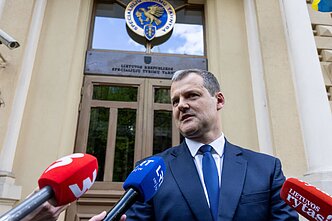
“I think this is something worth discussing, and it would make sense to share information with the public about those who are still holding certain positions,” he told reporters.
Under the current law, those who have willingly confessed to having collaborated with the Soviet security service are offered a 75-year protection from public disclosure.
The Nemunas Dawn party, which is part of the ruling coalition, has proposed declassifying information about politicians, officials, civil servants, judges, military personnel, intelligence officers, heads of state institutions and companies, media figures, and political party members who worked with the KGB.
According to Paluckas, the disclosers would not be numerous, since many of these people who came forward have already passed away.
However, the prime minister believes that declassification would “help ease tensions in society”.

“There are still people who believe that Lithuania is still ruled by KGB people,” he said.
Saulius Skvernelis, the leader of another coalition partner, the Democrats “For Lithuania party, declined to comment on the Nemunas Dawn proposal, saying he had not yet had a chance to review it.
The law, which took effect on February 1, 2000, allowed former KGB and other Soviet intelligence officers and secret collaborators to confess and register with a special commission. The identities of those who came forward remain classified for 75 years.
However, there are already exceptions: if these individuals run for president, parliament, or local government, or apply for government posts or positions as judges or prosecutors, their confession is no longer considered a state secret and must be made public.
Back in 1991 and 1992, former KGB collaborators had the opportunity to confess to a temporary parliamentary commission.
After a deadline for voluntary confessions was set, 1,589 people turned to the Lustration Commission and admitted to their past collaborations with the Soviet security services.
Several amendments to the law have been registered in the parliament to declassify the names of former KGB collaborators who confessed, but none have been passed.

Newsletter
Every Friday morning.