





Lithuania will reduce its political representation at meetings in Hungary in response to its Prime Minister Viktor Orbán’s visit to Russia, while President Gitanas Nausėda will decide whether to go on a potential visit to Budapest together with the leaders of other European Union countries.
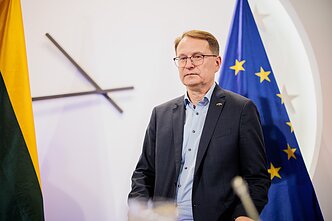
This was confirmed to BNS by MP Žygimantas Pavilionis, chairman of the parliamentary Committee on Foreign Affairs, and several sources in the government.
“For the time being, we have simply decided to limit our participation at the political level in Hungary,” Pavilionis said.
The position is shared by both the government and the president, according to him.

No ministers going to Hungary
Hungary took over the rotating EU presidency for six months in July and on Tuesday held an informal council of competitiveness ministers in Budapest. However, Lithuania and some other EU countries were represented by junior officials.
Lithuania’s representative was Ambassador Mindaugas Rukštelė rather than one of the ministers or deputy ministers, as is customary.
“We are joining the unison of those who are dissatisfied with [Orbán’s] position,” said Pavilionis.
More sources have told BNS that Lithuania has decided not to participate in the informal councils organised in Budapest at the ministerial level but may send deputy ministers.
Latvia and Estonia will do the same. The big EU members, including France and Germany, are also reducing their representation at meetings in Hungary.
Ministers from Lithuania will continue to attend formal EU Council meetings in Brussels, regardless of the presidency.

President to consult with counterparts
The European Council of EU member states’ leaders is also due to meet in Hungary in six months but it is not yet clear whether Lithuanian President Gitanas Nausėda will boycott the event.
“The position on participating in the events in Hungary at the level of the heads of state will be coordinated with the EU partners,” the President’s Office told BNS.
Orbán caused outrage among EU leaders when he went on an unannounced visit to Ukraine on the first day of his country’s presidency of the Council, but flew to Moscow a few days later to meet Russian President Vladimir Putin.
The visit to Russia, which was organised on a bilateral basis, was misrepresented by both Orbán and Putin as taking place under the EU flag.
“This is not only unacceptable but also violates a number of political agreements at the highest level, for example on non-cooperation with the Putin regime, which has been accepted even at the level of the European Council,” said Pavilionis. “This is not the EU position and it contradicts our positions.”
President Gitanas Nausėda condemned Orbán’s visit to Moscow and insisted that although Hungary holds the Presidency of the Council of the EU, the Hungarian prime minister did not represent the EU.
Other member states have also expressed their dissatisfaction at the regular meeting of EU ambassadors in Brussels on Wednesday.

Newsletter
Every Friday morning.