








Some 12,500 Russian citizens have received Lithuanian citizenship on the basis of their ancestry. While some of them genuinely cherish their links to the country, others use the opportunity for purely pragmatical reasons – while serving in the Russian army or working for government-linked companies.
“Good afternoon, is this Mr Paniukov? I am looking for Nikita Paniukov.”
“Alo! Alo? Alo,” the man on the other end of the line repeats several times in Russian and hangs up the receiver.
We dial the number for a mobile phone registered in Russia’s Krasnoyarsk, more than 5,000 kilometres from Lithuania, dozens of times, but we never manage to talk.
Paniukov is serving in the Russian army, in the 3476th military unit stationed in Krasnoyarsk. In the photographs of him we have come across, he is wearing the uniform of the Rosguard, Russia’s internal special forces, sporting a St George ribbon and carrying wreaths on the Memorial to Soviet Heroes.
Paniukov is no different from hundreds of thousands of Russians, but he is also a citizen of Lithuania. He received the Lithuanian passport as a descendant of a Lithuanian deportee.

This right is guaranteed by the Law on Lithuanian Citizenship, and there are some 12,500 Russian citizens who are descendants of exiles and have claimed Lithuanian passports. More than 250 of them have exercised this right in the last two years, since Russia’s invasion of Ukraine in 2022.
The law also allows the descendants of Lithuanian exiles to retain dual Russian and Lithuanian citizenship.
The LRT investigation team, in cooperation with Scannerproject and partners abroad, have interviewed dozens of people in Russia who had restored their Lithuanian citizenship, picked up the phone and agreed to talk or answered our questions in writing. We wanted to find out how the Lithuanian passport is used by Russian citizens.
The research shows that some of them are active opponents of the Russian government. While living in Russia, they did not shy away from expressing their negative views about Vladimir Putin’s regime, took part in protests and signed petitions against human rights violations. Others were active members of the Lithuanian communities in the regions where they lived, continuing to uphold Lithuanian traditions in the places where their grandparents and great-grandparents had been exiled.
However, some other holders of Lithuanian passports serve in the Russian military, are linked to the government in Moscow. Some do not maintain any ties with Lithuania, do not speak the language or know anything about the history of deportations. Rather, they use their Lithuanian passport to travel and work in Europe. And some of them, judging by their social media posts, are loyal not to Lithuania but to Russia.
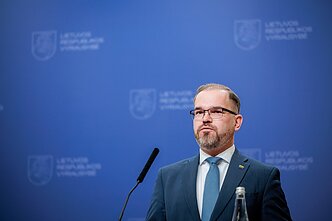
“Even if we were to establish that a person poses a threat to Lithuania’s security (as we are doing now, because we are carrying out stricter checks), this would not be a reason for not restoring Lithuanian citizenship,” says Evelina Gudzinskaitė, head of the Migration Department.
According to her, the department could refuse to restore a person’s citizenship if they had committed a serious crime against humanity, peace or a crime against the Lithuanian state.
The State Security Department (VSD), Lithuania’s intelligence agency that does background checks on applicants, tells LRT it believes that the law should be stricter: people who serve in the Russian army, work in state-owned or strategic Russian companies, law enforcement or government officials should not be entitled to Lithuanian citizenship.

“After February 2022, this [citizenship] restoration process became a loophole, giving unvetted Russian citizens an opportunity to become residents of the EU. And it is evident that the process in Russia of looking for family ties, for access to the Schengen area, for residence permits in third countries has started. It is an open secret that they are looking for ways, the process is going on, and it can have dangerous consequences in Lithuania,” philosopher Paulius Gritėnas commented to LRT.
Loyal defenders of Russia
The LRT Investigation Team have identified at least four cases where individuals who have obtained Lithuanian citizenship have been or are still associated with the Russian military. One of them is Vlad (we do not mention his surname at his request). He served in the Russian army a decade ago and shares photos of himself in military uniform on his VKontakte account.
“This is mandatory service, there is no alternative service like in Europe or other countries. Yes, I am of military age. I can be mobilised at any time,” Vlad told LRT.
However, he says he is currently engaged in business and has no plans to go to the front.
“When all these events started in 2022, I immediately activated my plan to emigrate if I had to do it quickly. I contacted the Lithuanian Embassy, and at that time I still had a valid passport. But since then, I got married and have a family here, so there are additional complications. They explained to me what documents I needed to prepare, and I got on with it. And I don’t rule out the possibility that if the situation escalates, I will emigrate to Europe. One hundred percent I am not going to the front,” Vlad said.
Another case is the aforementioned Paniukov, who could not be reached for comment.
After his military service, Alexander joined Vankorneft, a subsidiary of the Russian oil industry behemoth Rosneft. His photos on social media suggest that Alexander visits Lithuania. In 2016, for example, he was photographed in the Grūtas Soviet Sculpture Park, posing in front of sculptures of Stalin and Lenin.
Algirdas, a former Soviet paratrooper, later worked in the Russian special police unit OMON and now works as a lawyer. On his social media, Algirdas posts his old photos in uniform, posing with the paratrooper flag, etc.

Russian communist
Ana Chudakova, 28, a Lithuanian citizen, belongs to the Communists of Russia party. She is reportedly the first secretary of the party’s Oriol region. She was also the financial representative of the party leader Sergei Malinkovich when he was running in the presidential election this year.
The Communists of Russia was created in 2012 as an alternative to the Communist Party of the Russian Federation. It was alleged in the public sphere that it was a Kremlin project to promote left-wing populist ideas. The party calls the war in Ukraine a “Great War” and their political programme consists of “Ten Stalinist blows to capitalism”, advocating the nationalisation of property and the reintroduction of capital punishment.
The party actively supports Russia’s war in Ukraine, and some of its members are volunteers at the front. It also claims to be sending humanitarian aid to Russian troops at the front.
Another Lithuanian-Russian dual national has links to Putin’s United Russia party, with which he unsuccessfully ran for the Krasnoyarsk deputy. The LRT Investigation Team also found cases where people with Lithuanian citizenship held political positions, for example, shaping industrial and energy policy in one of the regions.
Drone pilot training and projects in Crimea
Russian businessman Stanislav Okunev also regained Lithuanian citizenship last year. He owns the computer technology companies Rostkom treid, Rostkom centr and Er-si grup, which live off state contracts worth over 10 million euros as of 2019. This April, Rostkom treid supplied equipment to the Kerch Vocational School in Crimea for 31 million roubles (321,000 euros).
The Rostkom Group is also involved in the national UAV programme, which will be launched in Russia in 2024, and provides patriotic training for Russian citizens. Although the programme itself is not linked to the military, the project is imbued with a military flavour.
Okunev’s Lithuanian heritage comes from his deportee grandfather, but the businessman cannot say more about him. When asked about getting Lithuanian citizenship, Okunev said that he did it once he learned it was possible. “Anyway, it’s interesting to go, to see, to understand my family history,” he explained.
The Russian businessman said on the phone that he did not agree with the view that “Russia is a hostile country to Lithuania”, that it was a media invention. He called questions about Russia’s war in Ukraine “provocative”. “I am not saying that I do not support it [Russia’s special military operation]. I am not involved in it at all. I don’t like the war,” he explained.
Asked what he would do if he were mobilised – go to the front or use his Lithuanian passport to leave Russia – Okunev said that this question was too difficult for him.
“I don’t have an answer to your question,” he said. “I do not want to answer provocative questions. Why would I?”

Law focused on the past
Philosopher Gritėnas reflects that the current Law on Citizenship is oriented towards the past connection.
“I think this is a wrong approach, because both in the past and in the future, we need to look at the relationship of each person, their perception of the package of rights and freedoms they receive with citizenship and in general to look at what the geopolitical situation is like, and this law does not take this into account,” he commented.
According to LRT’s investigation, Okunev is not the only one who has made a career in Russia with strategic projects. We have identified more than twenty people of Lithuanian nationality who work for strategic Russian companies, for example in the aviation sector, including the Russian state-owned airline Aeroflot.
Yegor Tyupakov, who has just turned 30, is chief economist at the Central Bank of Russia. Several others who have regained Lithuanian citizenship have also worked for this bank, as well as for the sanctioned VTB.
However, most Lithuanian passport holders work in oil, gas, and metal companies. At least nine people work in companies linked to Gazprom, Rosneft, and Rosatom alone, and many more in regional central energy companies.
The LRT investigation team has managed to identify several “new” Lithuanian citizens holding positions at Stroytransgaz, which was placed on the US and Canadian sanctions lists after the annexation of Crimea in 2014. This oil and gas construction company is controlled by the oligarch Genediy Timchenko, a close friend of Putin.
At least six people working for strategic Russian companies have decided to apply for Lithuanian citizenship after 2020, including Elena, a graduate of the prestigious St Petersburg Emperor Alexander I Engineering University. She is currently working at the Institut Giprostroymost which is on the Western sanctions list. The institute was involved in the design of the Kerch Bridge which connects Russia with occupied Crimea.
Daughter of an oligarch trustee
Valerija Brusokaitė, 35, shows off her luxury on social media: travels around the world, yachting, designer clothes and handbags costing thousands of euros. Some of the photos she posts show off her patriotism: in a Victory Day parade, in front of Soviet tanks or posing with a Soviet army cap. In her social media posts, the young woman describes the Leningrad blockade with sensitivity and is proud of the Soviet Union’s victory over Nazi Germany. However, there is no mention of Soviet deportations, although Brusokaitė’s grandfather was forcibly taken to the interior of the Soviet Union to find out what he had been doing in German forced labour camps.

She got her Lithuanian citizenship in October 2022, after Russia had already launched a full-scale attack on Ukraine.
When interviewed on the phone, Brusokaitė admitted she had never seen her grandfather and knew little about his life story. “I had never thought about it in my life and probably would never have thought about it, but my father suggested it, and said: Look, it’s a possibility. Then I thought, why not? I’m half Lithuanian after all.”
Brusokaitė’s father is presented in Russia as a well-known businessman. He lived in St Petersburg for a long time and has now returned to Lithuania and is based in Palanga. Alvydas Brusokas was vice president of Baltic Bank in Russia and then worked in private business. In 2012, Mining Investments, a company controlled by him, was granted a 24-year licence to mine gold in Georgia.
However, Brusokas insists he has no businesses in Russia and, what is more, he has never been the real owner of any big companies. “I was an employee. I’d be made a shareholder when they needed to conclude a contract quickly – they ask you to sign and then you transfer it back. That’s it. It’s technical,” he explained.
According to records, he had a gold mining business with Russian billionaires Dmitry Troitsky and Dmitry Korzhev, who now also share a gold mining business in Armenia. Troitsky is also one of the main shareholders in the O’Kay group, which operates the O’Kay retail chain. Brusokas was for some time a senior executive there.
Brusokitė refers to this company in Moscow as her employer. Her career and life follow the pattern of Russia’s elite offspring: she was educated in the United Kingdom and her first jobs included the Russian Ministry of Economic Development, the Information Committee and the Land Management Committee.
Asked by LRT whether she supports Russia’s war in Ukraine, Brusokaitė said: “Well I’m not going to answer that question, am I?”
“I will not talk to you about political issues,” she added.

Brusokaitė said she had visited Lithuania and was planning to come again soon. “I don’t see any problem with visiting Lithuania. The people have been very hospitable and have remained so. Just like here in Russia, there is no negativity towards people. Many of us are united by our past in the Soviet Union, especially the older generation. Of course, the situation is so sad, but the most important thing is to stay human with each other,” she explained.
Another descendant of Lithuanian deportees in Russia has connections with big Russian businesses.
Pavel (his last name known to LRT) works for United Metallurgical Company (OMK) and its subsidiaries. Although the company is not state-owned, its activities are directly linked to the Russian defence industry. The company is headed and owned by one of Russia’s richest oligarchs, Anatoly Sedich, who is ranked 56th in terms of wealth among oligarchs. He is on the UK sanctions list and his metallurgical company is sanctioned by the US, Ukraine and the UK for its links to Russian defence.
Fear of staying in Russia
However, among the descendants of Lithuanian deportees who have regained Lithuanian citizenship, there are also active opponents of the Russian government. While living in Russia, these people did not shy away from expressing their negative views about Putin’s rule, taking part in protests and signing petitions against human rights violations. Many of their activities are linked to the movement of Alexei Navalny, who died last February in a penal colony in the Arctic.
Andrei, a 26-year-old Lithuanian-Russian citizen living in Vilnius since 2021, calls the country where he was born Mordor. “I’m not afraid of spiders, dogs, heights (what else are people afraid of there?). I have only one phobia: that I will end up in the ‘Soviet Union’ (Russia) again and will be forced to stay there, not of my own free will,” he told the LRT investigation team.
Born in St Petersburg, Andrei applied for Lithuanian citizenship when he was 16, as a descendant of a Jewish-Lithuanian man from Kaunas who was deported to Siberia. He says that his final decision to leave Russia coincided with the poisoning of Alexei Navalny in 2020.
“I wouldn’t say that I had until then believed that something could be changed in that country. But as long as Navalny was there, as long as he was travelling around cities, organising meetings, it seemed that things were not yet so bad. I thought: who would come after me if they don’t even touch someone like Navalny? When he was poisoned, I had just graduated from university, and I realised it was time,” Andrei said.
Just before his departure, he attended an anti-Putin rally, something he has been doing since 2017. “Gradually, I realised that people in Russia don’t need change, they are not interested in it. And why would I risk it for people who don’t need it, when there is a country I am not ashamed of and where I am safe?” Andrei said.

As the LRT investigation team found out, most Russians who received Lithuanian citizenship after 2011 have not given up their Russian passports, even after leaving the country. Andrei, who left Russia in 2021, says it is very difficult to do so: the process takes a long time and the result is not necessarily guaranteed. Like other LRT interviewees, he said he does not want to have any contact with Russia or its representatives in Lithuania.
At the same time, he doubts that he could attract the interest of Russia’s secret services while living in Lithuania. “In Vilnius, there is the entire Russian opposition. So I would be somewhere in the back of the list of people of interest to the KGB. All the main ‘extremist terrorists’ are gathered here. You walk in the centre of Vilnius and an ‘extremist terrorist’ passes you by on an electric scooter,” Andrei said.
Unaware extremists
The LRT investigation team have identified at least seven people with Lithuanian citizenship who are on the so-called “terrorist extremist” list in Russia. The list, entitled FBK Extremists 2021 03 0Z, was drawn up after the Russian Ministry of Justice banned organisations linked to Navalny in the summer of 2021 and added them to the “extremist” register.
The Anti-Corruption Foundation (FBK), the Foundation for the Defence of Civil Rights and the Navalny Headquarters movement were declared extremist. According to the Moscow Prosecutor’s Office, these organisations, “under the guise of liberal slogans”, are allegedly creating the conditions for destabilising the socio-political situation and thus aiming to change the structure of the state, and are supported by foreign centres carrying out destructive actions against Russia.
People interviewed by LRT who have Lithuanian and Russian citizenship and whose names are on the “extremists” list said they had no information about this. However, some of them did not rule out this possibility, while others disputed that they were part of “Navalny’s extremists”.
Kirill, who is currently living in the Netherlands, would not be surprised if he were in the radar of the Kremlin’s services. It took him almost five years to get Lithuanian citizenship – he received the passport in 2019. Although it is compulsory for Russian nationals to notify the authorities when they receive second citizenship (otherwise they face administrative fines and even criminal prosecution), Kirill said he had not done so.
His opposition activities should have brought him to the attention of the Russian authorities, he says. Kirill was a public relations expert for the Russian branch of Transparency International, an international anti-corruption organisation, and later worked for the Navalny Headquarters movement.
“I’m surprised that I’m on a list of extremist terrorists, but it’s possible. I did not restrict myself on social media. I received money from the FBK in 2018 when I worked for them in Yaroslavl. Later on, I supported various structures, especially the FBK. And in March 2021, I left Russia. Apparently, just in time,” he said.
Daniil, 22, who arrived in Vilnius only a month ago, does not believe he could have become an “extremist” in Russia. “Of course, many of us have signed various petitions, but I have never heard of any extremist lists,” he said.

Daniil received Lithuanian citizenship last year, but was no longer living in Russia at the time. Before settling in Vilnius, he spent several years in Kazakhstan and Montenegro from 2022. He is currently continuing his distance learning at the Moscow School of Economics’ College of Design, where he enrolled in 2021, and has no plans to quit.
“I’m very lucky that the people there are all very decent, and their views are quite similar. A lot of them are distance learners, living in other countries, and a lot of the teachers also teach remotely, because after 2022 a lot of them left Russia. This is quite unique in the Russian context, and for me it is very important,” he explained.
Lithuanian celebration under anti-NATO posters
Other people who used their right to get Lithuanian citizenship were active members of Lithuanian communities in their regions of residence, upholding Lithuanian traditions in the places where their grandparents’ and great-grandparents’ were deported.
One of them is Elena who moved to Lithuania from Krasnoyarsk with her son a few years ago. Her great-grandparents and grandfather were exiled to Siberia, near the Yenisei River. When she applied for Lithuanian citizenship, she even took on her great-grandfather’s Lithuanian last name.
In Elena’s family, Lithuanian heritage or language did not survive. Her grandfather, an “enemy of the people” in Siberia, avoided mentioning his background. He only came out as a Lithuanian in the 1990s. Elena became involved in the local Lithuanian community much later. In Krasnoyarsk, Lithuanian festivals were organised which included river swims, Lithuanian flags, visits to the graves of Lithuanian deportees. In recent years, however, the situation has changed significantly.
According to Gritėnas, there were no conditions to nurture Lithuanian heritage or identity in Russia in recent decades. “The Mission Siberia initiative has been blocked and obstructed. Marking the graves of deportees, speaking about the crimes of World War Two and Stalinist repressions are not allowed in Russia. This means that there are not many conditions for the development of conscious Lithuanianness, for the understanding of why your family ended up in Russia,” he reflected.

Elena had a similar impression. Just before leaving Krasnoyarsk, she attended the 30th anniversary of the Lithuanian community. Many guests were coming to the celebration, including from the Lithuanian mission. The celebration took place at the Krasnoyarsk Regional House of Friendship of the Peoples, and was authorised by the Krasnoyarsk Cultural Council.
“A few weeks before the event, an exhibition was put up there depicting NATO as the enemy, with pictures, slogans and so on. And here’s our event, and we’re told: ‘Oh, this can’t be covered up.’ I mean, it was allowed, of course it was nice, everybody tried to ignore it, but that’s how it was,” Elena shared.
Lithuanian passport is ‘stronger’
“Both my parents are Russian. Only my grandmother was Lithuanian. I don’t speak Lithuanian,” says Snezhana, who regained her Lithuanian citizenship in 2014. Like some other descendants of deportees, she admits that the appeal of getting a Lithuanian passport is also the opportunity it gives to travel freely and to leave Russia.
“A Lithuanian passport is much ‘stronger’ than a Russian one,” said the woman, who currently lives in the UK and has no near-term plans to move to Lithuania.
Valentina, who is based in Estonia, says the same. “A Lithuanian passport makes travelling in the EU a lot easier, it helped me find a job and get out of Russia,” she said.
Valentina, like many others, says she has no intention of renouncing her Russian citizenship, at least for the time being. But not because it is a complicated procedure. “I have relatives in Russia, property and so on,” she explained her reasons.
Tatiana, who has lived in Klaipėda since 2008, is of the same opinion. She came to Lithuania from Magadan to take care of her grandmother who had moved from Russia even earlier.

“This summer, my child’s grandmother is coming to visit her. They can’t come here, they can’t get a visa. So they are flying to St Petersburg, and we will fly there too. And we will meet there so that my daughter can see her grandmother, see her cousins.
“In the past, I needed treatment, and it was much cheaper to get treatment in Russia than it would have been in Germany, while they don’t have this treatment here at all. But the main problem is that my family is scattered and can’t get visas,” explained Tatiana.
Her daughter also holds both Lithuanian and Russian citizenship.
Gritėnas thinks that everyone should answer the question of what Lithuanian citizenship means to them personally.
“Let’s not forget that the children of the deportees didn’t care and became Russian citizens, but the grandchildren, having learned about history, having learned about their grandparents’ history, may react sensitively, may become interested in Lithuania, in the culture of Lithuania, and may feel a connection. This should not be dismissed.
“But, on the other hand, we should probably look at what is being reproduced. Is it the right to the freedoms guaranteed by Lithuania that is being restored, or is it the connection that is actually being restored? At least as defined, what is being restored is civic status. We are giving a lot of civil powers and freedoms to a person whose real connection we cannot measure or do not make the effort to do so,” said the philosopher.
Citizenship handed out with generous hand
By law, the descendants of deportees have an indefinite right to restore Lithuanian citizenship, regardless of the country in which they reside. The requirement to renounce the citizenship of another state does not apply to people who were exiled before March 1990 – when Lithuania declared independence from the USSR – or their descendants.
“This raises thoughts that are constantly on the minds of our specialists,” said Evelina Gudzinskaitė, head of the Migration Department, when asked how the institution regards Russian applicants with links to Russian political parties and strategic companies.

According to the law, an applicant’s employer is not a factor in deciding whether to give them citizenship. “Even if we were to find that a person poses a threat to the security of the state, this would not be a ground for not restoring Lithuanian citizenship,” explained Gudzisnkaitė. “It is possible not to restore citizenship if the person has committed a serious crime against humanity or against the Lithuanian state.”
However, each application is approved only after consultation with the intelligence agency, VSD, even though rejections are rare. “There have been cases, but it is not systematic. Usually, people live abroad and have never set foot in Lithuania, so we do not have information about them,” the head of the Migration Department told LRT.
In a comment sent to LRT, the VSD stresses that, in their opinion, individuals who pose a threat to Lithuania should not be able to become Lithuanian citizens.
“Not only persons who have served or are serving in the Russian Armed Forces (with the exception of compulsory military service), who work in Russian state-owned companies, but also officials and employees of intelligence and security services, law enforcement, state institutions, and state-controlled companies operating in strategic sectors should not be able to regain citizenship of the Republic of Lithuania,” the VSD’s comment reads.
In order to prove their right to Lithuanian citizenship, applicants must provide original documents showing that their relative held Lithuanian citizenship before June 1940. They also have to prove the family link with the person.
Those who have lived their entire lives in Russia can only provide Russian documents, and since February 2022, authenticating them has been a complicated mission. There is also the possibility that letters from archives can be forged.
“This is where we see more attempts to forge documents. It happens, in isolated cases, where citizenship has been restored, but when we start investigating something else, we discover deception,” said Gudzinskaitė.

Newsletter
Every Friday morning.