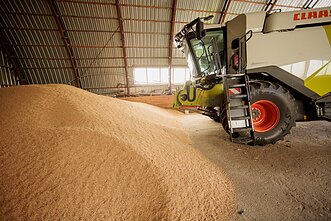


Most of the cheap Ukrainian grain imports have been concentrated in Poland, which led to the farmers’ partial blockade on the Polish-Lithuanian border. The Baltic farmers, meanwhile, say they are more troubled by the Russian grain imports.
Since Friday, Polish farmers have been blocking a major highway at the former Kalvarija-Budzisko border checkpoint and checking trucks, citing fears that some of the Ukrainian grain imported into Lithuania is returning to Poland.
Since attacking Ukraine, Russia has blocked key Black Sea trade routes Ukrainians used to export their agricultural products.
To help Kyiv economically, the EU decided in 2022 to lift tariffs on Ukrainian goods transiting the 27-nation bloc. However, due to logistical problems, much of Ukraine’s grain exports have been concentrated in Poland, pushing prices down for local producers. This has led to tensions between Poland and Ukraine.
However, the Lithuanian grain growers say their biggest problem is not Ukrainian but Russian grain, which enters the EU in huge quantities.
“These are impressive figures, with over 3 million tonnes of Russian grain having passed through Latvia and Lithuania combined in 2023. In total, 12 million tonnes of Russian grain were imported into the EU market last year,” said Aušrys Macijauskas, head of the Lithuania Association of Grain Growers.

Russian grain is driving down prices across the EU, he said, adding that the Russians are deliberately dumping prices to create chaos in the agricultural sector. But the European Commission has instruments to put a stop to this.
“There is a regulation that allows the EU to intervene in the market in an emergency situation and start buying food products the prices of which are falling drastically. In this case, it could buy Ukrainian grain on the territory of Ukraine and thus stabilise the market,” Macijauskas said.
Grain processors estimate that around 50,000 tonnes of Ukrainian grain were imported into Lithuania last year, far less than before the war. Processors, like grain growers, stress that the real problem is Russian grain.
The Latvian parliament has temporarily banned imports of agricultural products from Russia and Belarus until at least July 2025. But even this move has not changed much, processors say.
“They haven’t stopped anything. They sent a very nice message that they are stopping imports into Latvia, but even they haven’t stopped the movement of the same Russian grain into Spain. The same grain will be able to travel by boat to Spain and be sold within the EU. If the commodity is going to third countries, there is no prohibition on its transit through Latvia,” said Karolis Šimas, president of the Association of Grain Processors and Traders.
Some Lithuanian MPs criticise the government’s indecision on banning the imports of Russian and Belarusian grain.
“It should have been done right away, and I don’t know why it hasn’t been done yet. We have a really good experience of transit checks in Kaliningrad, and our border guards, our customs officers really know how to deal with this,” said MP Giedrius Surplys of the Farmers and Greens Union.

So far, the Agriculture Ministry has decided to stop and inspect all grain shipments coming from Russia and other high-risk countries as of March 14.
“The tightening will be imposed on all grain travelling from that origin. The legislation is still being harmonised, so, naturally, the companies and individuals involved in the logistics are making their comments, as they should,” said Agriculture Minister Kęstutis Navickas.
Some MPs are also proposing a temporary ban on the import of Russian or Belarusian agricultural products into Lithuania. Viktoras Pranckietis, chairman of the parliamentary Committee on Rural Affairs, says this is aimed at preventing grain from Russia and Belarus from entering Lithuania and Poland.
“If we start taking normal steps, we will help our own market and we will also help the Poles. This has been exacerbated by the Polish farmers’ protests,” he said.
If the amendments are adopted by the Seimas, the ban would be in force from April 15 until July 1 next year.
Lithuanian President Gitanas Nausėda said he would back the ban on Russian and Belarusian grain imports into Lithuania.

Newsletter
Every Friday morning.