










Lithuanians are among the biggest supporters of Ukraine’s membership in the European Union, and a majority of Europeans see Russia's invasion of Ukraine as a potential threat to their own country’s security, according to a Eurobarometer poll published on Wednesday.
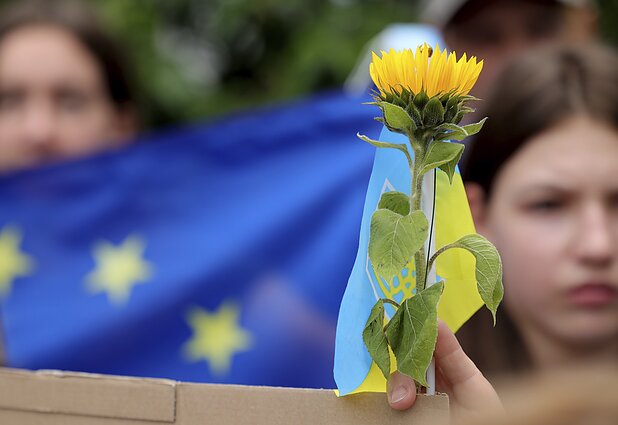
According to the poll, 79 percent of Lithuanians and 61 percent of Europeans are in favour of granting EU candidate status to Ukraine. Only in the Czech Republic, Hungary, Slovakia, and Bulgaria was the support less than 50 percent.
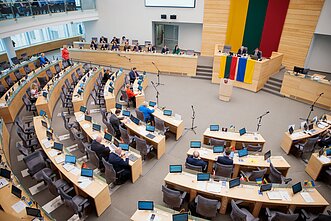
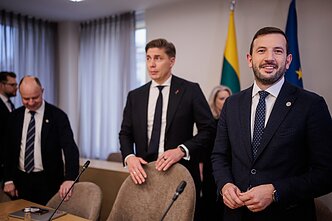
“Talk of public fatigue in supporting Ukraine is exaggerated. There is a clear perception in Europe that Russia’s invasion of Ukraine is a threat to both the EU and individual countries,” Marius Vaščega, head of the European Commission Representation in Lithuania, told a press conference on Wednesday.
He also notes that support among Europeans for various EU actions in support of Ukraine remains strong.
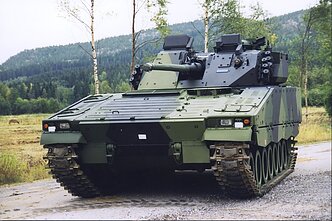
In Lithuania, 86 percent of the respondents – and an average of 72 percent of citizens in all EU countries – support financial assistance to Ukraine, while 83 percent of Lithuanians favour sending military support to Ukraine, compared to an average of 60 percent in other EU countries.
Russian invasion is seen as a threat
According to a survey conducted in EU countries between October and November last year, eight out of 10 Lithuanians and seven out of 10 Europeans see Russia’s invasion of Ukraine as a potential threat to their country’s security. A similar number see the EU’s support for Ukraine as protecting European values.
Eighty-eight percent of Lithuanians and 79 percent of Europeans support more EU defence cooperation, 78 percent of Lithuanians and 65 percent of Europeans support more defence funding, 84 percent of Lithuanians and 69 percent of Europeans support increasing the EU’s defence industry capacity.
On the issue of aid to Ukraine, the survey shows that the majority of respondents (95 percent in Lithuania and 89 percent on average in the other EU countries) are in favour of providing humanitarian aid to the affected people. There is also a fairly unanimous consensus on welcoming Ukrainian refugees (93 percent in Lithuania, 84 percent throughout the EU).

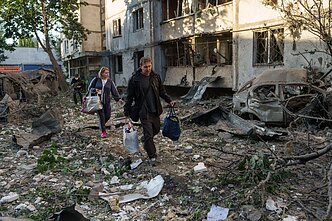
The Eurobarometer survey also asked EU citizens about their views of the security and economic impact of the Russian war in Ukraine. In Lithuania, it is seen as a potential threat to national security by 84 percent of the public, while throughout the EU, by 73 percent.
A year ago, 89 percent of Lithuanians and 76 percent of citizens from other EU countries thought so. The countries with even more concern for the national security implications of the Ukraine war are Poland (90 percent), Sweden (88), Finland (85). Very high numbers were also in Portugal and Denmark (82 each).
More than 90 percent of Lithuanian citizens surveyed believe that the war in Ukraine has serious economic consequences for their country. On average, 83 percent of respondents in other EU countries think so. These figures are broadly unchanged from a year ago.
The number of respondents who think that the war has serious financial consequences for them personally is much lower: 46 percent in Lithuania and 58 percent across the EU.
Inflation is the biggest problem
Eight out of 10 Lithuanian citizens are satisfied with their lives despite geopolitical tensions, a figure that is at an all-time high.
“We have reached a historical high of 81 percent when people expressed satisfaction with their life in Lithuania, despite geopolitical turmoil, despite economic uncertainty. This is not the highest result in the EU, but it is the highest result in Lithuania’s history,” said Vaščega.

According to the survey, the expectations of the Lithuanian population for the near future remain stable: 28 percent think that the next 12 months will be better.
Inflation is still considered the most pressing public problem in Lithuania, but its importance has fallen by eight points to 52 percent over the year.
On average across the EU, the importance of the problem has fallen by nine percentage points to 44 percent, but Lithuania is in the same group as Estonia, Ireland, Greece, Bulgaria, Croatia and Poland, where more than half of citizens consider inflation to be the most important problem facing their country.
“Inflation has become less important in the last year, both in Lithuania and across the EU. Although it is still seen as the most important problem by the society, we can see that the pressure of rising prices is easing,” Mindaugas Degutis, the sociologist who prepared the Lithuania report, told the press conference.
The survey also shows that trust in the European Union remains consistently high, with 63 percent of Lithuanians trusting the EU. The share is higher only in Denmark and Sweden (68 percent each).
The Eurobarometer survey was carried out between October and November last year in all 27 EU Member States for the European Commission. The survey covered 1,013 respondents in Lithuania by face-to-face interviews and has a margin of error of 3.1 percent.

Newsletter
Every Friday morning.