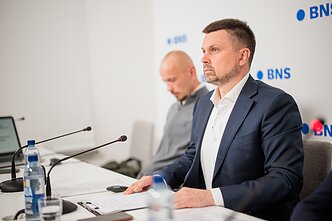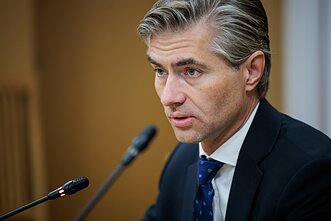













Paulius Lukauskas, who took the helm of the Lithuanian Trade Representation in Taipei a year ago, says he sees enormous potential for Lithuania to establish close ties with Taiwan. However, the results will not come immediately, and one must be realistic about the potential gains for the country.
A Taiwanese representative office opened in Vilnius in 2021. The decision angered China, which protests against any attempt by Taiwan to act as an independent country. The Lithuanian government’s move has also been criticised by some opposition politicians, who have argued that economic ties with Taiwan will not compensate for the losses caused by deteriorating relations with China.
Lithuania officially opened its trade representative office in Taipei in November 2022. At the time, Vilnius claimed it was seeking to strengthen its position in South East Asia and expand exports of Lithuanian lasers and biotechnologies, as well as food products. Trade with Taiwan grew by more than 50 percent in 2022, reaching over 167 million euros, according to the Economy Ministry.

Trade balance not the most important thing
Paulius Lukauskas, head of the Lithuanian Trade Representative Office in Taipei, says Lithuanians are impatient in that they expect immediate results from the increased cooperation with Taiwan. “The public is looking for quick wins to prove that the decisions taken by our government were wise,” he says.
He said his first job when he arrived in Taipei was to assess the business environment and to look for areas where Lithuania had something to offer.
Meanwhile, the first investments from Taiwan have already reached Lithuania. These are not large projects, but they are indicative of the things to come: the Taiwanese have invested in a laser company and in biotechnology. High-tech business is therefore where the Taiwanese investments are likely to focus.
“I think the smart way to go is not only to get a financial injection but also to get access to the markets and knowledge that the Taiwanese have. [...] We have managed to do some deals for the first bank loans, and the first companies got loans from Eximbank, which promotes bilateral trade.
“Fourteen Lithuanian laser companies now have a laboratory here in Taiwan, in the premises of the Industrial Technology Research Institute (ITRI), which is basically the cradle of all the wonders of the Taiwanese economy, because TSMC (Taiwan Semiconductor Research and Manufacturing Company) and all the major corporations come from this institute, which employs about 6,000 people. Most of them are PhDs and develop new technologies.
“So the fact that our laser companies are now there gives them a great opportunity to enter this industry. [...] The cooperation with Taiwan opens a whole new page for our laser companies to work where the big things are happening, whether in Taiwan or South Korea,” said Lukauskas.

The tech company Teltonika is one of those that have concluded an agreement with the ITRI. According to Lukauskas, it is a noteworthy success story.
“We have already won because I think that many countries around the world would like to cooperate in this way, and the fact that the Taiwanese have given us the opportunity to use their know-how gives Teltonika a wonderful opportunity to make a leapfrog. Will they succeed? That’s a different question,” he says.
Moreover, he said, Lithuanians have quickly achieved several successes in the field of food exports, with Lithuanian beer and chocolate coming to Taiwan. In the Carrefour supermarket, for example, Lukauskas counted 66 different Lithuanian products. According to him, it would not be so easy to find Lithuanian products in other countries in the region.
“I suggest to our politicians, businesses, and society to think of cooperation with Taiwan as a technological cooperation and not to focus on the balance of trade. We intuitively started looking at trade figures, but both Taiwan and we are small countries, we don’t have much to export nor is Taiwan a big consumer market.
“Therefore, I think that the greatest potential is technological cooperation, projects relating to semiconductors and lasers. This is where we will help each other to be more competitive in global markets,” says the Lithuanian representative.

According to him, a comparable level of technological cooperation with China would be impossible. The Taiwanese have built their economic miracle and success on their respect for intellectual property, business ethics, and agreements, which, according to Lukauskas, opens up completely new opportunities for Lithuania to work with a technologically very advanced partner.
Lithuanian presence before representative office
Lukauskas says that Lithuanian businesses had been operating in Taiwan even before the opening of the representative office in Taipei. For example, Teltonika used to buy semiconductors from Taiwan, and Tesonet is a major supplier of VPN services here,
“More than 100,000 Taiwanese use Nord VPN or SurfShark. When you tell them that these are Lithuanian products, they are surprised, they don’t know it, but we are the most important player in this field.
“Laser specialists have been working here probably since 2011–2012 and already had their own distributors. It is true that they have not had much success because they have been more successful in jumping on the Japanese technology train. However, if you look at the technological race now, you will see that the Japanese sun is going down a little bit, while Korea and Taiwan are going up. What would really be important for our laser players is to jump on the other technology train, and then we’d have the volumes we want,” says Lukauskas.
He notes that the structure of Lithuania’s economy is designed to serve the European market and that Lithuanian businesses export to European countries, while Asia is more often the supplier of components and equipment.
“These are so-called intermediate goods to which we add some added value and push them further. Maybe then, in the form of a finished product, these products come back to Asia, in the form of brands like Volkswagen or Mercedes, but we have not yet been able to create any big brands ourselves in our 30 years of independence. Asia needs brands or technology, and you can be interesting to them if you are technologically superior or if you have the brands that they need.

“We don’t have brands because our exports are based on B2B (business-to-business) goods, the so-called intermediate consumer goods, and lasers are probably our crown jewel where we can confidently say that we are better, and the Taiwanese acknowledge that, so the dialogue is going very nicely,” he said.
According to the Lithuanian representative, Lithuanians and Taiwanese are evenly matched in the field of biotechnology, so cooperation is also developing in this area. However, he says, cycles in biotechnology are very long and it will take some time before commercial results can be seen.
“But in other areas where we don’t have a technological advantage, we can’t really compete, they can make everything themselves because they either have the technology or they can make it cheaper in Vietnam, Indonesia, or Malaysia. Why should they buy anything from Lithuania if they can make it themselves either cheaper or with better quality? We can only bring here products we are better at making. Are our VPN services the best? We sell them here. Are our lasers the best? We sell them,” says Lukauskas.
Explosion two years ago
Speaking about what low-tech Lithuanian products can be found in Taiwan, Lukauskas says that Taiwan has been importing Rūta chocolates since 2015, and Lithuanian beer and other alcohol since even earlier. But exchanging representative offices gave a perceptible boost.
“Two years ago, there was an explosion, and the Taiwanese desperately started looking for Lithuanian goods. In fact, there was suddenly an impulse to bring in more Lithuanian goods. It was a kind of manifesto, people wanted to buy something Lithuanian, to say thank you,” says Lukauskas.
However, while this was a favourable short-term impulse, in the long run, Lithuania needs to look at sustainable business models and think carefully about what its advantages are.

“Lithuania is a very large grain producer, but we export a lot of it, which is not good. We should make something of it at home with a higher added value and then export. Since we also have a large volume of grain production, around 6 million tonnes, that means that we have some fundamental basis for producing something competitive – anything made from grain, whether it be pasta, pet food, derivative product based on grain, even the chicken or eggs are actually a secondary product in the food chain, starting from grain.
“We can think about ways to strengthen our position here. It’s a long, gradual process, it needs marketing, it needs to be communicated, it needs to be explained. A Lithuanian flag or stamp adds some value, but it is not the whole job. There has to be a good product, a good distributor, good marketing, and it depends on the patience of our entrepreneurs,” he says.
However, he adds, Taiwan is a small market, with only a fifth of the population of Japan, so Lithuania cannot just limit itself to selling its products here.
“This is why I suggest thinking about the core potential, that is technological cooperation, and perhaps cooperation in supply chains,” he says.
According to Lukauskas, developing direct links with Taiwanese businesses could also help Lithuanian companies secure alternative suppliers of equipment and components for their products that they can then successfully sell in markets they are more familiar with – Europe and North America.

“Our journey to [Asian] markets is just beginning. It’s great that the government has spotted the region and developed the Indo-Pacific strategy. Denmark opened its office 40 years ago, the Czech opened theirs 30 years ago, and we Lithuanians are already asking after a year: where are our results, how can we explain to the public now what we have achieved in a year? It takes time. In Taiwan, there is a culture of relationships, everything is done through relationships, through trust. How steady we are in our long-term strategy is up to us, but we need to be patient in dealing with these markets,” he says.
Semiconductors are the new oil
On semiconductors, Lukauskas points out that only the US, Japan, Taiwan, and South Korea are able to play the “semiconductor big game” in this market. This is a market of enormous size, he says, and it requires enormous resources to be a player in it, to grow, and to consistently upgrade the technology. Despite all the dreams, ambitions, and desires, Lithuania needs to be realistic about its weight class, Lukauskas believes.
“Teltonika is a fantastic example, our pride and joy in how they’ve managed to grow into what they are today. They buy ready-made semiconductors from Taiwan and put them into products for further export. But they want to start designing things themselves, to start testing the packaging, which is also a huge thing. Maybe even engage in small-scale chip production, playing in some niches.
“We will have to play in our own league where we can make money. This philosophy is probably followed by many Lithuanian businesses, that we mostly work in certain niches,” he says.
He also believes that talent is a very important element.

“The big-boy game requires tens of thousands of workers. You have to ask whether we could set up a factory of that scale today when we haven’t even taught semiconductor engineering in universities for years. It is encouraging that companies like Teltonika and many others who have accumulated some knowledge, learned through experience, through collaboration that they are pulling us up a little bit,” he says.
He is convinced that Lithuanian universities have to produce specialists first, they have to enter the labour market, get enticing offers, and then the wheel will start turning.
“To jump in now and say that we will immediately be able to compete with the US, Japan, Korea, and Taiwan is unrealistic. Let’s say the German project [the TSMC factory in Dresden] is worth 11 billion euros, of which 5 billion will come as a subsidy from the German government. Let’s ask ourselves are we capable of investing that much?” Lukauskas asks.
He also points out that the investment in Germany is not being made by the Taiwanese government but by a private company which is listed on the stock exchange and has to explain its decisions to its shareholders.
“How would one explain to shareholders why they pick a place that does not offer a 5-billion-euro subsidy and reject one that does? Moreover, Germany has an automotive market, the largest consumer of semiconductors in Europe. With all due respect to our business and our industry, today we consume very few chips for our industrial needs. So we don’t have a market, we don’t offer financial subsidies, and we don’t have tens of thousands of trained engineers,” says the Lithuanian representative in Taipei.

He believes that the strategy chosen by Teltonika of finding partners in Taiwan is the right one. The Taiwanese are coming with their know-how, their technology, which will help them progress faster.
“We have a unique chance to enter the game that will be increasingly important in the future. Everyone already recognises that semiconductors are the new oil, and China itself today pays more for semiconductors than for oil imports. This shows that semiconductors are becoming an increasingly important resource for any country, both for its future and for its economic success. For example, all artificial intelligence technologies involve semiconductors, as do the vast majority of the devices we use at home and at work, and our defence systems. Semiconductors are a critical commodity. And if we are able to have a company in Lithuania that is capable of producing these things, it will not only increase our economic success but also the security of our country,” he said.
Lithuania targets fintech
For some time now, Lithuania has been talking about the possibility of a Taiwanese bank coming to the country. Lukauskas believes these ambitions are entirely appropriate.
“Taiwan has a very successful economy and that means that they are also financially successful. Taiwan has the sixth largest foreign exchange reserve in the world, with around 600 billion US dollars in its coffers, more than, say, Russia. Their financial institutions are sitting on 3 trillion dollars and have to find where to invest it. So the financial potential of Taiwan is enormous,” he says.
Historically, Europe has not been an interesting market for Taiwanese capital, according to Lukauskas, but the situation has changed with the arrival of TSMC and other Taiwanese investments in Europe.

“As things develop, the demand for banking in Europe is likely to grow. This is an opportunity for us. Our fintech ecosystem, our regulator, the Bank of Lithuania, has shown that it can be a little faster, a little more flexible. And the whole beauty of the banking sector is that once they are licensed in Lithuania, they can really operate across Europe without any problems. We can definitely say that we are now selling a concept to Europe, and these banking services are simpler than semiconductor manufacturing,” Lukauskas is convinced.
According to him, in Taiwan, the government is still involved in the banking sector, as nine banks are state-owned. Lithuania is in dialogue with the Taiwanese, trying to show its advantages, trying to sell the idea to them, he says.
Realistic expectations
“I would certainly not suggest putting all the eggs in the Taiwanese basket or say that all the success that Lithuania expects in the next five years must come from Taiwan. We have a very good chance of building cooperation in technology, in supply chains, but I am not suggesting that we should now stop cooperating with China or with other countries because of that.
“We have to be steady, the more alternatives we have, both in terms of supply and sales, the better off we are, the stronger we will be,” says Lukauskas.
He would not speculate when the results of Lithuania’s cooperation with Taiwan will start showing perceptible results.
“Lithuania needs to realise that our resources are limited, we need to channel them in a very focused way, not to spread them very widely. My job here is to identify those areas, to direct maximum political, human, and business attention there, and to get results that our society can understand.
“I have worked all my life in business, not in diplomacy or politics, and I find this case interesting professionally because, for perhaps the first time in our history, the name of our country is an asset. I am really interested from a business perspective in how to maximise that value and how to translate it into the greatest benefit that our citizens can enjoy,” says Lukauskas.
The journalist’s trip to Taiwan was funded by the Bakala Foundation and the US State Department. This did not affect the content of the article.

Newsletter
Every Friday morning.