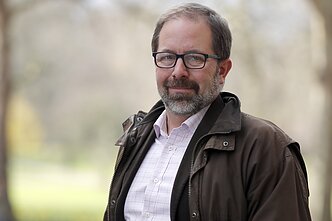

















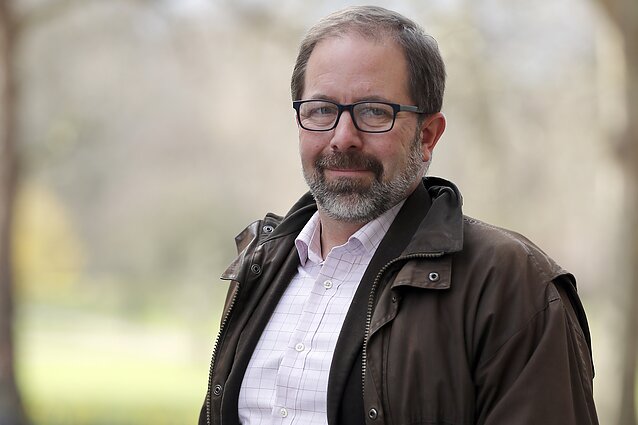
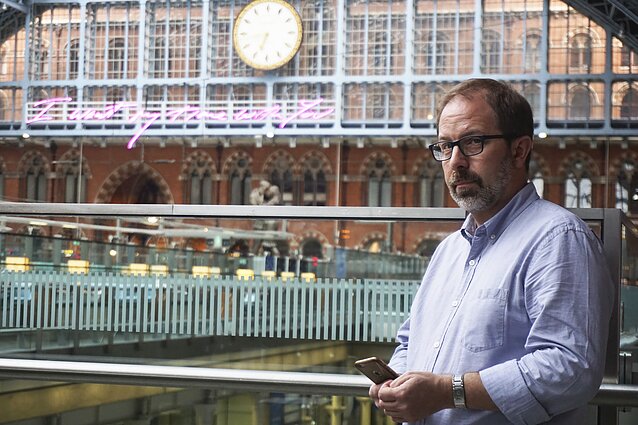
Both the Kremlin elites and the Russian society see their country as an empire. The only way this can be changed is by taking the same measures as against Nazi Germany and Japan after the Second World War, says Keir Giles, senior consultant fellow at the influential Chatham House think tank.
In an interview with LRT, Giles says that Russia has stayed on a path that inevitably leads to conflict with the West, but European and US leaders still fail to grasp the scale of the threat posed by Moscow.
“I fear that [...] decisions will have to be taken about suspending support for Ukraine altogether,” said Giles, who is also an author of several books and numerous academic articles on Russia, its armed forces, and nuclear strategy.
Eastern Europe and the Baltic states have been warning about potential dangers from Russia. Why did Western countries fail to see, or did not want to see, the threats? And has this situation changed?
There were different complementary reasons why it was not easy or convenient for the Western parts of Europe to accept or admit that they had a Russia problem.
This was not just because there were direct costs that were involved in doing so, [but] because so much of the Russian behaviours and so much of the Russian problem were incomprehensible to diplomats, politicians, and decision-makers. It was completely outside their range of experience.
They had been educated and had their careers in an environment where nothing that Russia does is recognisable as a normal way of doing business. They had worked in organisations [...] where you achieve agreements over something by consensus and compromise. Generally speaking, there's an assumption that countries cooperate for the common good.
It has changed slightly since the full-scale invasion of Ukraine. But that still has to overcome these deeply ingrained assumptions about how countries behave and also assumptions about what is actually feasible and possible in Europe today. […]
We have not seen across Europe the return to a defensive posture, the return to taking an interest in the actual physical territorial defence of countries and the reinvigoration of the defence industry that went with it.
We are still grappling with the consequences of 30 years of drawing down defence capabilities across Europe and that supertanker still hasn't turned round.

To start unpacking your arguments, how does Russia work?
It all fits within a fairly narrow bracket of state behaviour. They all operate in a different mindset, it was just hard for Europeans to recognise that the the Russian approach was in the same category as, say, North Korea, and the Taliban.
Do you think that the conflict against the West is deeply ingrained in Russian society and Russian thinking in general?
It is deeply ingrained in the thinking of the leadership and the assumptions and attitudes of society. It expresses itself in some ways that make conflict inevitable. [People in] Russia assume that they are entitled to domination over the countries that surround Russia, they're entitled to an empire at the expense of those other peripheral countries. That is fundamentally incompatible with the Western liberal democratic view that each of those countries is entitled to a say in its future. And that is an unreconciled clash.
In the previous book that I wrote in 2019 called Moscow Rules, [...] it was suggested that unless that difference of opinion was addressed in some way, it would inevitably lead to an open conflict. And here we are.
But how can that change? Does it have to happen because of pressure from abroad or some internal changes?
Internal change is going to be exceptionally hard, not just because these attitudes are so deeply ingrained but also because Russia has been accelerating backwards away from what we think is a normal and natural viewpoint and reinforcing all of these attitudes.
And the basic ingredients for changing a country's mind simply aren't present. They have fought a succession of relatively successful post-imperial wars to either stop losing territory or reassert themselves against their neighbours, like, for example, in Georgia, in Ukraine in 2014.
What they haven't had is a defeat and It is always a defeat that changes countries' [mind] about whether there actually should still be an empire.
The defeat has to be traumatic and it has to be accompanied by a willingness to actually change. In 1991, at the end of the USSR, technically that met some categories of defeat, but it didn't come with the national reappraisal of the country's position.
Russia could fall back on these attitudes in much the same way that Germany did after 1919. You have the same preconditions that led to in the late 1930s Germany having a sense of betrayal, seeking revenge and a brainwashed, indoctrinated youth that was ready to launch military adventures. The parallels with Russia are absolutely clear.
How to deal with it, unfortunately, is probably not feasible.
A few years ago I was discussing exactly this with a senior Russian diplomat in London. He was having an unusually frank conversation because he was coming to the end of his tour. And he said, if you want to change Russia's attitude so it becomes a peaceful neighbour, then the answer is to do what you did to Germany and Japan at the end of the Second World War.
You bomb it flat, you defeat it completely, you occupy it, and you change its entire political system, social system, education, and constitution. Then you sit on the country for a couple of generations to make sure that those changes have taken root. But unfortunately, that is not going to be an option for dealing with the Russia we have today.

Do you see any kind of willingness in the West to tackle the Russian problem? Is there a clear strategy or at least a shared understanding of what to do, and what end goal we want to achieve? Everyone is just taking one step at a time, hoping that Russia does not dissolve as a state.
Unfortunately, all of those things are true. There are different opinions across Europe and also across North America regarding what to do and indeed what can be done. The options for what can be done seem still to be driven by this idea that Russia, because it possesses nuclear weapons, cannot be handled roughly and cannot be handed a defeat.
This is completely untrue and based on a number of misunderstandings of how Russia projects this intimidatory message about nuclear use and what the real picture is, and also some deliberate misreadings of history.
The countries with the clearest vision are the usual suspects, it's the frontline states – it's that arc of countries from the Nordics to the United Kingdom that are the hardliners. And in the middle you've got the blob – you've got France, Germany, and Italy which are deeply unwilling to confront the problem.
Do you think Russia’s nuclear threats are empty? Why do you think they have subsided?
We wrote a long study which was called Russian Nuclear Intimidation: How It Shapes Western Behaviour. The key point that a lot of people missed was that this was not something that started in February 2022.
The other key point is the enormous difference between what Russia's propagandists say and that includes the whole information warfare apparatus. [But] it's the armed forces that actually own the missiles. They would be responsible for firing them, they would be the essential ingredient in actually launching a nuclear weapon, and they have shown no inclination to change their posture at all.

People are terrified about the idea of Russia launching a nuclear weapon in Ukraine. But does Russia actually have any nuclear, chemical, biological, radiological, or nuclear defence units in Ukraine at all? Not that anybody's seen. So they are absolutely unprepared for doing anything of the kind.
It’s what’s happening is what people miss when they focus so intently on the propaganda.
How do you see the current situation inside Russia? Is Putin's regime still strong?
Prigozin was an indication that the regime was not as solid as had been for so long. But on the other hand, Prigozhin was an outlier and it was an isolated incident. [...] But also there's nobody else in a similar position that is outside the system, there's nobody else that has an interest in bringing the system crashing down, which is what happens if you start to disrupt that pyramid.
We see instead a continuation of the trend that was briefly interrupted by Prigozhin, which is greater repression, greater intimidation, and less inclination by the Russian population to resist.
How do you see the current situation in Russia’s war against Ukraine? There is some concern that Western countries might pressure Ukraine to start negotiations.
I fear that the decisions that were taken by countries like Germany and the United States about the amount and nature of support that could be provided to Ukraine are now leading to a situation where decisions will have to be taken about suspending support altogether.
The combination of how support has been provided and the failure of the European defence industry [...] mean that those countries that are supporting Ukraine have been casting around the world looking for the munitions that Ukraine needs to survive. There is a finite supply because the industry has not restarted. Therefore, there will come a point when it becomes harder and harder to supply because the campaign will probably drag on through 2024, possibly beyond.
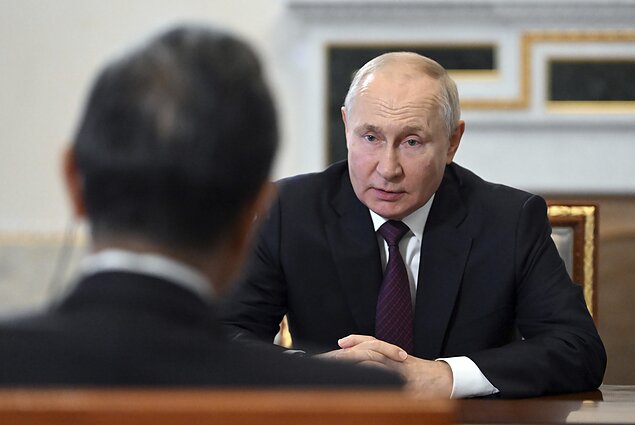
This is one way of how the extended conflict plays into Putin's hands. The other way is the limited tolerance of electorates around the world for the amount of money that is being poured into the Ukrainian economy.
Even though this is a misrepresentation, particularly in the United States, the opponents of Ukraine portray this as US taxpayer's money being poured directly into President Volodymyr Zelensky's pocket.
They don't realise that it is expressed in terms of weapons that were paid for a long time ago and are reaching the end of their shelf life [and would now be used] for the purpose that they bought for in the first place – destroying Russian munitions. The funding is staying in the US because it's funding the defence industry there.
So there's a perception issue which is not being well managed across Europe and the United States. But the core problem is that European politicians have been very bad at explaining the long-term nature of the problem and what it is going to cost. Because that's not a message that is going to win votes.
What would you advise on how to deal with Russia?
The unfortunate truth, [...] is that the only way to deter Russian military adventurism is through hard security, deterrence and actually possessing armed forces. They need to be able to successfully resist Russian military aggression and inflict sufficient punishment on Russia so that the costs of launching another small war are absolutely clear and undeniable in Moscow.
Now, sadly, that is expensive and it's unpopular, which is why so few countries around Europe, other than those which are under direct and immediate threat themselves, have been willing to recognise the problem and invest accordingly.
And about Ukraine? To support Kyiv as long as it takes, provide them more weapons, that they could also raise the price of aggression?
Absolutely. But also to stop playing the game on Russia's terms and by Russia's rules, stop putting these artificial restrictions in place on what Ukraine can actually do. There is no justification at all for the limits that, for example, the United States has put on the ranges of the weapons that it's supplying or putting this taboo in place, saying the Ukrainians cannot strike into Russia's 1991 borders.
That, of course, provides Russia with a safe haven from which it can launch missile and drone attacks to kill Ukrainian civilians. It is just an expression of this syndrome that we see repeated not just in the United States, but across quite a few Western European countries – it is the idea that your responses to Russia have to be purely reactive.
You've got no initiative, you've got no leverage, there's nothing you can do to shape Russian behaviour. You just have to sit there as a passive victim and do the best you can by following Russia's framework for how the conflict should develop. That is fundamentally wrong and the result has been tragic for thousands of Ukrainian civilians.

Newsletter
Every Friday morning.