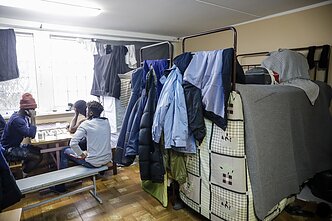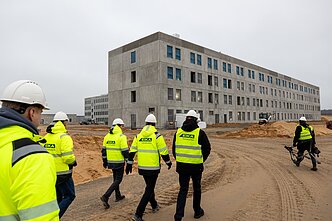
















Some irregular migrants can already move freely in Lithuania and settle outside the accommodation centres. However, some say they are not well informed about the procedure and leave into the unknown.
A large number of foreigners can leave the migrant accommodation centres for 24 hours. Now, they will also be able to move out permanently upon a favourable decision from the Migration Department or a court.
Miriam (not her real name) said she signed a document in the Medininkai migrant centre, vouching that she had enough money and wanted to live in Vilnius.
“Two weeks later, they came to me and told me they had good news – you can live wherever you want, as long as you report where you are every Thursday,” she told LRT.lt. “At the beginning, they said I had to leave the centre in 24 hours. A few hours later, they came again and said I had 12 hours left.”
According to her, she was not prepared to leave the migrant centre, nor could she find a place to stay so quickly.
Miriam is from Iraq and is a member of the Yazidi minority that suffered the genocide of the Islamic State. Her asylum application in Lithuania was denied, so she must be deported from the country but will not leave willingly. She is currently living with people who agreed to take her in.

According to the NGO Sienos Grupė, which helps irregular migrants in Lithuania, they regularly receive messages saying that foreigners are being told to leave the migrant centres, but they do not know where to go.
“They keep repeating that they are being told: ‘If you want freedom, write that you have a place to live and go.’ Then, they write down any address and leave because they are afraid that they will not get freedom otherwise. But they have nowhere to stay, they rent a place in a guesthouse, and the money runs out,” said a volunteer from Sienos Grupė.
The migrants are being pressured to leave because there is no longer any justification for keeping them in the accommodation centres, said Viktor Ostrovnoj, head of advocacy at the Lithuanian Red Cross Asylum and Migration Programme.
“These are people who are no longer asylum seekers but cannot be deported from Lithuania for one reason or another. […] To our knowledge, such people are encouraged to find their own accommodation to make it look as if they are not being thrown out on the street but are going to live somewhere else,” he said.
Detailed information?
According to Ostrovnoj, migrants might choose to leave Lithuania if they see no prospect of surviving in the country.
However, if a foreigner tried to leave and was captured in another EU country, he or she would be returned to Lithuania, the first EU country they entered. All migrants living in one of Lithuania’s migrant centres have been registered, their fingerprints collected.

According to the State Border Guard Service (VSAT), the claims that migrants are told to leave the accommodation centres without knowing where to go are baseless.
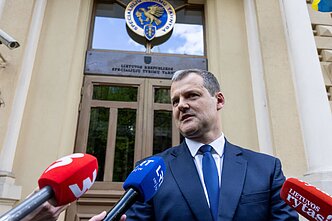
“When a migrant applies for a residence elsewhere, he or she is planning and setting the date from which he or she will move out and reserve a place to live outside the centre. Without such a reservation, it would be impossible to apply to the court,” said Rokas Pukinskas, a representative of the VSAT.
In his words, officials inform migrants of the rules for leaving the centres in detail.
“There are cases when foreigners who have already had to move out suddenly change their minds and ask to be allowed to stay in the centre. In this case, the person has to take care of his or her own food, since he or she is technically no longer living in the centre and is no longer provided for by the state,” Pukinskas said.
According to the VSAT representative, 25 migrants from the Medininkai migrant centre have been granted the right to leave so far.
“It should be noted that almost 50 percent of such foreigners used either the services of a privately hired lawyer or state-guaranteed legal aid,” said Pukinskas, adding that this shows that migrants have all the necessary information about the procedure.

He also noted that all migrants who left the centre so far remain in Lithuania: “All these foreigners [...] inform the VSAT about their whereabouts in an orderly manner at the set time.”
In June, Lithuania’s Interior Ministry drafted law amendments, allowing rejected asylum seekers free movement in the country. Under the new legislation, migrants have the right to work even if they do not have a Lithuanian residence permit.
However, finding employment for them might be impossible. Most Lithuanian banks cannot open an account unless the person has an identity card, passport, or residence permit. Most migrants do not have any of these documents.
Miriam also has no identity documents, only several documents from courts, showing that she was denied asylum in Lithuania and that she must be deported.
“I have no plans, maybe I will know in the future,” she said when asked what she plans to do after leaving the migrant centre.
Read more: Lithuania to stop detention of migrants, allow asylum seekers to work

Newsletter
Every Friday morning.