













The Lithuanian parliament Seimas has drafted a “desovietisation” law, which proposes to remove symbols of authoritarian and totalitarian regimes and the information used to promote them from all public places in the country. Which objects does it cover?
The draft law proposes to prohibit the propagation of totalitarian and authoritarian regimes and their ideologies in any form of commemoration or depiction in public places, such as:
- Symbols used to promote the regimes;
- Information promoting the regimes;
- Persons if they were or are active in occupying political, military, or repressive structures
- Organisations, events, or dates associated with totalitarian or authoritarian regimes or with military aggression committed or being committed by such regimes against other states;
- Persons, organisations, events, or dates related to the Soviet occupation of Lithuania in 1940-1941 and 1944-1990, and the Nazi occupation of Lithuania in 1941-1944.

Which objects are covered?
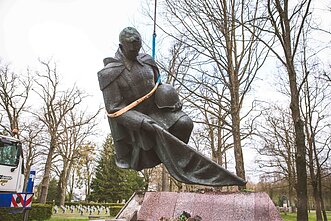
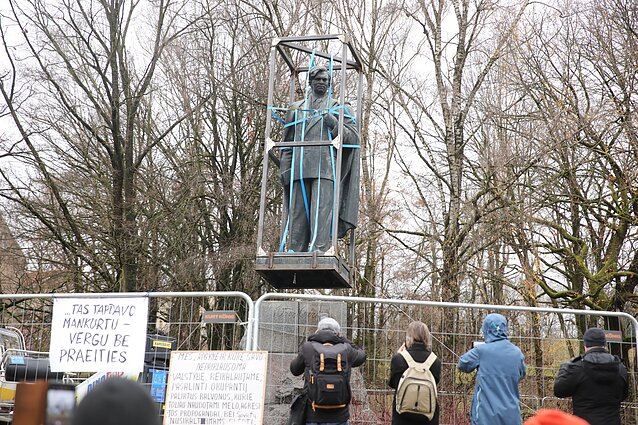
The prohibition would apply to all public objects, ie public facilities, monuments, sculptures, obelisks and memorial plaques, other commemorative objects, and property owned or managed by the state or municipalities, as well as public places, such as streets, squares, parks, or any other public space, as well as their names.
According to the draft law, if it is decided that a public object promotes authoritarian or totalitarian regimes or their ideologies, it would be replaced if its components, features, or name, which do not comply with the requirements of the law, could be removed without ruining the object’s purpose. Otherwise, the public object would be removed altogether.
The provisions of the law would not apply to public facilities that are:
- exhibited in the context of the activities of museums, archives, and libraries;
- used to inform the public about totalitarian and authoritarian regimes and the ideologies they propagate, as well as historical and current events and their consequences;
- used for educational, scientific, professional artistic, and collecting purposes.
Who would decide?
An inter-ministerial commission would be set up to assess whether totalitarian or authoritarian regimes are being propagated by certain public objects and would submit a conclusion to the director of the LGGRTC for a decision. Municipal authorities would collect information on objects that may violate the law.
The inter-ministerial commission, when deciding on public objects located in the territory of cemeteries or other burial sites, must obtain the opinion of the defence and foreign ministries. In the case of public objects related to the activities of religious communities and societies, the commission must consult the Justice Ministry.
The final decision on whether a public object propagates totalitarian or authoritarian regimes and their ideologies and needs to be replaced or removed would be taken by the director of the Lithuanian Genocide and Resistance Research Centre (LGGRTC). This decision could be appealed to the court.
It is proposed that the Law on the Prohibition of Promoting Totalitarian and Authoritarian Regimes and their Ideologies will come into force on November 1.
Read more: New ‘desovietisation’ law takes aim at Lithuania’s remaining Soviet-era signs

Newsletter
Every Friday morning.