










After Russia launched an unprovoked war against Ukraine in February, Lithuanian politicians decided to start drafting agreements among the country’s political parties to ensure continuity in national security and foreign policy. These are two separate documents setting out Lithuania’s objectives until 2030.
The documents still need to be endorsed and signed by Lithuania’s main political parties. The goal is to ensure that different governments pursue consistent policies.
While there is a broad agreement among ruling and opposition parties about Lithuania’s main security and foreign policy goals, some differences have emerged while negotiating the agreements. Initial proposals included universal military service and a hard target of raising defence spending to 3 percent of GDP. Both proposals have not survived in the final draft.
Moreover, the current conservative-led government’s confrontational stance on China and exchanging representative offices with Taiwan have been criticised by opposition politicians.
The Farmers and Greens Union, the biggest opposition party in the Lithuanian parliament, has also threatened to drop out of the agreement if the ruling coalition pursues initiatives to legalise same-sex civil partnership and grant the head-of-state status retroactively to former conservative leader Vytautas Landsbergis.
Here are the main provisions of the provisional inter-party agreements on national security and foreign policy:
Agreement on national security
The Agreement on National Security and Defence identifies three areas of focus for Lithuania: strengthening the Lithuanian Armed Forces, strengthening international security and defence guarantees, and preparing the country for armed defence and response to hybrid attacks.
The first axis is strengthening the Lithuanian Armed Forces
The first part of the agreement identifies the measures which, if adopted, would strengthen the country’s armed forces. It specifies that particular attention must be paid to stockpiling, strengthening logistics capabilities and developing alternative supply chains.
Lithuania’s territorial defence capabilities need to be strengthened, according to the draft agreement. This would be done by increasing the number of volunteers, ensuring that they are adequately equipped with weapons and supplies, and improving the conditions of service and the incentive package. The agreement provides for the need to increase the active reserve of the armed forces. The measures envisaged would ensure that by 2030 the active reserve will reach 50,000 soldiers.

A decision is foreseen on a gradual increase in the number of soldiers in compulsory initial military service in line with the needs of national defence, in parallel with the development of an alternative military service system. It also identifies the objective of strengthening not only the military, but also the other institutions that make up the Lithuanian Armed Forces.
In the short and medium term, it is envisaged to develop new and reinforce existing national air defence capabilities to ensure preparedness in the event of potential conflict.
The second axis is strengthening international security and defence guarantees
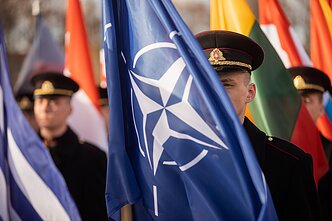
The second strand foresees the strengthening of the transatlantic link and the extension of NATO’s collective defence guarantees.
It also seeks to achieve additional significant permanent deployments of NATO allies in Lithuania on a multilateral and bilateral basis, while guaranteeing the seamless provision of host nation support and the movement of allied troops for the potential deployment of additional allied forces in Lithuania.
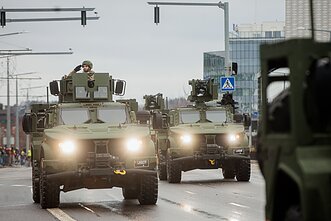
The draft agreement stipulates that the US is a strategic partner of Lithuania in the areas of security, defence and foreign policy, and that its contribution to strengthening defence and deterrence in the region is indispensable. Therefore, the document calls for the permanent presence of US combat forces and the forward deployment of combat equipment in Lithuania, and to this end, it is necessary to develop and improve the infrastructure required for the deployment of US forces and capabilities, including air defence, in Lithuania.

Given Lithuania’s strong partnership with Poland, the document envisages pursuing long-term trilateral security and defence cooperation with the US and Poland. In addition, it is envisaged to seek greater German involvement in the security of Lithuania and the Baltic region. Cooperation with the United Kingdom, the Baltic and Nordic countries will be strengthened, and support will be given to the accession of Sweden and Finland to NATO.
The third axis is on preparing for armed defence and response to hybrid attacks
This part of the Agreement foresees preparing a National Defence Plan by 2023, which would define the role and actions of civilian institutions, the private sector and citizens in defending the country. The document also foresees organising national mobilisation exercises in 2024 to test the preparations.
The agreement would also see strengthening the Lithuanian Riflemen’s Union and, if its members agree, use the organization as a basis for a civilian force. The provisional target is a civilian force of 50,000 riflemen by 2030.
The document also envisages stepping up the training of citizens for armed and unarmed civil resistance, strengthening national identity, respect for the fundamental values enshrined in the Lithuanian constitution, the commitment of citizens to preserve the state, etc.

Other goals include strengthening Lithuania’s intelligence institutions, openly communicating national security challenges to the public, limiting the potential for information warfare against Lithuania through legislation, strengthening Lithuania’s cyber security and defence capabilities and the civil protection system.
Funding
According to the draft agreement, the previous commitment of spending 2.5 percent of GDP on defence, made earlier this year, will be maintained, and “further financing of defence must be linked to the needs of the national defence system and the Lithuanian Armed Forces”.
Agreement on foreign policy
Unlike the national security agreement, the foreign policy agreement does not set out a clear direction. It foresees the need for the EU to become strong and autonomous enough to assume strategic responsibility for the stability of its neighbouring regions (especially to the east), developing democracy and furthering European integration.

The plan is to further a strategic partnership with the US and to work together to ensure the effective integration of the Eastern Partnership countries into the EU, in particular Ukraine, Georgia and Moldova.
The document states that Lithuania's strategic geopolitical interest is to strengthen the EU and to remain among the core of the EU’s constituent states, actively building coalitions in Lithuania’s interests. It is also envisaged to actively support Finland’s and Sweden’s membership in NATO.
The draft agreement states that Lithuania is obliged to provide all possible military, economic, political and humanitarian support to Ukraine, which is facing aggression from Russia and Belarus, and to push for support at EU and NATO level.
The plan is to seek an early end to EU-wide imports of energy from Russia and to maintain strong sanctions on Moscow. The document states that normalising relations with the Russian Federation will only be possible after the collapse of the Vladimir Putin regime and once Russia returns Crimea and all the occupied territories to Ukraine, South Ossetia and Abkhazia to Georgia, and Transdniestria to Moldova.
In relations with Minsk, the draft agreement claims that Lithuania’s interest lies in a democratic, European Belarus. Lithuania will not recognise Alexander Lukashenko as legitimate president of Belarus and will treat any deals he makes with other countries as null and void, according to the agreement. The safety of the Astraviets Nuclear Power Plant, which was launched in 2021 against Lithuania’s fierce protestations, is to be continuously raised at the International Atomic Energy Agency (IAEA) and in other international organisations.
The document calls for fostering good neighbourly relations with the Baltic, Nordic and Visegrad countries “at all levels”. The intention is to further strengthen political, cultural, economic and trade relations with Taiwan, in particular its high-tech sector, through a strategic partnership with the US.
The agreement also claims that Lithuania has a national national interest “to pursue the supremacy of the liberal democratic Western world over the Russia-China axis” and to develop relations with China in the EU context.

Newsletter
Every Friday morning.