










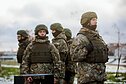


The migrant return policy on the border, also called pushbacks, has been adopted by Lithuania in response to what it says is a weaponisation of migration by the Minsk regime. However, the practice may end up violating humans rights.
Last week, Interior Minister Agnė Bilotaitė signed a decree allowing border guards to stop irregular migrants from crossing into Lithuania from Belarus and to direct them to border checkpoints or diplomatic representations.
“Lithuania's border must be protected with all legal means from any illegal crossing of the state border as an instrument of hybrid aggression Lithuania is now being subjected to,” the interior minister said in a statement.
The pushback policy proved quite effective, with border guards turning back up to 300 irregular migrants each day.
Belarus then claimed that the Lithuanian Border Guard Service (VSAT) was using violence against migrants.
Later in the week, it was reported that the Belarusian authorities were preventing some Iraqis still in Belarus from returning to Minsk. Armed Belarusian border guards allegedly fired flares and used gunshots to force the migrants towards Lithuania.
With both Belarus and Lithuania pushing them back, migrants would be stranded for hours in the strip between the two countries.
Read more: Belarus uses gunshots to force migrants over the border, says human rights monitor

Concern for migrant rights
The Lithuanian prime minister, the opposition leader, heads of parliamentary groups and several ministers held a meeting last week to discuss the influx of irregular migrants from Belarus.
“The decision to push back migrants, I think, will lead to a new situation. Lukashenko risks choking on the [migrant] flows that he himself has initiated,” said Eugenijus Gentvilas, leader of the Liberal Movement’s political group. “And if he is still trying to initiate new ones while Lithuania continues to push back migrants, imagine what will happen in Belarus.”
Gentvilas also expressed concern for the migrants, whose fate is uncertain if they end up stuck in Belarus.
Read more: Video shows migrants stuck on Belarusian–Lithuanian border
Lithuania’s mission right now is to show that the present influx of migrants is too large to adequately ensure that their rights are protected according to international conventions, said Gentvilas.
“Lithuania cannot and is incapable of following the guidelines of those conventions in terms of human rights for these people, since the flow [was created by] force, [...] and was made into a tool of hybrid aggression,” he said.
Higher standards for democratic countries
“We cannot close our eyes. We need to meet our international human rights obligations,” said Vytautas Valentinavičius, the human rights bureau chief at the Seimas Ombudsmen's Office. Last week he was on a mission to monitor how the pushback policy was implemented in practice.
“It seems that while it defends its borders from migrants, Lithuania is deterring migrants without differentiating their vulnerability, which is the most important criterion according to international documents,” Valentinavičius said.
Border guards are supposed to consider the age, gender, and possible disabilities before pushing people back, according to him.

“What is happening right now is a mass pushback from the border without any differentiation, when it’s clear to everyone that there are children, who are a particularly vulnerable group,” he added.
Lithuanian border guards were given a very difficult task, one that is questionable considering Lithuania's obligations to protect migrant rights, according to Valentinavičius.
“Some officers ask if what they are doing is justified, when they can clearly see children. [...] Considering international obligations for human rights, this is an inhumane move,” he said. “Of course, officers must carry out [the government's] decisions, but I’m questioning if we, as a country that is celebrating the 30th anniversary of being a democratic state, are going in the right direction.”
Valentinavičius also pointed out that migrants were left stranded in the rain, and given no directions when they asked where to turn in their asylum applications.
“This violates international documents, which state that people have the right to apply for asylum when they approach border guards, and border guards are obliged to provide exact information.”
While democratic countries could excuse some decisions made by the Lithuanian government against the irregular crossings due to it being an instrument of hybrid aggression, migrants cannot be pushed back and forth with guns or left stranded by the border, said Valentinavičius.
“If we say that we are a part of the European Court of Human Rights, we need to fulfill these obligations, we cannot torture a person or strip them of their dignity.”
Border guards should identify vulnerable people before carrying out pushbacks, as required by international law, according to Valentinavičius.
“What is most important is to follow the principle of humanity. Border guards should understand when they see children drenched in rain that consequences could be dire.”
Democratic societies are held to a much higher standard than authoritarian regimes, he added.

Read more: ‘Some lose their minds.’ Problems are brewing in Lithuania's migrant centres
Each case is considered
Border guards are obliged to follow the principle of humanity and abide by the law while carrying out the pushbacks, Lina Laurinaitytė-Grigienė, spokeswoman for the interior minister, said on Friday.
“I cannot comment on the tactical measures used by the officers, but I can reassure that officers consider each case and respond appropriately to a sensitive situation,” she said.
However, the main task of the border guards is to stop migrant flows, therefore they have to stay alert and use tactical measures, Laurinaitytė added.
No cases of the Lithuanian State Border Guard Service (VSAT) officers exceeding their powers and using excessive force against the migrants were reported, VSAT spokesman Rokas Pukinskas told LRT.lt.
Praise for border guards
“What I saw was professional and high-level work. [...] I think that the work of our officers deserves the highest recognition,” said Laurynas Kasčiūnas, head of the parliamentary Committee on National Security and Defence (NSGK).
He claimed that he also spent Friday at the border and witnessed the pushbacks first-hand.
“I don’t wish for a situation where non-governmental organisations, human rights defenders, monitors [...] would become supporters and facilitators of irregular migration,” he added.
The VSAT defends Lithuania's border and “European civilization”, Kasčiūnas said.

Read more: Lithuania publishes ‘likely proof’ of Belarusian guards directing migrants
Risk of armed conflict
By using force to push migrants towards Lithuania, “Belarus may be provoking an armed conflict”, political analyst Marius Laurinavičius told LRT.lt.
“Lukashenko’s actions are very dangerous, but we need to protect our border. And when Lukashenko is carrying out this attack, we need to make it even clearer that we are protecting our border,” he said.
The pushback policy poses a lot of risks, but Lithuania has no other choice, Laurinavičius said, adding that the policy was carefully discussed with the EU, which is why it took longer to implement.
Read more: Latvia warns of risk of ‘incident’ between NATO and Russia in Baltics
Lukashenko will use the migrant crisis to smear Lithuania and make false claims, however, and Lithuania needs to “have its own agenda instead of responding to his every action”, he added.
While Belarus’ moves could lead to armed incidents, Lukashenko’s next move is impacted by various factors.
“They have several scenarios at the same time that depend on various factors, including our response. Then they choose which direction to follow [...],” said Laurinavičius. “However, we have to keep in mind that there's no more such thing as a red line.”

Newsletter
Every Friday morning.