









A unique product developed by Lithuanian school students has caught the attention of big firms.
In her classes, economics teacher Vaida Janavičienė encourages students to think creatively. Her goal is to inspire students to start their own business.
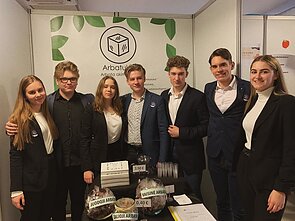
And some have done so even before leaving school – recently a group of Janavičienė's students at Klaipėda Vydūnas Gymnasium set up a functioning company that makes real products.
Inspiration came from an everyday situation rather than textbooks.
“One of the students wanted to quickly make some tea at home, but it slipped out of his hand and tea leaves spilled all over kitchen,” says Janavičienė. “He began wondering how to make tea without tea leaves and avoid such accidents.”
As soon as the idea was there, the students rolled up their sleeves. It took some experimenting to create solid, water-soluble cubes of tea.
The final product was ready for roll-out by the first months of 2021, a soluble tea cube made without any food dies or artificial flavours. The students set up a company titled Arbatukas, or ‘little tea’.
“The school is often criticized for teaching subjects that are useless in a real life,” says Janavičienė. “But this particular curriculum helps students develop real financial literacy skills.”
Small steps towards the goal
For Gvidas Ruškevičius, one of the students behind Arbatukas, motivation came from belief that an idea discussed in class could actually turn into a product.
“We found soluble tea powder, but it contained a lot of preservatives, dyes, and flavour-enhancing chemicals,” Ruškevičius recalls the creative process. “We wanted our product to be healthy.”
It took several months to develop the final product. “We had to do a lot of testing at home, after school. Our stomachs suffered as well,” he says.
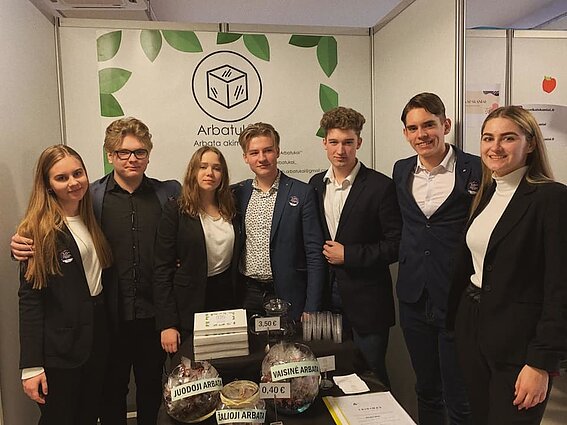
At several points in the process, the team almost gave up.
“Of the eight people who joined the team, we only have three left,” Ruškevičius says. “But as the team leader, I always believed that we had to go to the end, at least create the prototype.”
Now, the school project has turned into cooperation with a Swiss company and, with some help from a big Lithuanian company, the students are planning to bring their product to the market.
Their plans were somewhat upset by the pandemic, which sent students from classrooms to computer screens at home.
But the team are using the time to better their product – at the moment, for example, they are looking for ways to extend its expiration date in order to meet European regulations for tea products.
“We are planning to patent our product,” Ruškevičius adds.

Teaching economics
Raising capital is now the biggest challenge for students.
“Business development requires money, and as school students we don't have much,” says the young entrepreneur.
For Ruškevičius, however, the biggest help in the process was the economics education programme, the Lithuanian Junior Achievement. He says such programmes should be deployed in schools, including in fields other than economics.
Junior Achievement Lithuania is an NGO running the programme that teaches economics to 20,000 students from more than 350 schools across the country.
Although economics teaching is improving, financial literacy among Lithuanian students is still worse than among their peers in Western Europe, says Andželika Rusteikienė, the head of Junior Achievement Lithuania.
Most students in Lithuania still learn what they now about economy and finance from their parents rather than at school, she says.
“We have to start teaching economics from the first grade. Not only theoretically, but practically. This is how Estonia thinks,” Rusteikienė says.
While the EBPO's PISA survey ranks Lithuania among the top ten countries in terms of financial literacy in schools, Estonia is number one.

“We started to learn economics too late,” agrees Ruškevičius who thinks that financial literacy classes should start as soon as students start receiving lunch money from their parents.
Surveys indicate that a big part of the Lithuanian population do not have enough savings to fall back on in case they lost their job. That, Rusteikienė believes, is a result of insufficient financial literacy.
According to her, older generations of Lithuanians did not even have economics classes at schools, and it shows in how the society treats money, savings and investment.
“Habits don’t form overnight, they have to start developing at school. Financial literacy needs to be included into the educational process together with mathematics and information technologies,” Rusteikienė says.
According to surveys, most Lithuanian students prefer a career in the public sector. Better knowledge of economics and business could change that, Ruškevičius thinks.
“Many prefer guaranteed income, because business is always risky. To learn how to reduce the risks, one needs financial literacy,” he says.

Newsletter
Every Friday morning.