








Around the same time as Lithuania declared independence, US journalist and writer Anne Applebaum began her journey across the east. What did she witness then and what would she find on "the edge of Europe" some 30 years later?
"This isolation [in Eastern Europe] and the accompanying desolation, were the result of decades of war, ethnic cleansing and totalitarian rule,” she writes, drawing close parallels with the satirical (and fictional) East European 'country' Slaka that was wrecked by every tribe “specialist in pillage and rape”.
In the 2015 foreword to her book Between East and West: Across the Borderlands of Europe, Applebaum admits that “the people I met on that trip are doubtless more worldly, [...] maybe more cynical than when I met them. [...] They would no longer treat me like an emissary from another world, and I would no longer perceive them, as I did then, as exotic and strange”.
But this does little to soften her gaze or the snarky judgement handed out in nonetheless vivid precision.

The people she comes across thirty years ago are “gently feminine” males, tired people with “squashed peasant face[s]” or resembling a “small rodent”. They brazenly try to deceit the travelling Westerner to prove their version of history, because having been told so many lies during their lifetimes, they have invented their “own versions of the truth”.
Even the solitary dog she encounters on the way is “an unpleasant black terrier”. An easy-to-admire poet Igor in Belarus does not escape her judgement either, which she delivers in snap, short sentences, demeaning his self-consciousness about speaking limited English.
She gazes upon people, describing them as stragglers with a shaken past who are grudgingly inching onward to an unclear future, stricken by the confusion and the sudden collapse of the system that had enveloped them for so long – not far from the dissonance-inducing perceptions in Alexei Yurchak’s Everything Was Forever Until It Was No More.
Today, this ‘last Soviet generation’, as Yurchak labels them, have landed on solid ground – but what ground is it exactly?
No longer ‘suffocating in its own dirt’
Starting in Russia’s Kaliningrad in the north, Applebaum cuts across Lithuania, Belarus, Ukraine, and Moldova, before coming “back [to] the West” in Istanbul.
In Brest, she explores a Belarusian border town that was a gateway to the wealth in Poland. Today, many still see it as a gateway to freedom and, most of all, safety.
In the years that followed her visit, Chechen exiles have crowded the same train station, attempting to reach Poland that still entailed “a fresh coat of paint” for the lives of many as it did thirty years ago. The stick is no longer the crushing poverty, but the terror of persecution by Ramzan Kadyrov’s regime.
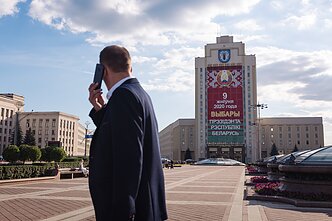
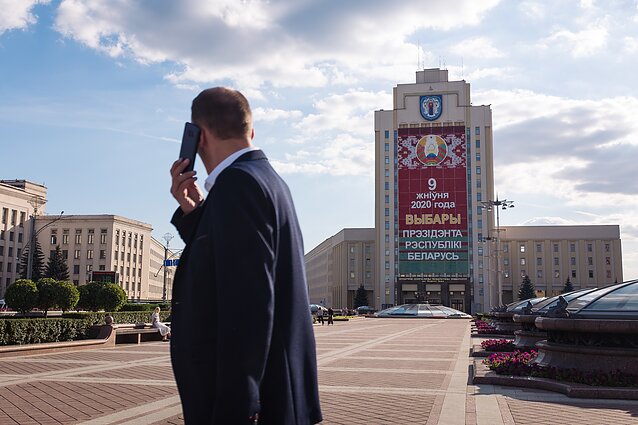
The squalor and spectacular ugliness of early-1990s Minsk, as described by Applebaum, seems to have helped Alexander Lukashenko propel his populism.
Even today, as mass protests continue to rip through Belarus, regime propaganda is repeating the same three-word mantra: Belarus is a “peaceful, beautiful, clean” nation.

Minsk is no longer “suffocating in its own dirt”, the sidewalks are not broken, the metro is without the “odours of unwashed bodies and old cigarette smoke”.
But the same “large, bland, impersonal structures” housing public institutions have remained. And so did the Soviet-like regime with the Soviet-era repressions.
During my own trip to Belarus back in 2016, an eager teenager – apparently a local radio host – blurted out praises to his government as we got off a train in Brest. “Where do you see a dictatorship,” he asked me rhetorically, manically swinging his arms around the station. “We have fast trains, jobs, everything is clean,” he smiled, “do you see a dictatorship here?”
In 2020 and onward in 2021, exactly thirty years after Applebaum’s visit, Belarus indeed was forced to come to grips with what ‘dictatorship’ means.
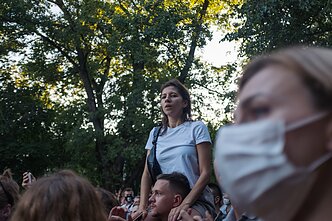
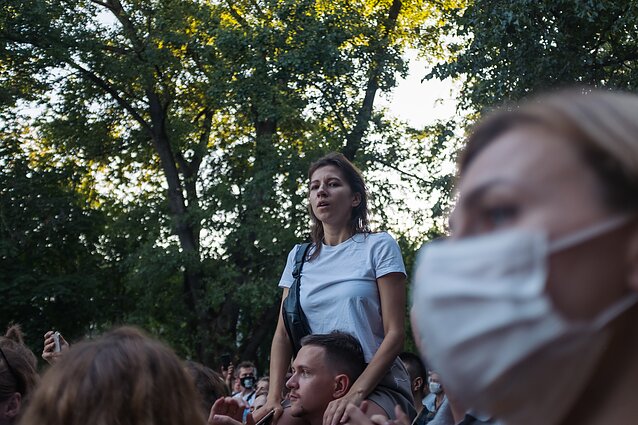
As torture, killings, and suppression of dissent returned to the streets of Minsk, people again flocked to collective memory as the site of struggle, forming a human chain at the site of NKVD massacres, nudging the society to re-examine the Soviet myth, its muted horrors, and the “partisan nation” self-image eagerly maintained by the 26-year regime.
“It was always easy to say what the Belarusians were not,” writes Applebaum. Now, the mass movement is shaping something that Belarus has arguably never been – a civic nation.
While slipping past the Carpathians on her way to Moldova, hitching a ride with two Hungarians (the first people she describes in quirky yet positive light), Applebaum passes villages that slipped into meaninglessness during the Soviet occupation, and even more so after its collapse.
She recalls in beautiful, short chapters the biographies of people born there who have left a forever footprint on the world, including Andy Warhol, or Warhola.
A family she meets in Bukovina are similar to the long-dead Polish nobles she describes in eastern Belarus, who longed for the pre-partition glory while leading debilitating lives under the Russian Empire.
Their houses full of remnants of grandeur, the family in Bukovina now lives in cultural squalor, their memory displaced by the Soviets. Their offspring could have been princes, she recalls the words of the professor. “Yet they feared the future. They feared Ukrainian nationalism; they feared Romanian nationalism; they feared expulsion.”
Fear, it seems, haunts most of the people she meets on the way. The fear that the temporariness of transition chaos becomes permanent and that the future will be sold off in another rush of privatisation.
In a gathering of Russian smugglers, as she calls them, on a boat to Istanbul, she sees how one of them, Arkady, “had discarded the Communist world of his childhood and when that was done, there was – nothing”.
While the 1990s chaos in Lithuania has now been confined to contemporary art exhibitions, in Ukraine and Moldova the suspended temporariness of the post-Soviet era has in fact become permanent today.
The emerging mafia chiefs – many of whom later became entrenched oligarchs – “will sell us to Russia again if we are not careful”, Ivan Hel, a city councillor, warns Applebaum in Lviv back in the 1990s.

And he was right. Corruption, oligarchic power plays in Kyiv and among local chieftains colluding with Moscow enabled the war in Donbass to progress in a rapid ferocity, with weapons and troops – some in uniform, others in chase of a rebranded ‘Novorossiya’ ideology that also brushes past several passages of Applebaum’s book – streaming over the border into eastern Ukraine.
Passing away in 2011, Hel did not witness his words come to fruition in 2014. Now, the “plaques and marble vases” in Lviv cathedral “dedicated to Hoffmans and Tarnowskis” are joined by flags and monuments to the fallen in Donbass.
Officially, Russian rulers never saw their incorporation of Ukraine as a conquest, writes Applebaum, “merely a ‘putting right’ of a traditional wrong”. The same rationale echoes in an old – pre-Maidan – history museum in Lviv.
In post-2014 Ukraine, the country’s geopolitical realignment came amid an outpouring of support from the former Commonwealth neighbours. References to Lithuania and Poland as “occupiers” in the history museum will likely be reassessed once the building with its creaky Soviet floors receives a makeover, together with the narratives contained within.
Read more: Six years of war and separatism. Life in Ukraine’s Grey Zone
The putting right of wrongs, and “recovering what was torn away” manifested again cynically with the 2014 annexation of Crimea.
Moscow retook the ‘gift’ that Nikita Khrushchev gave to Ukraine. New wars, which could be viewed in a primordial light, have pushed Ukraine again towards a search for better neighbours, as it had done time and time again since the 16th century, swinging between the Muscovite east and the Commonwealth north, and subsequently, the Austrian and German west.
Elsewhere, the “spoilers” she meets – ethnic minority figures placed by the Kremlin to drive a wedge into the emerging national movements – have morphed into harbingers of a full-fledged war in Transnistria and bouts of (deadly) ethnic strife in Odessa.
In the last drunken stretch of the boat journey to Istanbul, one of the Russian men stands up, struggling to maintain shaky balance against booze and the rocking ship, and toasts to Russia, “the world’s most civilized nation”. The man then sinks into his chair, uttering: “we are nothing, [...] we are nothing of what we were”.
The search for what ‘we once was’ is a question that hangs above the Kremlin to this day, manifesting in foreign policy shifts that swing from imperial longing to European rapprochement, to keeping a foot in the ‘near abroad’ or retaining the self-image as a ‘great power’ vis-a-vis the United States.

In Kaliningrad, these discussions continued for much of the post-Soviet era – would the exclave become a forepost for trade, a Hong Kong of Russia, or a menacing military outpost? A journalist tells Applebaum that the exclave would “develop into a great trading nation”. By 2021, that has become ever less likely.
The foundations for Kaliningrad’s future, meanwhile, have remained brittle, built on a legacy of ethnic cleansing and destruction that marked the region’s war-forged identity.
But thirty years later, the name Königsberg is seeing a return. New signs and monuments linking Prussia with imperial Moscow and St Petersburg were put up in the run up to the 2018 FIFA World Cup in Russia, which was a triumph for Vladimir Putin’s push to showcase a modern, thriving side of the country, despite the wars it had fostered over the previous decade.
The new monuments now carefully celebrate the Prussian heritage by sewing a thin line from Moscow to Kant and Königsberg via Russian scholars, elites, and tsarist venturers.

From books to museums, Kaliningrad’s new history-markers staunchly defend the Russian influence – or even its alleged roots – in the region. As if coinciding with this return to a Russian Prussia, today even the tour guides attempt to muddle the Soviet traces of the Second World War-era destruction, which they say was inflicted by droves of “American bombers”.
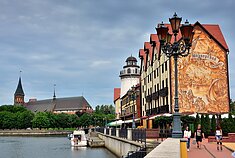
In Kaliningrad, Applebaum recalls seeing occasional “signs of another, older, order poking through the wreckage of the new”. Even now, it’s not uncommon to see Prussian brick houses with Soviet cinder block extensions or even topped with golden domes that transform the structures into Orthodox churches.
Further afield, concert halls, bars, restaurants and glitzy, if not kitschy, shopping malls mask multi-layered CCTV towers in central squares. Meanwhile, Prussian forts stand surrounded by five-storey khrushchovki apartment blocks, overgrown with shrubs and with bricks precariously hanging over parts of the walls that have already tipped over into dirt.
Yet, buses no longer “lurch over potholes, broken asphalt, trolley tracks, and bits of old cobblestone road”. Kaliningrad is no longer the worst place to live in Russia, as it was known in the 1990s.
“Lithuanians?” one slightly drunk man told me back in 2019 in the Curonian Spit, split between Russia and Lithuania. “Before, we used to say your roads are great, but look at us now.”
On the other side of the Russian border, which now marks the line of a renewed confrontation between Moscow and NATO, an unresolved trauma continues to plague Lithuania.

Read more: Protest in Vilnius against mayor's memory policies draws several hundred demonstrators
“No one remembered that the Red Army had also murdered Jews, or that the Nazis had also murdered Lithuanians,” writes Applebaum. The description could have been taken out of a news report describing the Nazi collaboration controversy around Jonas Noreika-Vėtra and the protests of summer 2019 in Vilnius.
In one of the many passages on collective trauma, a man in Ukraine drags Applebaum to see a recently discovered mass grave.
There, victims of atrocities committed by many different imperial and totalitarian regimes lie in layers upon each other. Her companion mutters contradictory sentences, in shock, as solemn yet startled people dig up bones and fragments of the times past.
The man with her, writes Applebaum, “had lost his senses, his sense of time”, epitomising juncture of the post-Soviet borderlands in 1991 – a juncture when the past was as disorientating as the future.
This book review was written in the framework of the Russian and Eastern European programme at Vilnius University.

Newsletter
Every Friday morning.