






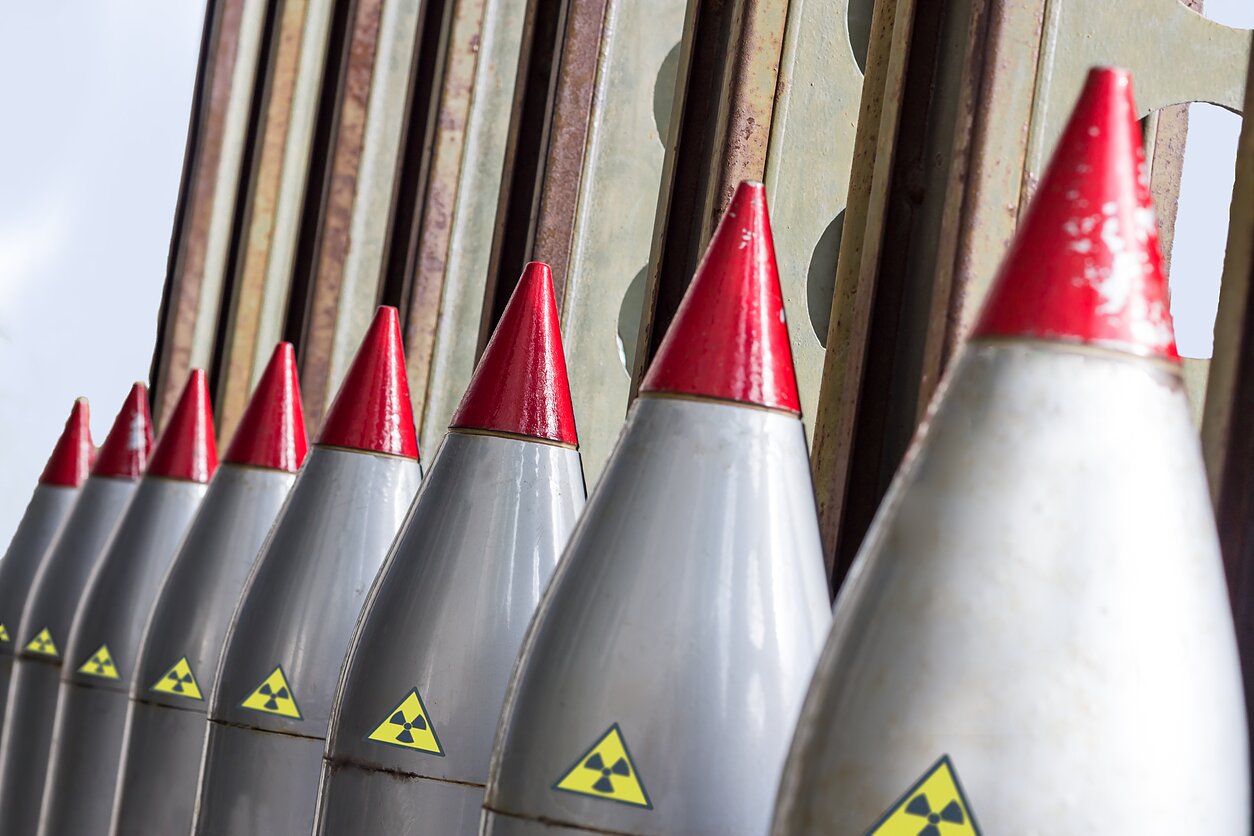
Lithuania’s parliament on Tuesday backed a proposal to remove from the constitution a ban on stationing weapons of mass destruction and foreign military bases on the country’s territory, opening the way for a potential future deployment of NATO nuclear weapons.
The proposal received 99 votes in favour, 13 against and five abstentions during its consideration in the Seimas. The vote advances the constitutional amendment but does not itself authorise the deployment of nuclear weapons in Lithuania.
The Constitution’s Article 137 currently states that weapons of mass destruction and foreign military bases may not be stationed on Lithuanian territory.
Parliament Speaker Juozas Olekas said the first vote on adopting the constitutional amendment is scheduled for October 6, with the final vote planned for January 12, 2027.
Constitutional amendments require two votes separated by at least three months, with at least 94 of the 141 lawmakers required to approve the measure at each final stage.
Remigijus Žemaitaitis, leader of the Nemunas Dawn party, opposed the proposal, arguing that Russia and Belarus could use it for propaganda purposes. He also said nuclear-armed states would be able to use nuclear weapons to defend Lithuania if necessary without removing the constitutional provision.
He argued that the relevant constitutional article should only be changed through a referendum.
Ignas Vėgėlė, a member of the parliament’s mixed group, questioned why the proposal would remove the entire provision rather than only the restriction on weapons of mass destruction. The article also prohibits foreign military bases.
“Why are we deleting this part of the sentence as well? Are we planning to hand over Lithuanian territory to military bases that we will not control or manage?” Vėgėlė asked.
He noted that Lithuania’s Constitutional Court has ruled that allied foreign military bases can operate in Lithuania if they are established by allies and remain under Lithuanian control. He argued that a similar principle should apply to weapons of mass destruction.
Laurynas Kasčiūnas, parliamentary leader of the opposition Homeland Union-Lithuanian Christian Democrats, said nuclear weapons are a key component of deterrence.
He said nuclear deterrence helped prevent the Cold War from becoming a direct military conflict and argued that Lithuania should not maintain restrictions that do not apply to some of its NATO allies.
“We are the only country in the region that has this restriction. Latvia does not have it, Estonia does not have it, Poland does not have it, Finland has just removed it,” Kasčiūnas said.
He cited a hypothetical scenario in which a US allied ship carrying nuclear weapons or a nuclear-capable aircraft might need to pass through Lithuanian territory for deterrence purposes.
Kasčiūnas stressed that removing the ban would not mean Lithuania had decided to station nuclear weapons there, but said eliminating the constitutional restriction would give the country more options as part of NATO’s deterrence arrangements.
Remigijus Motuzas, chairman of the Seimas Foreign Affairs Committee and a Social Democrat, also said Lithuania should not create obstacles to NATO’s nuclear deterrence or become the weaker link in the alliance’s regional security posture.
“Lithuania must clearly show our allies and adversaries that we will defend our independence by all means,” Motuzas said. “We cannot be less protected than other NATO countries.”
He said changing the constitution would send a strong signal intended to reduce the risk of military aggression.
Liberal Movement leader Viktorija Čmilytė-Nielsen said deterrence should not be viewed as an escalation of war.
“Today’s vote is about ensuring that we are not weaker,” she said.
The proposal comes amid broader discussions in Europe about nuclear deterrence. French President Emmanuel Macron has promoted the idea of developing a European nuclear deterrence framework under which partner countries could potentially host French strategic aircraft equipped with nuclear weapons.
The Financial Times reported in June that the United States was considering deploying nuclear weapons in additional NATO countries in Europe, although no such deployment in Lithuania has been announced.

Newsletter
Every Friday morning.