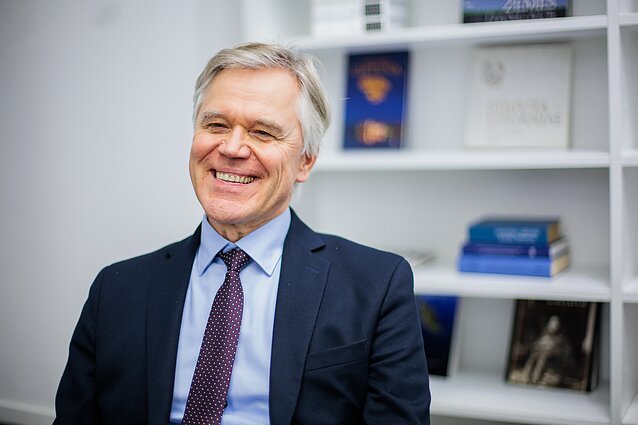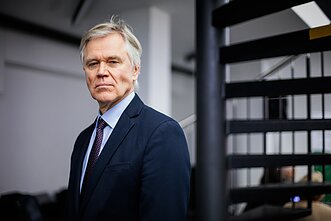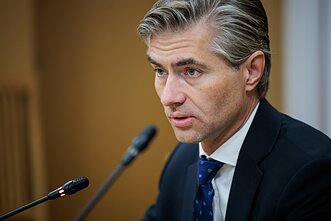














Audrius Valotka, head of the State Language Inspectorate, has expressed regret over his recent remarks suggesting that Polish-language schools in Lithuania should be shut down.
“I regret my hasty remarks about Polish schools and assure everyone that they do not reflect my opinion,” Valotka wrote in a Facebook post on Friday, after his comments were criticised by Poland’s top diplomat in Vilnius.
“My approach to protecting the Lithuanian language is strict and conservative, but it never amounts to contempt for or stigmatisation of ethnic groups. I can state without hesitation that this is not the position of the institution I represent either,” he added.
Valotka, who heads the institution overseeing enforcement of Lithuania’s language laws, stressed that there is no threat to Polish-language schools in Lithuania because the right to study in their native tongue is guaranteed for Lithuania’s Polish speakers by the Treaty on Friendly Relations and Good Neighbourly Cooperation between Lithuania and Poland.
“My comments were made in the heat of the moment, with no actual intention of closing these schools or restricting their operations in any way,” he said.
Valotka emphasized that defending the constitutional status of the Lithuanian language is not only his job but also his life’s mission.
He also argued that poor Lithuanian language exam results of graduates from minority schools were the result of insufficient effort to master the state language.
“Are poor exam results or not taking the state language exam at all merely the result of ineffective teaching, or do they also reflect an attitude in non-Lithuanian-speaking families that there is no need to encourage children to master the most important and unique language of our state?” he wrote on Facebook.
Valotka also expressed discontent that people in Lithuania’s eastern districts – where ethnic minorities are concentrated – use Russian in public and have information signs in Polish. He is also upset that there is a monument to Soviet soldiers in the town of Šalčininkai.
“We cannot turn our backs on these people and pretend everything is fine. Let’s talk about it. I invite representatives of ethnic minorities to sit down at the table and discuss this directly, rather than through statements and appeals in the media,” Valokta said.
Possible disciplinary action
On Friday, the Culture Ministry announced it is setting up a commission to investigate whether Valotka’s comments about ending education in Polish and Russian constitute a disciplinary offense.
The commission will be chaired by the ministry's chancellor, Regina Jaskelevičienė.
“The commission is tasked with investigating the misconduct and submitting a reasoned conclusion to the culture minister on the results of the investigation by August 25, 2025,” according to a statement released on Friday.
Criticism from the Polish Embassy
Valotka drew criticism after saying on Alfa TV programme in early July that all education in the country should be in Lithuanian, scrapping both Russian- and Polish-language schools.
“Why should we maintain places like the ‘Šalčininkai ghettos’, why preserve these linguistic ghettos?” Valotka said.
In response, Grzegorz Poznański, Poland’s chargé d'affaires in Vilnius, sent an open letter to Culture Minister Šarūnas Birutis.
“I find it unacceptable that Audrius Valotka is calling for the closure of public schools that teach in the mother tongue of Lithuania’s Polish minority, while also spreading falsehoods about so-called ‘Šalčininkai ghettos’ or ‘linguistic ghettos’,” he said.
Poznański said stigmatising Lithuanian citizens based on their ethnicity or native language is morally reprehensible and incompatible with public service ethics. He warned that closing Polish-language schools would violate international law and bilateral agreements between Lithuania and Poland.
Previous controversies
Valotka has previously faced criticism for controversial comments. During a past government term, then-Culture Minister Simonas Kairys publicly called for his resignation.
In other instances, Valotka described some migrant rideshare drivers as speaking “strange čiurkų languages”, using a slur word for people of Asian origin. Valotka later said he meant “Turkic” (tiurkų) but had mispronounced the word.
He also compared the desire of Polish residents in the Vilnius region to display street signs in their native language to policies seen in Ukraine’s Russian-occupied Donbas region.
The State Language Inspectorate, in operation since 1990, monitors compliance with the State Language Law and provides guidance to individuals, institutions, and businesses on proper language usage. It also plays an educational and consultative role.
Valotka was reappointed as head of the inspectorate in May after winning a competitive selection for a second term.

Newsletter
Every Friday morning.