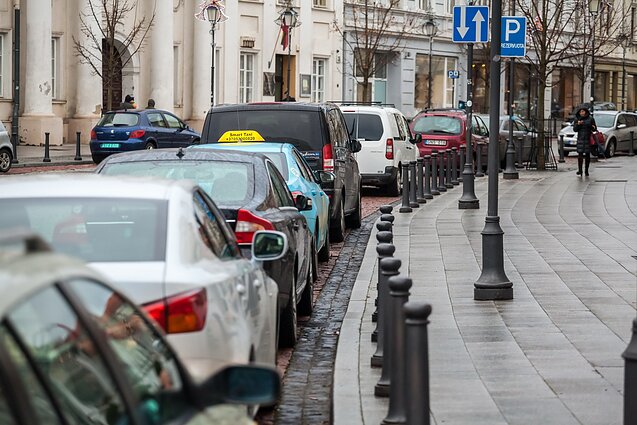












Next year, the cost of parking in the most expensive blue zone in Vilnius could rise to 4 euros per hour (from 2.5 euros currently). The municipality says the changes are long overdue.
According to the proposal, from July next year, the parking fee in Vilnius’ blue zone would increase from €2.5 to €4 per hour, in the red zone from €1.5 to €2.5 per hour, in the yellow zone from €0.60 to €1 per hour, and in the green zone from €0.30 to €0.50 per hour. The white zone would also be introduced further away from the city centre at €0.20 per hour.
“Currently, parking prices in Vilnius are among the most affordable in the European Union: the cheapest zone has the lowest rate among EU capitals, while the most expensive zone also remains one of the lowest (half the price of Riga and Tallinn),” the municipality said. But is it true?
The most expensive place in Europe to leave a car is the centre of Amsterdam, which costs €7.5 per hour. Copenhagen and Tallinn are also expensive, with a €6 charge in their most expensive parking zones.
But there are some cities where it is cheaper to park even in the centre. In Sofia, Athens, and Warsaw parking costs €1 per hour in the most expensive zone. The European average is similar to the current price in Vilnius’ blue zone – between €2 and €3.

When comparing parking prices in the cheapest zones, Vilnius is indeed the leader. The overall average for the cheapest zones in EU capitals is around €1, with only Helsinki at €2.
According to Jonas Damidavičius, Head of Mobility Transformation at the municipal company JUDU, the comparison with other cities is only part of the reasoning behind the change in pricing policy.
“We have compared with foreign countries what pricing and principles they apply; we have taken stock of where Vilnius is among other European capitals and cities, and that is what we have come up with,” he said.
But the main motivation, he stressed, was to reduce parking occupancy. It is particularly high in the Old Town, where almost 100 percent of the spaces are always occupied, while the aim is to maintain 70 percent occupancy.
“When the occupancy rate of parking spaces in the city is approaching or exceeding 85 percent, we need to take steps to reduce the occupancy rate somewhat, to maintain a threshold so that if you want to park your car, it does not cause additional congestion and pollution, so that everyone finds a space,” said Damidavičius.

Newsletter
Every Friday morning.