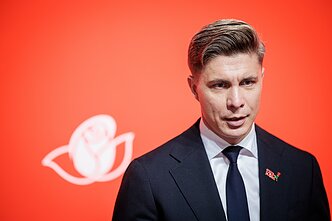









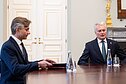





An informal meeting between conservative leader Gabrielius Landsbergis and liberal MP Eugenijus Gentvilas has sparked speculations about what it could mean.
Last week, after parties of Lithuania’s ruling coalition – the conservative Homeland Union (TS-LKD) and its junior liberal partners, the Liberal Movement and the Freedom Party – met to discuss candidates for the European Commission, one of the liberals, Eugenijus Gentvilas, complained that he had not spoken with the conservative leader for eight years.
This week the situation changed. A low-key talk between Gentvilas, who leads the Liberal Movement’s group in the parliament, and TS-LKD leader Gabrielius Landsbergis turned into national news when details about the meeting were shared with the media.
“He [Landsbergis] terrorised me with calls and texts,” Gentvilas told reporters about who initiated the meeting.

Landsbergis invited Gentvilas for a chat in a café near the parliament building. It wasn’t announced on the conservative leader’s agenda, only on Gentvilas’.
When he emerged from the café about half an hour later, Landsbergis said the conversation was private, meant to discuss the end of the legislative session.
When asked if they spoke about the European Commission nomination – which Landsbergis is eyeing, but his coalition partners do not seem all too eager to offer him – he said “no”.
“I feel dragged into a conversation where I have a personal stake and I do not want to give the impression that I am campaigning for myself, it is not right in this situation,” Landsbergis told the reporters who waited for him outside the café. “The prime minister is responsible for proposing the candidate [for the European Commission], let her comment on it.”

Gentvilas, meanwhile, said that his conversation with Landsbergis did not just focus on the legislative session. The two also discussed relations between their respective parties, he said.
“They are complicated, relations in the coalition are tense, we have a small leverage and we need a smooth mechanism. That’s what I always demand from the big party,” he said.
As the two politicians parted, Landsbergis promised to be more available to the liberals: “I will try to call as often as I can.”
The opposition, however, is convinced that the EC appointment is exactly what the two politicians discussed. Social Democratic MP Rasa Budbergytė says the issue made the conservatives realise they could not take the liberals’ support for granter.
“They suddenly realised that they need to look for a constructive dialogue, which was not there before,” says the leader of the Social Democratic parliamentary group. “The ruling parties understand that either Gabrielius Landsbergis or another candidate will have to seek support from the coalition partners.”
Political scientist Gabrielė Burbulytė, of Klaipėda University, says that the liberals are using the EC appointment as a leverage to get something from the conservatives.
“Maybe [the meeting] wasn’t directly about the EC posts, but they must have spoken about what the junior coalition partners can get for themselves in the last months of the term,” she says.

The other partner, the Freedom Party, in particular, may feel frustrated about lack of progress on its signature platform item, same-sex civil partnership. The legislation has stalled because conservative MPs are split on the issue.
However, Freedom Party representatives say their communication with conservatives is smooth.
“I would describe the current dialogue in the coalition as very constructive,” says MP Tomas Vytautas Raskevičius.
“My wish for my colleagues is to be less preoccupied with the distribution of posts and to talk about the work we could do,” he adds.
Raskevičius has been one of the initiators of the same-sex partnership legislation. The Freedom Party has repeatedly said that it would support the conservative candidate for the EC in exchange for more support on the civil partnership issue.
“There is no commitment in the coalition agreement to a specific EC candidate, but there are other commitments which have not yet been implemented,” Raskevičius says.
The nominee for the EU commissioner is proposed by the government in agreement with the president and the parliament.


Newsletter
Every Friday morning.