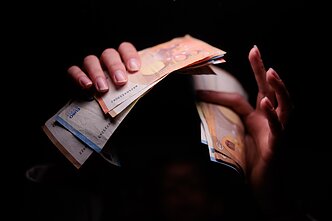














Prostitution, cocaine, illicit alcohol, and gambling – these are not images from a Hollywood film, but the dark side of interwar Kaunas, Lithuania’s capital city of the time.
According to historian Modestas Kuodys, prostitution was legal in Lithuania for most of the inter-war period until 1935. Although sex work was common, it was frowned upon in society.
"The church, catholic parties and organisations [...] were influential and fought against prostitution. There was a lot of public opposition, and the example was taken from the British, where suffragette and abolitionist movements were active and fought against the immoral exploitation of human beings," he told LRT.lt.
Prostitution was also legal in some other countries, such as the even more conservative Poland, and thus also in interwar Vilnius, then under Polish rule. According to the historian, the legal framework was taken over by Lithuania, which became independent in 1916, from Tsarist Russia.
When Kaunas became the centre of the region and the fortress was being built, many workers and military personnel came to the city. A large number of women involved in prostitution followed them there, Kuodys said.

"In Tsarist Russia, women who wanted to do sex work had to go to the police, hand over their identity documents and were given a yellow booklet that was like a passport. It was a booklet with details – there were no photographs in those days – describing the appearance and the place of residence," the historian said.
It was also compulsory to have regular health checks and to keep up-to-date documents proving that the woman was free of sexually-transmitted diseases. However, the reality was often different.
"Many women wanted to work illegally, because they were much more constrained by all the administrative stuff," he said.
Juozas Beleckas, a journalist who wrote a book on prostitution in Kaunas between the two world wars, said around 200–250 sex workers were working legally in the city until 1935. If we are to believe his figures, he said up to a thousand more women worked in prostitution illegally.
"They were exploited by others, even at several hierarchical levels – from the landlady, who looked after the house, the place where they received clients, to the guards or caretakers, who represented the criminal underworld, collecting money," Kuodys said.

"These poor women, especially if we are talking about the lowest category [...] were very vulnerable," he added.
According to Kuodys, sex workers were divided into several categories.
"Those [upper class] ladies had one or more sponsors and they didn't loiter in the streets," he said.
Prostitution was also common among the various female workers in Kaunas, who would provide sexual services on Thursdays and Fridays, and did regular work on other days.
Maids were also often sexually exploited, some of whom were turned into mistresses and would become pregnant. Society would condemn them, leaving them in the street. Therefore, the only place to take them in were the houses on Nemuno Street, a place notorious for prostitution.

Cocaine and illicit alcohol
Nemunas Street was situated next to the main points of the city – the municipality, the Old Town, the bus station and the river with its harbour.
"On Nemunas Street, [prostitution] was going on until about 1928, until the Kaunas police took action," said Kuodys. "At the same time, there was cocaine distribution, illicit alcohol, and other criminal activities such as pick-pocketing and gambling."
Restaurants and hotels in Kaunas were also divided into different tiers. Some of them would also be involved in prostitution, including the famous Lausanne Hotel (formerly known as the Locarno Hotel), whose fine, inter-war architecture has been preserved to this day.
According to the historian, sexual services were provided there, but subtly. For example, there were too many waitresses working there, but many realised what was behind it.
"Anyone who went there already knew that it was [a brothel]. It was a kind of role-playing game as if the customers were coming for the wrong reason, but it was clear to everybody what was going on," Kuodys said. "Often there were more serious guests and officials, and it usually started with a drink and a meal, but it was clear what the end result was."

However, there is not much information about the sex workers themselves.
What is known is that they were usually very young, even in their teenage years, and fell into prostitution due to difficult living conditions. As Kuodys noted, even young girls often looked much older because of cocaine or alcohol use.
According to him, a night on Nemunas Street would cost 2 to 4 litai, equivalent to the price of a meal in a good restaurant. He stressed that the exploited sex worker would keep little of the money to herself.
"Often in the press, I have found that it was the middlemen who beat her up, not the client," said Kuodys.
A modest living in Kaunas in the late 1930s required about 100 litai a month. He also noted that gender discrimination was evident – while a male worker in the lowest-paid jobs received from 4.5 to 5 litai, a female laundress, for example, received only about 4 litai.
Beleckas, the interwar journalist, wrote extensively and vividly about prostitution in Kaunas in his book Nuodėmių Gatvė (The Street of Sins).
"The author claims to have visited the places himself, to have talked to the girls, to have hidden under a bed at one point, but how much truth there is in his story is unknown," said Kuodys.

Speaking about the popularity of the book, Kuodys said that it was a good reflection of the attitudes of the time – although society was catholic and condemned prostitution, many were interested in it.
"There was a tendency to moralise, but it was very interesting to see what was going on in those 'caves'. The book was a great commercial success, and was picked up by both grammar school students and housewives," said Kuodys.
There is no information on the specific people who visited the brothels.
Beleckas writes that well-known figures or officials used to visit, but he did not reveal who they were.
According to Kuodys, sexual services were bought by a wide variety of men, from gymnasts to cultural figures, but the inter-war press more often contains stories related to the criminal world.
For example, it was common to catch criminals hiding in brothels. Kuodys noted that in other sources one can find some hints about famous cultural figures and their mistresses.
Bringing STDs home
Another problem of those times was the prevalence of sexually transmitted diseases (STDs). According to Kuodys, diseases were widespread, especially during the World War One-era German occupation, but also during the interwar independence period.
"When boys from the villages enlisted in the army, and if they served in Kaunas or other towns, many of them became infected, and when they returned to their homesteads, they got married and spread the disease," Kuodys said.
In 1935, prostitution was banned. A decree was also passed at the same time, according to which a person suffering from STDs had to undergo compulsory treatment. If one went into hiding, the historian added, the person could even face imprisonment.

Drugs common, but unpopular
Kuodys said cocaine was the most common drug, but its use was not prevalent – it was more popular to get drunk.
"They [the drugs] were mostly smuggled in from Germany, where they probably came from South America. At that time, it was not very criminalised. They were not considered legal, but there were no harsh penalties or jail sentences for possession – just a fine," said Kuodys.
According to the historian, illicit alcohol was treated much more harshly, but for practical reasons: "It was an excisable product and it was not treated as poisoning someone, but as damaging the state budget.”
"They even used to put people in jail for drinking vodka, even if it was for a short time, for a few months or a year. And cocaine was a marginal thing," he added.
Human trafficking and ‘white slaves’
Human trafficking also existed between the wars – some women were taken abroad, not only to Western European countries, but also to more remote parts of the world, such as Latin America or Brazil, the colonial lands of North Africa and elsewhere. This had even given rise to the term "white slaves".
"There were slaves in the Arabian Peninsula at that time, not to mention in some African countries such as Ethiopia. Wealthy local people would buy 'exotic' Lithuanian women," he said, adding that the true extent of human trafficking was unclear.
Sometimes, he said, searches for missing Lithuanians were announced, which were usually unsuccessfully. The authorities also organised preventive measures, like encouraging women not to be tempted by offers of easy money abroad.
However, the interwar society was highly migratory, and some of those who left fell into the hands of traffickers.
Prostitution did not disappear from Kaunas even after the ban, but the brothel district on Nemunas Street was liquidated in the late 1930s.
Police launched raids, forcing the women who lived there to move out. The brothels then spread out across the city.

Newsletter
Every Friday morning.