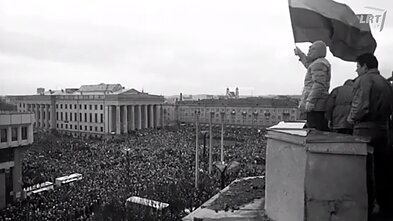






The parliament on Thursday voted to recognise that Vytautas Landsbergis, chair of Lithuania’s Supreme Council from 1990-1992, was the head of state at the time.
Under Landsbergis’ chairmanship, the Supreme Council declared Lithuania’s independence from the Soviet Union on March 11, 1990.
Normally, the president is considered the head of state in Lithuania. However, the country only introduced presidency with a new constitution in 1992.
On Thursday, the parliament passed a special law on the legal status of the chairman of the Supreme Council, the post held by Vytautas Landsbergis at the time, in a vote of 74 to one with four abstentions.
According to the law, the chairman of the Supreme Council, as the highest official of the Republic of Lithuania, had and exercised the constitutional powers of the head of state between March 11, 1990, and November 25, 1992.
The ruling bloc, which is dominated by the conservative Homeland Union (TS-LKD), a party founded by Landsbergis, argues that the law simply states a historical fact, while the opposition maintains that it represents a rewriting of history.
An attempt to grant Landsbergis the head-of-state status failed during the previous parliamentary term as the initiative of Viktoras Pranckietis, the then speaker of the Seimas, failed to receive political backing from the then ruling coalition.

Newsletter
Every Friday morning.