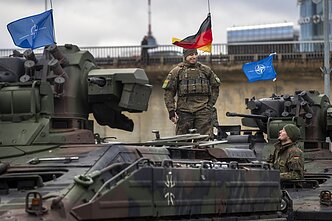














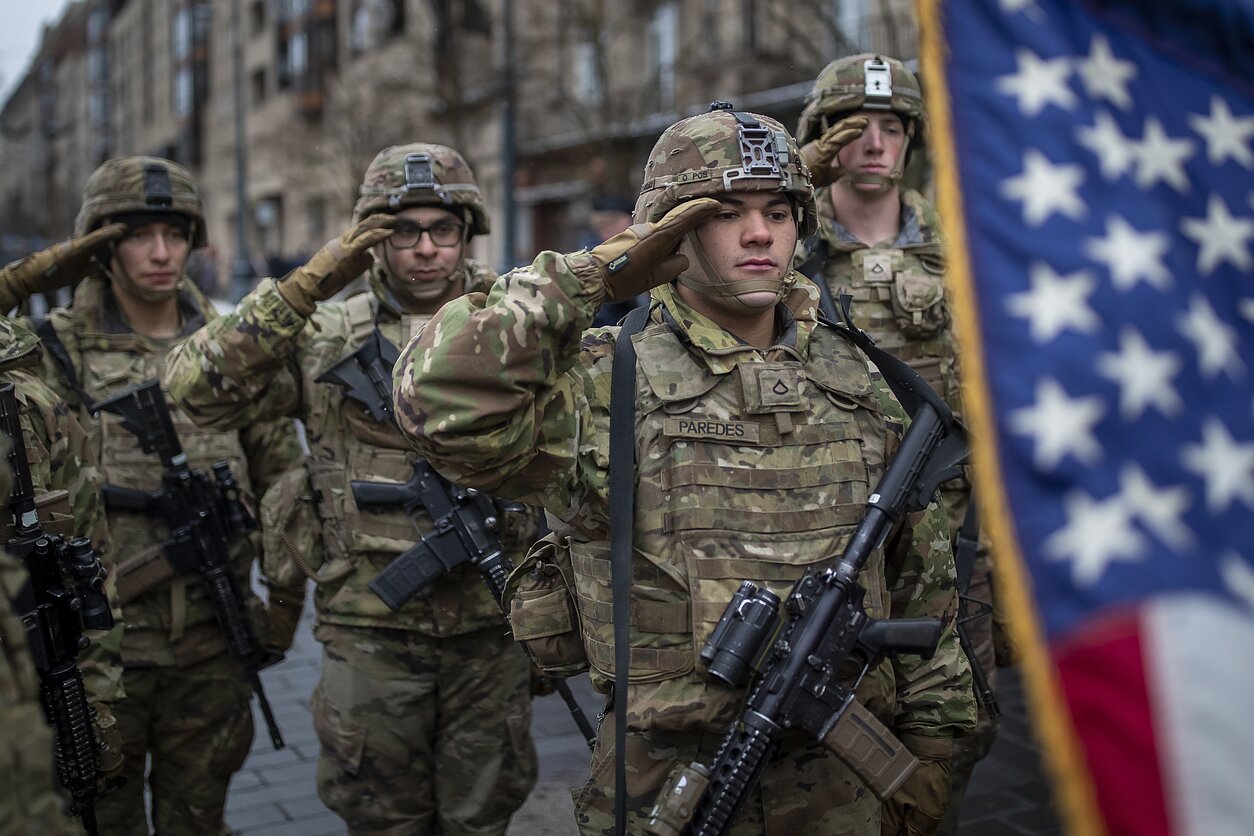
After a six-month break, US troops are set to return to Lithuania, with about 1,000 soldiers expected to deploy under a new rotation. Lithuanian officials and defence experts say the return sends a strong deterrence message to Russia, while Vilnius is also seeking a permanent US military presence.
The Americans are familiar with the forests around Pabradė, where their presence in Lithuania grew steadily over the past decade – from several hundred troops to more than 1,000 following Russia’s invasion of Ukraine.
But the continuous US mission ended in June as Washington reassessed its military role in Europe. A newly built facility in Lithuania stood empty for six months. Within a month, however, it is expected to house American troops again.
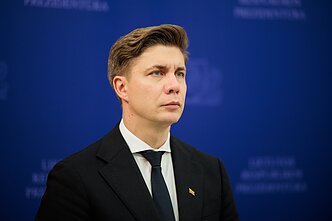
The new rotation will include a heavy battalion equipped with Abrams tanks, as before, while an artillery battalion will be replaced by an engineering unit, President Gitanas Nausėda said.
Defence Minister Robertas Kaunas said the deployment would contribute significantly to the development of Lithuania’s national division and strengthen the protection of defensive lines along the border.
The engineering capability is particularly important because Lithuania’s own engineering regiment in Kaunas is still being developed and lacks much of the equipment needed for heavy units, said retired Col. Gintaras Ažubalis.

Former military commanders said Lithuania is developing its own artillery capabilities, making the US engineering deployment a useful complement to the country’s existing forces.
“The artillery unit means fire support; now we have an engineering unit, which means logistical support, so that the tank battalion can operate effectively,” said Lt. Gen. Jonas Vytautas Žukas, who served as Lithuania’s military chief from 2014 to 2019.
The Americans will also bring specialised equipment and machinery that Lithuania does not have, said Lt. Gen. Arvydas Pocius, who served as military chief from 2009 to 2014.
The number of US troops is expected to remain around 1,000, although it is not yet clear whether the rotation will continue without another break after nine months.
“I doubt this nine-month rotation would have happened if there were no plan to continue the rotation afterward,” Žukas said.

Pocius agreed, saying there had been no indication that the deployment would be a one-time arrangement.
A regional deterrence message
Estonia has also secured the temporary return of US troops.
“That is good news, because American troops on the eastern flank are very important for our security, and it is a very clear message to President Putin: There is no point even thinking about aggression against NATO’s eastern flank,” Estonian Foreign Minister Margus Tsahkna said.
It is not yet clear where the US troops returning to Lithuania will come from.
They could be drawn from US units already stationed in Poland, Ažubalis said, arguing that the source of the troops would not change the strategic significance of the deployment.
Former MP, security and defence expert Giedrimas Jeglinskas said the deployment was linked to US forces in Poland and Washington’s plans for a permanent base there.

US President Donald Trump has said progress has been made toward establishing a permanent American base in Poland, where negotiations have been underway for about six months.
Experts say such a move would fit into a broader strengthening of NATO’s eastern flank.
The precise form of the US presence in Poland remains unclear. It could involve a permanent deployment sought by Warsaw, potentially involving about 5,000 additional troops, or strengthened rotational forces numbering around 10,000, said Gerlinde Niehus, a former deputy director of NATO’s defence policy and planning division.
“Whatever form it takes, the overall direction is clear – strengthening the eastern flank,” she said.
Lithuania is also seeking a permanent US base.
“Since we are compensating for the presence of US troops in Lithuania, I proposed establishing a permanent US military base,” Kaunas said.
Whether Lithuania’s existing military infrastructure will be enough to persuade Washington to establish permanent bases in both Poland and Lithuania remains uncertain.
Retired officers say NATO and the United States view Poland and the Baltic states as part of a single strategic region.
“All of this is part of the security of our common region. I have no doubt that these groups will not be separated,” Žukas said.
He nevertheless argued that Lithuania should first focus on completing the establishment of the German brigade.
Germany’s brigade remains Lithuania’s priority
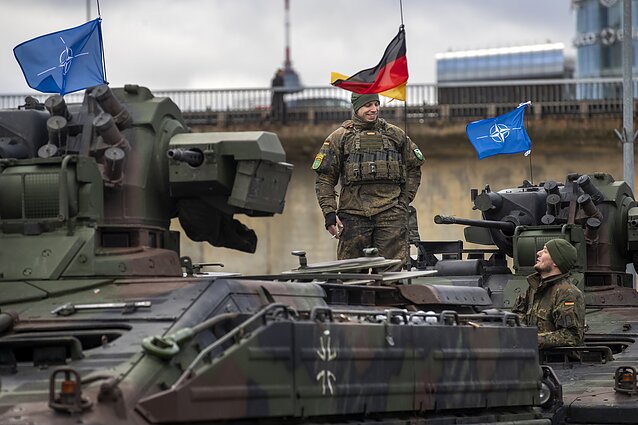
By the end of next year, Lithuania expects the German brigade to number about 5,000 troops – roughly five times the planned US deployment.
But Germany has faced difficulties recruiting enough personnel, particularly specialists.
“Our commitment to transfer a full-capability brigade to Lithuania no later than the end of 2027 is carved in stone,” German Ambassador to Lithuania Cornelius Zimmermann said. “We are particularly looking for specialists in information technology and other fields, and they are not so easy to find.”
Fausta Šimaitytė, head of the Konrad Adenauer Foundation in Lithuania, said the brigade should be viewed as a military commitment rather than a voluntary project.
Germany’s domestic politics could also affect the broader environment in which the brigade is established, with the Alternative for Germany party continuing to gain support.
“Germans keep their word, especially the military. Of course, much will depend on political decisions and who comes to power,” Pocius said.
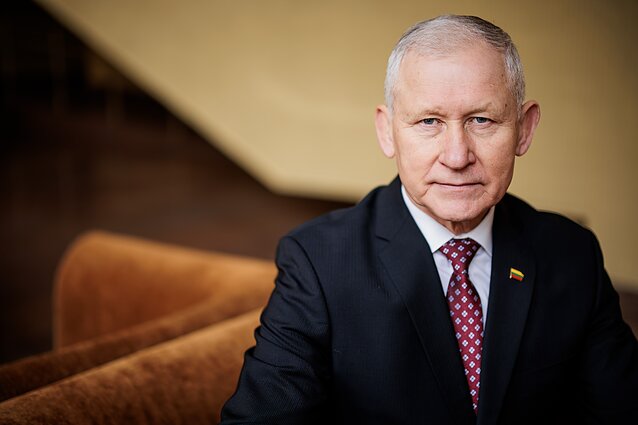
Nausėda sought to reassure those concerned about the German commitment.
“I see that various messages are being spread again. Rest assured, the German brigade will be in Lithuania at full strength,” he said.
While Germany is building up its presence in Lithuania, Canada plays the leading role in NATO’s forward presence in Latvia, with France also increasing its contribution.
French President Emmanuel Macron has committed to strengthening French forces in Latvia, particularly in air defence, Latvian Prime Minister Andris Kulbergs said.
NATO is also moving toward transforming its Baltic air-policing mission into an air-defence mission, although for now that remains a political decision rather than a fully implemented capability.

“Of course, we would always like to have more, but what we have is a sufficient basis for deterrence,” Žukas said. “The message being sent to a potential adversary is that NATO countries will act together, and perhaps the Americans will act together with NATO.”
Pocius said the presence of US forces itself carries particular weight.
“It is sufficient deterrence. For Russia, the American flag is the main bogeyman,” he said.
The United States is expected to present its plans for its military forces in Europe in December. US forces are widely expected to decline in western Europe as Washington urges European allies to take greater responsibility for their own security.
At the same time, Lithuania and other countries on NATO’s eastern flank hope that any reduction in the US presence in Western Europe will be accompanied by a stronger American role farther east, stretching from Romania to Finland.

Newsletter
Every Friday morning.