













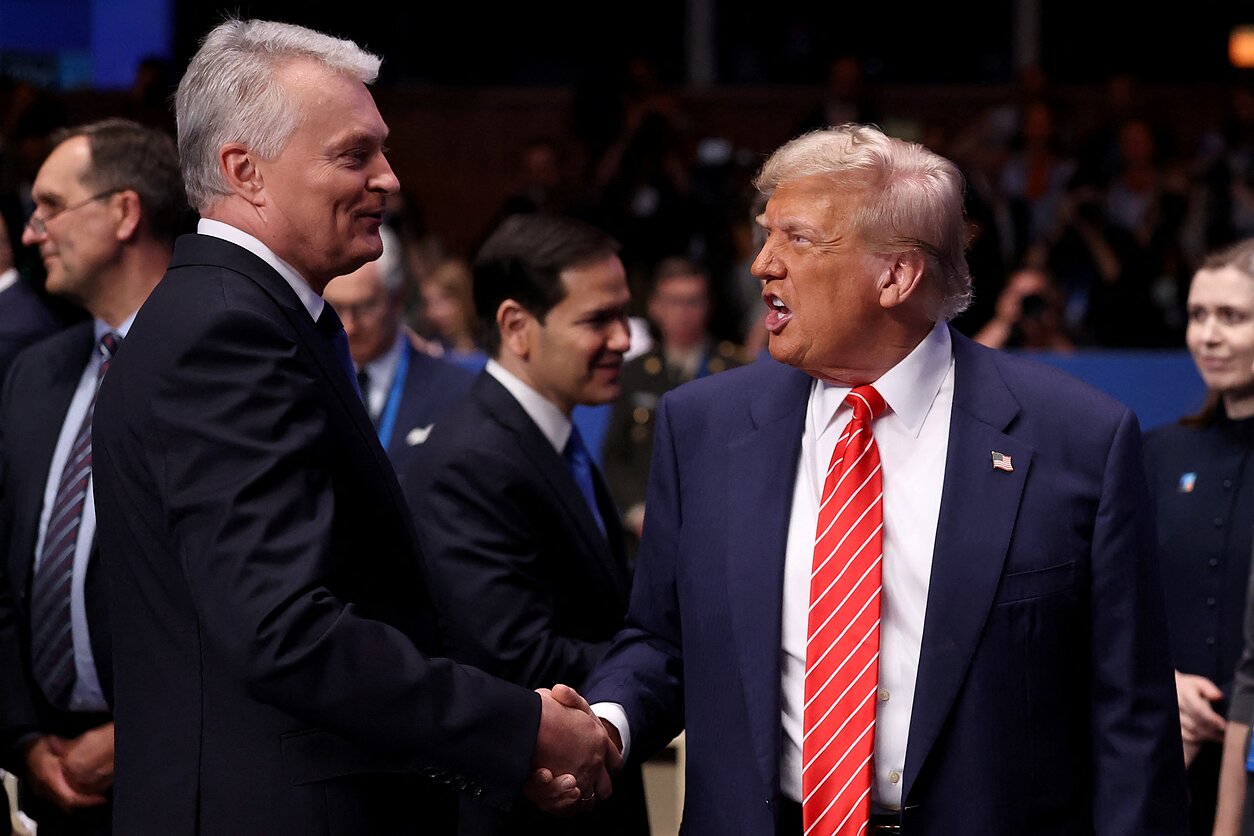
As the United States steps up its campaign against the International Criminal Court and urges allies to distance themselves from the tribunal, Lithuanian officials are working with European Union partners on a coordinated response while downplaying suggestions that Washington could force Vilnius to choose between supporting the court and maintaining a US military presence in the country.
The diplomatic pressure campaign, launched by Washington in mid-July, argues that the Hague-based court poses what US officials describe as an “unjustified threat” to American sovereignty.
In an opinion piece published in The Wall Street Journal, US Secretary of State Marco Rubio said he could not accept a world in which “US soldiers, police officers, border patrol agents and elected leaders” could be brought before an international court, tried by foreign judges and imprisoned thousands of miles from home.

Although the United States is not a party to the Rome Statute, the treaty that established the ICC, Washington has pledged to urge foreign governments, particularly those benefiting from US security guarantees, either to withdraw from the treaty or reject what it calls the court’s claimed authority to prosecute American officials and service members.
The renewed campaign comes as US military operations against Iran continue alongside Israel, whose Prime Minister Benjamin Netanyahu is the subject of an ICC arrest warrant over alleged war crimes linked to the war in Gaza.
Relations between Washington and the court have been strained since President Donald Trump’s first administration, and the United States has imposed sanctions on some ICC judges. Washington also continues to object to the court’s unresolved investigations into alleged torture and war crimes involving US troops and CIA personnel in Afghanistan and secret detention facilities in Europe.
Pressure to allies
Lithuania has already received an informal US diplomatic paper outlining Washington’s position and is reviewing it together with other EU member states.
“Lithuania, like other European Union countries, has received the US-prepared non-paper regarding the International Criminal Court and is examining it,” the Foreign Ministry said in a statement. “Coordination is taking place at the EU level to ensure a common position in dialogue with the United States regarding the future of the court, based on the principles of international law.”

The ministry reiterated the EU’s support for the “universality, integrity and full implementation” of the Rome Statute system.
For Lithuania, the court has particular importance because of its investigations into alleged war crimes and crimes against humanity committed during Russia’s invasion of Ukraine, as well as an ICC investigation opened at Lithuania’s request into alleged crimes by the Belarusian government against members of the Belarusian opposition who fled to Lithuania.
International law vs American troops
The issue comes at a sensitive moment for Vilnius as Washington reviews the future of US troop deployments in Europe. Lithuania has sought to present itself as one of America’s closest and most reliable allies on NATO’s eastern flank.
Deividas Matulionis, President Gitanas Nausėda’s chief national security adviser, said Lithuania has received no indication from Washington that the ICC issue could be linked to decisions on US military deployments.

“These are completely separate issues,” Matulionis said. “The presence of troops concerns security, which is important not only for Lithuania but for all of Europe and for the United States.”
He added that Lithuania has not yet held bilateral discussions with Washington on any specific expectations related to the ICC and stressed that Vilnius would coordinate its position with the broader European Union.
Matulionis also noted that bilateral agreements already provide guarantees that US service members stationed in Lithuania will not be transferred to the jurisdiction of third countries or international organisations.
‘Explain’ to Americans
Lawmakers from both the governing coalition and the opposition similarly expressed confidence that the dispute would not undermine US-Lithuanian security ties.
Remigijus Motuzas, chairman of the parliamentary Foreign Affairs Committee, said Lithuania should explain to Washington why remaining a party to the Rome Statute serves its national interests.
“We should always engage with our partners and explain why membership is important for Lithuania and why our situation differs from that of the United States,” Motuzas said. “I believe the United States would understand.”

He argued that NATO security and the US military presence in Europe are strategic issues that extend well beyond Lithuania.
Conservative lawmaker Žygimantas Pavilionis also said he did not believe Lithuania’s continued support for the ICC would automatically jeopardise American backing. However, he warned that maintaining close ties with Washington requires constant effort.
“The status quo with America should not be taken for granted,” Pavilionis said, calling for new economic, defence and technology initiatives that would strengthen bilateral ties. He argued that Lithuania should pursue projects in areas such as drones, counter-drone technologies or other strategic sectors rather than weaken international institutions that uphold the rules-based international order.
Long-standing scepticism
Not everyone is prepared to dismiss the possibility that the ICC debate could influence broader US strategic calculations.
Linas Kojala, director of the Geopolitics and Security Studies Centre, said Washington’s scepticism toward the ICC is longstanding, recalling similar disagreements before NATO’s eastern enlargement in the early 2000s, when the United States sought bilateral agreements shielding its personnel from the court’s jurisdiction.
The current dispute, however, is broader, he said.
“Previously the discussion focused on limiting the court’s jurisdiction over the United States,” Kojala said. “Now there is open discussion about dismantling or fundamentally weakening the court itself.”

Kojala said Lithuania’s primary objective should be to avoid an escalation that would force a choice between its security partnership with the United States and its support for international law.
Still, he cautioned that the Pentagon’s ongoing review of US force posture in Europe could introduce political considerations into future deployment decisions.
“If the number of US troops in Europe changes and decisions are made about where they should be stationed, even arguments like this could unexpectedly become important,” he said. “Lithuania will want attention to remain focused on issues such as defence spending and NATO commitments instead.”
Established in 2002, the ICC prosecutes individuals accused of genocide, crimes against humanity, war crimes and the crime of aggression when national authorities are unwilling or unable to do so.
Lithuania joined the Rome Statute in 2003. The treaty has been ratified by 125 countries. The United States and Israel are not among them, while Chad and Venezuela recently announced plans to withdraw from the court.

Newsletter
Every Friday morning.