















Russia tried to build a cultural Moscow House in Vilnius, which would have become an instrument of soft power in the country. Leaked details reveal that Russia actively sought to complete the project.
LRT was granted access by the Danish public broadcaster DR to 300,000 documents, which help shed light on Moscow’s efforts in Vilnius.
Correspondence between the Kremlin and Moscow diplomats shows that the project was ultimately derailed by the Russians' own greed and the legal problems that followed, which generated costs nobody was willing to cover.
"Intermediaries involved in the construction here were actually paid at least twice as much as the building itself cost. The level of theft had become intolerable," former Vilnius City Municipality administration director Povilas Poderskis, now chancellor of the Environment Ministry, told LRT.
The documents reveal mounting debts and attempts to find a solution, including efforts to exert pressure on Lithuania’s interests in Russia.
"€5,450 for the person responsible for finances, €7,049 for Masyvo Statyba, €3,872 for accountants, €3,080 for the lawyer," read a letter listing debts sent to the Moscow government by Aleksandras Makarovas, a Lithuanian citizen.
He managed the construction through his own company, Masyvo Statyba, while serving as head of Moscow House. According to Makarovas, expenses had been covered out of his own pocket, but there was no longer enough money to pay for court proceedings.
"Dear Natalia Alekseyevna, I inform you that I no longer have the financial means to support Moscow House in Vilnius and cover legal expenses," the then director wrote to the Moscow government's Department for Foreign Relations in August 2020.
Plans to change the name
Construction permits were revoked in 2016 after an additional floor was added, increasing the height of the building by three metres beyond what had been authorised.
Vilnius authorities took the opportunity by turning to the courts and seeking an assessment from Lithuania's State Security Department (VSD). It concluded in 2018 that Moscow House posed a threat to national security, which prevented the project from receiving a new construction permit.
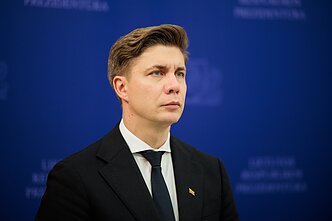
"Having Moscow House in Vilnius was extremely important to them. They saw it as a commercial and ideological centre and a place where premises could be rented out to various companies. For us at the VSD, there was no doubt it was intended as an instrument of influence in Lithuania," Lithuania's ambassador to NATO and former VSD director Darius Jauniškis told LRT.
Correspondence between the management of Moscow House in Vilnius, the Moscow government and Russia's Foreign Ministry intensified in the summer of 2020 and continued until mid-2021.
Emails show Kremlin representatives developing various rescue plans for the strategic project, promising to find funding and considering ways of influencing Lithuanian authorities or at least the leadership of Vilnius.
Two factors pushed Moscow to resolve the "Vilnius issue" quickly: time and money.
In July 2020, the Vilnius Regional Administrative Court rejected Moscow House's complaint and upheld the city authorities' refusal to approve the project because of national security concerns. Under the ruling, the Kremlin had two years, until November 2022, to secure a new permit.
Officials in the Moscow government responsible for the building hoped to find a way out. At a meeting in September 2020, several options were discussed, alongside optimistic news from the Russian Foreign Ministry.
"The ministry instructed Russia's Ambassador Extraordinary and Plenipotentiary to Lithuania, Alexander Udaltsov, to resolve the situation concerning the Moscow House project," a Moscow government resolution from September 2020 stated.
According to the documents, the meeting decided that three scenarios should be analysed over the following month: approving a new design and budget; changing the official name and purpose of Moscow House in order to bypass the VSD's conclusions; or selling the unfinished structure and returning the money to the Moscow treasury.
A week later, the Moscow Construction Department received a more detailed analysis prepared by Yuri Makushin, deputy head of the Moscow International Cooperation Centre and now head of the Russian House in Minsk. He considered changing the building's name and purpose the most realistic option.
"Changing the name and functional purpose could make it possible to submit a new project. It is unclear how the security department would react. We believe it would be appropriate to begin negotiations with Vilnius City Municipality," Makushin wrote.
Despite the plans drawn up by Moscow officials, Russia's Foreign Ministry pursued a different strategy based primarily on diplomatic pressure.
"Given that a construction permit for Moscow House is being denied for political reasons, it would be appropriate to examine the possibility of exerting pressure on Lithuanian interests in the Russian Federation," Moscow government officials wrote in internal correspondence in 2020.
What exactly these "Lithuanian interests in Russia" referred to remains unclear, although Poderskis recalled discussions in Vilnius in 2020 concerning the idea of a "Vilnius House" in Moscow.
"I remember one of those meetings, initiated either by the embassy or the Moscow government. A large delegation attended, accompanied by embassy staff. Their aim was to push forward the Vilnius House project in Moscow.
"They stressed that it should work on a mirror principle. But they usually build their 'KGB nest' abroad while burying projects in Moscow under bureaucracy. Very few buildings ever get completed there," he recalled.
The mirror project in Moscow was managed by Vilniaus Vystymo Kompanija, and Lithuania leased a plot in the centre of the Russian capital.
Jauniškis noted that Moscow House in Lithuania was being pushed forward rapidly while Russian authorities delayed and obstructed the Vilnius House project.
"After Crimea in 2014, everyone understood what Russia really was. VSD intelligence showed that the project was very important to the Kremlin, particularly as a means of promoting the ideology of the 'Russian world'," he said.
Poderskis also recalled that pressure from Russia had been more intense than from official representatives.
"It came from people who had interests in the land leased by Lithuania in Moscow," he said.
According to him, businessmen from Kaliningrad who claimed to have connections in Moscow attempted to mediate unofficially and wanted to undertake construction work in Russia.
However, Vilnius municipality had seen no need to continue the project since 2016, and the Russian company Vilniaus Namai Maskvoje (Vilnius House Moscow) was liquidated in 2021.
Reflecting on the strategy prepared by Moscow officials in 2020, Poderskis said the Kremlin had misread the mood in Lithuania.
"They probably drew up that strategy based on intelligence reports that completely misunderstood why the situation with the building had arisen. Changing the name might have helped a little, but it would not have changed the court ruling or the VSD assessment," he said.
Asked whether he remembered how events unfolded in 2020–21, Jauniškis said Moscow had chosen to fight through legal channels.
"I can say they chose the legal route. They tried to circumvent everything by changing the name and changing the purpose of the building, trying to get around Lithuanian laws," he said.
The documents show that the Moscow government officials' strategy was not accepted by Russian diplomats. At a Kremlin-initiated meeting on December 4, 2020, diplomats made it clear that construction had to continue.
"The Russian Foreign Ministry, together with the Russian embassy in Lithuania and the Moscow emergency situations department, will seek ways to complete construction of Moscow House. If positive results are not achieved, proceedings will be initiated in international courts," the report from the meeting stated.
The Kremlin also promised assistance with financing, encouraging Moscow authorities to make the necessary payments and to "resolve issues related to the national security threat posed by Moscow House", although the documents do not specify how this was to be done.
Those plans were disrupted by the Covid-19 pandemic, which prevented diplomats from holding face-to-face meetings in Lithuania, and by the resignation of the head of Moscow House, which provided grounds for Lithuania to freeze the project.
Hopes collapse
Russian bureaucracy proved too much even for Kremlin diplomats. Attempts to persuade institutions to cover the costs incurred in Vilnius failed.
On February 1, 2021, the Moscow government received a letter from the Moscow International Cooperation Centre saying it would not provide money, despite being a shareholder in the Vilnius project.
"In response to your instruction of January 25, 2021, I inform you that we have no legal grounds to compensate litigation expenses incurred by Moscow House in Vilnius," wrote the centre's director, Alexander Pankrukhin.
That meant the plea for help sent in August 2020 had gone unanswered.
Subsequent documents suggest that the refusal to cover legal costs may have prompted the resignation of the head of Moscow House in Vilnius. This is evident from another letter sent by Pankrukhin to the Moscow government.
He wrote that because no new director had been appointed, the organisation faced the risk of bankruptcy and there was nobody left to pay the bills. Kremlin officials noted that this enabled Vilnius authorities to terminate the lease agreement for state-owned land.
"In light of the above, I ask you to consider providing financial assistance in the amount necessary to cover the unpaid debt," Pankrukhin concluded in a letter dated May 31, 2021.
The response remains unknown. There are no further documents available, but it appears no money was forthcoming.
By 2020, Moscow House had fewer assets than liabilities, and bankruptcy proceedings were initiated in 2024.
"I think they simply realised it was hopeless and that whatever they did, they would not break Lithuanian institutions. They just stepped back, and now they will focus on other projects and ways of exerting influence here," Jauniškis said.
LRT sent questions by email to former Moscow House director Aleksandras Makarovas, but had not received a response at the time of publication. Attempts to contact him through all publicly available telephone numbers were also unsuccessful.

Newsletter
Every Friday morning.