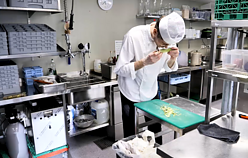















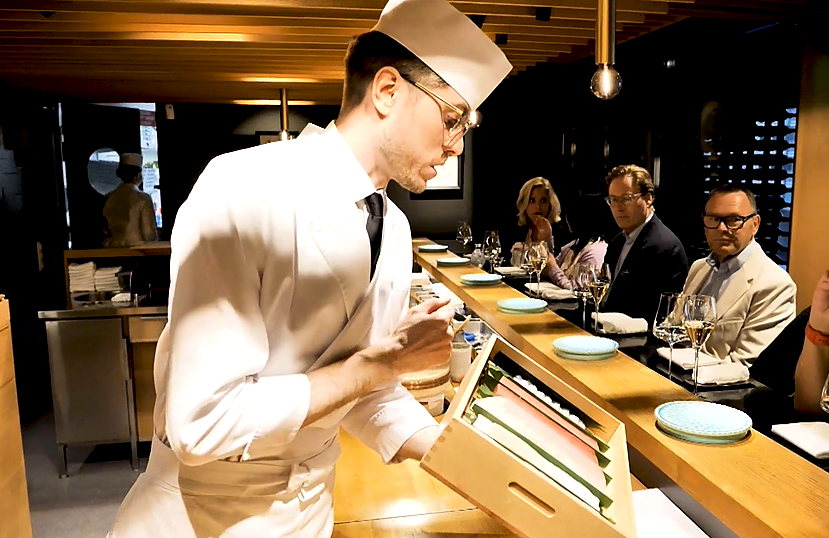
Airis Zapašnikas, the Lithuanian chef recognised as the world's best sushi master, calls his workplace in Oslo a second home. Having lived in Norway for 14 years, he says mastery of Japanese cuisine demands not only talent but a particular kind of precision – from the way an apron is tied to every movement at the kitchen counter.
Even after reaching the highest accolades, including the world sushi championship title and a Michelin star, he insists that learning in the kitchen never stops.
"Even now, I'm still picking up something new. This place is my second home. My wife would probably say it's my first," he laughs.
A different kind of surgeon
His path to Japanese cuisine began in adolescence, after a visit to a Japanese restaurant in his home city of Kaunas. What captivated him was not just the food, but the closeness between chef and guest – the chance to watch the whole process from the counter.

"You walk into the restaurant and the chef is standing at the bar, cooking. You can sit right beside him, talk, watch his techniques, listen to his stories. It drew me in completely," he recalls.
He soon began making sushi at home, and by the age of seventeen was working at that same Kaunas restaurant. After school he enrolled in medicine and considered a career as a surgeon – until an offer to work at a Japanese restaurant in Norway pointed him in another direction.
The decision to abandon his medical studies was not initially well received at home. His father had wanted him to pursue a more conventional professional path. With time, however, his view changed.
"My father wasn't happy about the sushi restaurant – he couldn't see a future in it. He wanted me to be a lawyer or a doctor. But now I tell him I'm respected like a fish surgeon – dressed in white, working with precision, with knives. He's relaxed about it now and is proud of me," Zapašnikas says.

Alongside his Michelin star, a champion's knife from the world sushi championship stands in his Oslo restaurant as a reminder of his achievements. He says the recognition that means most to him, however, comes from Japanese masters themselves.
"When the Japanese judge you – in their country, in their culture, and serious masters at that – that recognition means something incredibly special."
Every movement counts
At the world sushi championship, held in Japan, a panel of judges evaluates not only the finished dish but the entire process – from posture to each individual action at the counter. Discipline, hygiene, and the logical sequence of movements take priority, with even minor lapses costing points.
"How you stand, how you enter the competition everything is observed. You must be calm, every movement must have a purpose. If you pick up a fish, look at it, then put it back – that's points off, because there's no flow, no control," he explains.

Taste and presentation, he adds, account for only a small share of the final score. Far more weight is given to cleanliness and organisation.
"When you come to the counter, the first thing you do is rinse your towel and wipe down the surface. If you skip that, it's an immediate deduction. They even watch how much product you waste – too many offcuts and that costs you too."
The margin between the top competitors was just one or two points, making absolute precision essential. Zapašnikas found his edge through an unexpected Lithuanian touch – a teriyaki sauce brewed with a Lithuanian herbal liqueur, which gave it an additional herbal note.
"I let them taste the sauce and showed them the bottle, which had a grass snake on it. I told them it was our mythical serpent. That detail genuinely captivated them. It's those small things that make the difference," he said.
Back to basics
In his day-to-day work, Zapašnikas serves traditional Japanese sushi, including nigiri – a hand-pressed portion of rice topped with fish – which he recommends eating within fifteen seconds, before the rice has time to cool.

He is emphatic that authentic Japanese cuisine is built on simplicity and the quality of ingredients, not sauces or additions.
"Why do we add mayonnaise? Why cheese? Why all those colourings? It means we're trying to fill a gap – in flavour, in freshness, in quality. When you eat sushi, you should taste the rice and the fish. If you can't taste the fish, there's a reason for that."
He also points to a practical problem specific to Europe: regulations in many countries require raw fish to be frozen before serving, a process he says damages the product.
Since winning the championship, Zapašnikas says he has noticed a marked increase in Lithuanian customers at his Oslo restaurant. He has also been granted the right to organise the Baltic sushi championship, and is planning training courses and seminars on Japanese culinary principles for chefs.
He is keen to correct what he sees as a widespread misunderstanding in Western countries about sushi traditions, particularly the role of wasabi, pickled ginger, and vinegar.

"How did sushi culture develop – the forms, the wasabi, the ginger? Why is there vinegar and salt in the rice? It was all about hygiene. Fish and rice with vinegar and salt was protection against bacteria. Wasabi works the same way, as a natural disinfectant. None of it was ever created for flavour."
He does not rule out returning to Lithuania in the near future to nurture Japanese culinary traditions there, though he acknowledges the market is already fiercely competitive.
"There are probably as many sushi restaurants in Lithuania as there are pizzerias, maybe more. People eat it very regularly, which tells you the market is saturated. But that doesn't worry me."

Newsletter
Every Friday morning.